
 Film credits
Can the signal earn the decision?
A vision for optical measurements and research data that help a student, scientist or formulation team distinguish what changed, why it matters and what to do next.
Collaboration vision · Subject to institutional discussion and agreement.
The useful image is the one that changes a decision.
Optical evidence has a reason to exist when it resolves a material choice and keeps observation, analysis and interpretation connected.
An optical experiment can make a material look extraordinary while leaving its practical contribution unresolved. Our vision is to define the decision behind the image: whether a layer preserves clarity, whether a preparation change alters an interface, or whether a measurement method can reliably follow a material state. That gives a prospective researcher an explanation to pursue and gives a formulation sponsor a reason to invest in the evidence. The endpoint would remain physical and application-specific unless a separate qualified programme establishes something more. We want to investigate how raw observations, analysis and presentation can stay connected as the evidence moves from a microscope or instrument into a development discussion and a public scientific explanation.
Examine the development decision
Can the signal earn the decision?
Open the sequence to examine what a development decision needs.
Identify the exact preparation, its source, and the properties a second laboratory must be able to reproduce.
Explanatory geometry · no simulated or measured performance
Light–matter questions deserve a material boundary.
A relevant light–matter investigation begins with the specimen and application boundary, then asks which modelling and measurement expertise is needed.
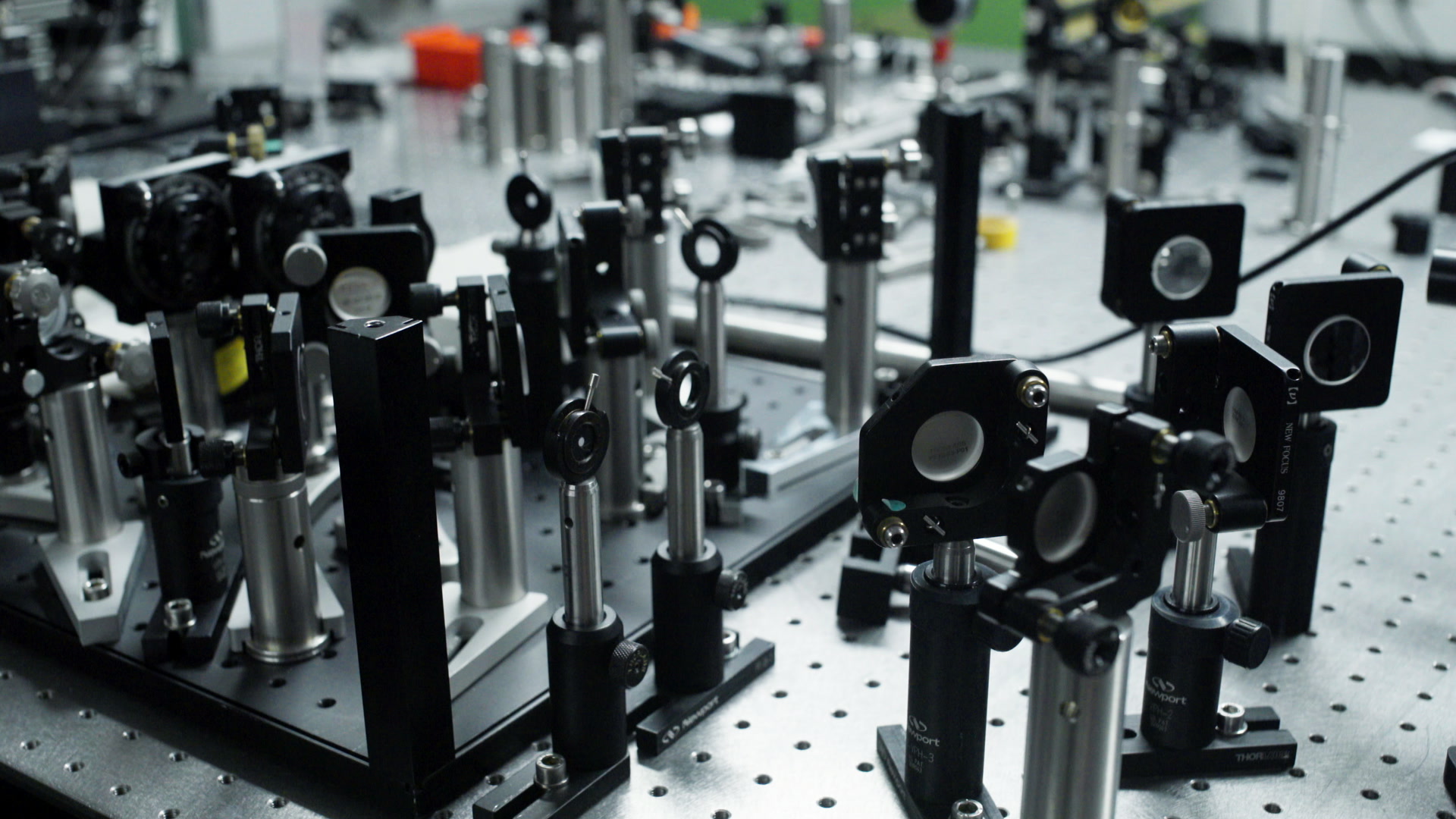
UCL’s Photonics Innovation Lab independently describes work spanning modelling, fabrication and experimental characterisation, including nanostructures and optical surfaces (UCL, n.d.c). That research context motivates a possible conversation about measurement and materials; it does not establish a Bio photonic preparation or access to the laboratory. We would want a prospective investigation to identify the specimen, wavelength or angular range, relevant material state and reason for comparison. A biological or formulation mixture may require a different method from a planar reference structure. The value of disciplinary expertise is knowing where a model remains useful and where it stops describing the sample. A dramatic visual effect should not select the scientific question on its own.
An automated measurement still needs a reference.
An automated analysis should be judged against a declared reference and its difficult cases, preserving what the original observation actually supports.
Gelado, Quilodrán-Casas and Chagot (2023) examine droplet detection and image restoration methods within a defined microfluidic image set. Their original study gives this vision a methodological starting point: an analysis method has to be judged against the observation it is meant to recover. The external findings do not qualify a Bio model, establish accuracy in a new material or make an enhanced image a new measurement. We would retain raw files and distinguish annotation, preprocessing, prediction and interpretation. For a prospective student, the scientific opportunity could be to define the cases where automation remains reliable, where it fails and what those failures mean for a preparation choice. That boundary can matter more than a flattering average score.

Keep the function. Understand the formulation.
Protein activity, interfaces and the smaller experiments that explain a larger formulation question.
Placing the comparison in physical units.
Physical units, reference uncertainty and independent test preparations turn a model score into an interpretable comparison for a material-development decision.
The displayed error is a proposed analysis descriptor for paired measurements, not an inherited performance result. A declared reference has its own uncertainty; manual annotation should not be treated automatically as ground truth. We would choose the unit and reference method according to the question, then inspect signed bias, dispersion and difficult cases alongside an average absolute difference. Pixel-scale calibration, image contrast and preparation variability could each affect the interpretation. A held-out experimental run or preparation is a more meaningful test of transfer than randomly splitting adjacent frames from one recording. The analysis plan should define those independence boundaries before a model is trained or a detection method is selected for routine use.
Report a physical-unit comparison with its reference and test boundary, rather than a context-free accuracy headline.
- mean paired absolute differenceµm
- number of declared paired observationscount
- analysis-derived diameter for observation iµm
- diameter from declared independent/reference methodµm
- paired-observation indexdimensionless
Model conditions. Positive n, matched physical scale and declared reference uncertainty. Pairing and independent preparation hierarchy retained; average does not establish transfer or exclude bias. Proposed comparison descriptor, not a Bio error result.
Measure the state that belongs to the question.
A change in signal may have several explanations; complementary measurements should clarify the material question rather than expand a visually impressive demonstration.
If hydration, coating thickness or dispersion changes, an optical signal may respond through several pathways. We would want the study to distinguish the primary endpoint from a plausible explanation for it. A transmission difference could justify investigating scattering, an interface change or material loading; it would not automatically identify one mechanism. A fluorescent marker adds its own distribution and illumination questions, and an externally excited reporter is distinct from biochemical light generation. The proposed preparation record would keep the state, elapsed time, background and instrument settings beside each reading. A researcher could then decide which complementary measurement is essential, and which attractive extra measurement would add complexity without changing the application decision.
Enter the experiment · an interactive scientific lens
Count what the sample absorbs.
More power and more absorbance change different parts of a photochemical experiment. Keep that distinction visible.
The data, equations and controls remain available below if 3D cannot load.
Calculated comparison · illustrative inputs
Move a control to compare the selected condition with the defined reference curve.
Build a photon-to-product comparison that a development team can interpret.
The defined comparison
A 450 nm monochromatic beam and 60 s exposure, with absorbance supplied as an assumption. Reflection, scattering, spatial gradients, spectral bandwidth and time-dependent absorbance are omitted. The 3D beam is a schematic path, not a field calculation. Absorbed photons alone do not establish product conversion, reaction quantum yield, emitted light or a useful material response.
Inspect the calculated values
Calculation grid, not measured observations. The source observation for the rheology reconstruction is stated above.
| Optical absorbance / dimensionless | Absorbed fraction | Transmitted fraction |
|---|
Let another scientist reconstruct the argument.
A useful data layer lets another researcher inspect the source observation, processing and assumptions without claiming ownership of every linked scientific record.
We would want a versioned evidence package that keeps the source observation, processing step, declared assumptions and recommendation visible. Raw data, a calculation notebook and a clear account of excluded observations could support different levels of review. UCL’s data guidance emphasises attribution, stewardship and appropriately bounded openness (UCL, n.d.g). Our proposed project would need to translate those expectations into a specific plan for the actual data owners and any funder. Public availability does not grant permission to rebrand a third-party dataset or redistribute every associated asset. A useful interface could expose authorised observations and calculations while identifying restricted preparation details. It should make the evidence easier to question, rather than hide missing information behind an impressive visual dashboard.
Turning an evidence question into a development choice.
The viewer’s decision determines which evidence deserves emphasis, from a concise poster to raw observations and a reproducible analytical comparison.
A formulation team might need to decide whether a clarity difference survives realistic preparation variation. An ingredient business might need to know which measurement best supports its proposed contribution. A research sponsor might want an analysis workflow that can be reviewed by a second laboratory. We would define that viewer’s decision at the outset and choose the report around it. A scientific poster could show the hypothesis, method boundary, comparator and supported result; a more detailed package could retain raw observations and sensitivity checks. The commercial proposition is the possibility of a decision that can be defended and revisited. No price, delivered analytical service, savings result or ready-made product is advertised by this research vision.
Building a contribution that outlasts one demonstration.
A method boundary or mechanistic explanation can outlast one material example, giving a prospective researcher a clear and independently valuable contribution.
The academic opportunity could lie in a robust measurement boundary, an interpretable analysis method or a study of why a physical endpoint changes with preparation. We would want the prospective researcher to have a clear question, suitable methods training and space to report contrary evidence. The supervisory structure and project design would belong within an institution-approved academic arrangement. UCL’s current Doctoral Code of Practice provides context for agreed questions and working arrangements, while its application guidance directs prospective candidates to explore departmental and supervisory fit (UCL, 2026; n.d.f). These are official university routes, separate from Bio’s vision. An industry-facing question should strengthen an original contribution, not replace it with an indefinite obligation to keep producing favourable demonstrations.

A comparison worth making.
Define the preparation, the measurable difference and the decision the evidence could change.
A comparison small enough to inspect closely.
A bounded first comparison can identify the reference, resources and evidence needed before a broader optical-data investigation is proposed.
Our preferred first package would set one material or image question, choose a defensible reference, retain the raw observation and identify the smallest independent comparison that could resolve the issue. It would include resource and access requirements before anyone promises an experimental campaign. The parties would agree publication, protected information and background contributions through their relevant processes; UCL’s IP policy is institutional context, not a grant of rights to Bio (UCL, 2019). A qualified researcher or sponsor can begin with a non-confidential question and the reason it matters. If that question earns agreement and resources, an optical-data investigation could create a useful method, a credible poster and a clearer next formulation decision.
A prospective study worth shaping
Make the optical signal answer a decision.
A striking image can conceal changes in illumination, scattering, detector response and sample geometry. A development team needs a result that can be compared across preparations and laboratories.
Define the reference optical path, the relevant sample change and the controls that distinguish material response from measurement response. Preserve the original data and processing before a deliberately small confirmatory comparison.
What a first scope
could produce.
- An illumination and geometry record
- A background and reference strategy
- Original-data and processing requirements
- A transfer-ready comparison and limitations brief
Bring a real question.
Bring the current benchmark, the unanswered scientific question, sample or data access, and the result that would change your next development decision. An analytical partner can contribute method expertise; a researcher can challenge the mechanism; a sponsor can define the application constraint.
A possible first commission would be a bounded feasibility, protocol-design or evidence-analysis package, followed by a separately resourced experiment where warranted. Scope, costs, delivery capacity, rights and institutional participation would be agreed before work began. These are proposed opportunities, not an assertion that a laboratory service or joint programme is already available.
Shape a non-confidential research scopeIndependent VARUNÉ Bio proposal. University participation, resources, rights and deliverables remain subject to discussion and agreement. Confidential material can follow an appropriate agreement once the parties and purpose are defined.
Inside the UCL research vision
Follow the
scientific question.
Return to the UCL visionExplore another scientific context.
Sources and reading notes.
External work is identified below. Access notes describe the material inspected for this page; company research questions and proposed work are not presented as findings from these sources.
UCL, n.d.cUCL (n.d.c) Photonics Innovation Lab.
Independent nanostructure, optical-surface and light–matter research themes.
Scope and limitations: Institutional context only; no access, endorsement, agreement or capacity secured for Bio.
Open original sourceGelado et al., 2023Gelado, S.H., Quilodrán-Casas, C. and Chagot, L. (2023) Enhancing Microdroplet Image Analysis with Deep Learning. Micromachines, 14, 1964. doi:10.3390/mi14101964.
Comparison of droplet detection and image processing in the authors’ microfluidic image set.
Scope and limitations: Abstract/intro-level appraisal; no training data, software, reported error metrics or experimental validation reproduced. Institutional affiliations checked; no Bio model inferred.
Open original sourceUCL, n.d.gUCL (n.d.g) Data policies and expectations.
Institutional data stewardship, attribution, preservation and bounded openness.
Scope and limitations: Actual project/funder/data-owner duties require a project-specific plan; no raw data acquired or automatically cleared for reuse.
Open original sourceUCL, 2026UCL (2026) Doctoral Code of Practice, academic year 2026/27.
Supervision, agreed research question and doctoral working arrangements; updated1October2026.
Scope and limitations: Official doctoral practice, not an agreed Bio project or a named supervisor commitment.
Open original sourceUCL, n.d.fUCL (n.d.f) Applying for Graduate Research Study at UCL.
Official prospective-supervisor and application preparation guidance.
Scope and limitations: Institutional context only; no access, endorsement, agreement or capacity secured for Bio.
Open original sourceUCL, 2019UCL (2019) Intellectual Property Policy.
Institutional ownership/use framework and project-agreement dependencies.
Scope and limitations: Policy page reviewed, not a legal opinion, assignment, licence or assurance of Bio ownership.
Open original source
