
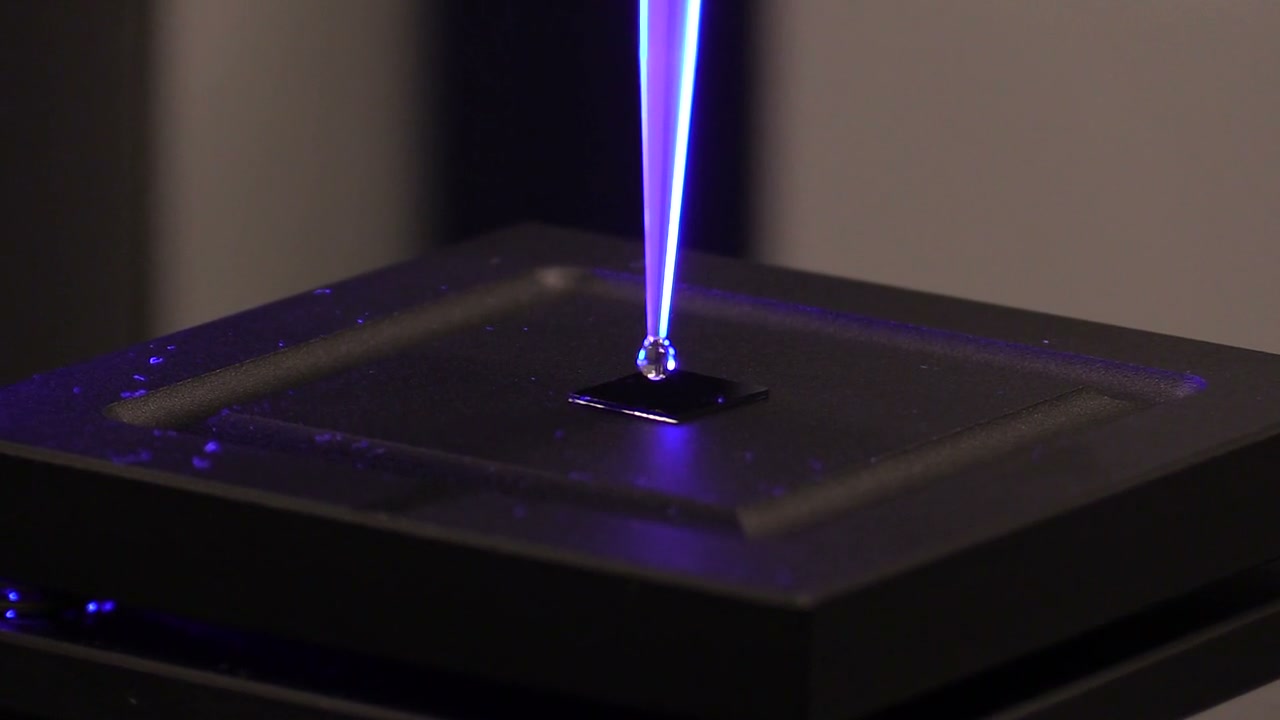
 Film credits
What happens before a droplet is finished?
A vision for investigating how interface age, adsorption and preparation history could change the formulation choices made after a dispersion leaves the device.
Collaboration vision · Subject to institutional discussion and agreement.
The final diameter cannot tell the whole story.
Understanding a forming interface could explain a preparation difference that final droplet size alone leaves unresolved for a formulation developer.
An ingredient developer comparing two dispersions needs to know what the preparation changed, not only which sample produced the smaller reported diameter. Our vision is to investigate whether a forming interface experiences the same stabilisation conditions as an aged sample. The practical decision could be which preparation route deserves further evaluation in a formulation base, or whether a proposed stabiliser merits a more demanding comparison against an incumbent. We would start with a defined non-clinical application and a manageable model preparation. The research question is specific: can interface history explain a difference that remains important at the point the material is mixed, deposited or dispensed? That question leaves room for a useful negative finding.
Examine the development decision
What happens before a droplet is finished?
Open the sequence to examine what a development decision needs.
Identify the exact preparation, its source, and the properties a second laboratory must be able to reproduce.
Explanatory geometry · no simulated or measured performance
A research context built around forming interfaces.
Published UCL research suggests a scientifically relevant conversation about adsorption and flow, with the actual question determining the appropriate tool.
ThAMeS independently describes research into droplet generation, adsorption at different interfaces and complex-fluid behaviour (UCL, n.d.a). Those themes give this proposed conversation a clear scientific focus. We would want to explore the connection between interface formation and the later behaviour a formulation developer observes, with qualified expertise deciding whether a microchannel, another droplet method or a simpler controlled comparison is suitable. The vision does not assume a device, laboratory slot or participating investigator has been secured. The reason to discuss a university investigation is the opportunity to separate a mechanism from several correlated process changes. An attractive droplet film alone would not answer that question or justify the choice of a carrier.
Surface tension has a history.
Comparing adsorption with formation times shows why an aged interface may describe a different state from the one created during processing.
Kalli, Chagot and Angeli (2022) examined dynamic interfacial tension during drop formation in a particular silicone-oil and glycerol-water system. Their comparison of formation, transport and adsorption times shows why an equilibrium value can be inadequate for a newly forming interface. The preparation and surfactants remain the authors’ system. For our vision, that finding motivates a question about timescales; it does not supply a Bio recipe, a threshold for a biological polymer or a transferable optimum. We would want the candidate material’s own measurement history retained, including medium composition and the method used to define interface age. The useful scientific opportunity is to test when a simplifying equilibrium assumption becomes defensible for the intended preparation.
Keep the function. Understand the formulation.
Protein activity, interfaces and the smaller experiments that explain a larger formulation question.
Keeping the physical balance visible.
A physical stress-scale comparison helps identify essential measurements without turning a simple equation into an unqualified prediction of droplet size.
The capillary number compares viscous and interfacial stress scales under declared conditions. A dynamic interfacial-tension value must refer to an appropriate interface age, rather than be substituted casually into a correlation developed for another geometry. We would use the relationship to organise a proposed comparison, while retaining channel shape, flow ratio, viscosity basis and any non-Newtonian behaviour separately. A biological mixture might alter more than one of those inputs. The equation is therefore a starting point for asking which variables deserve measurement, not a shortcut to predicting droplet diameter. A researcher could investigate the range over which a chosen approximation works and where additional adsorption or flow information is required before the model can explain the observation.
Use a physical scaling quantity with measured inputs; determine applicability for the actual preparation.
- viscous-to-interfacial stress-scale ratiodimensionless
- continuous-phase dynamic viscosity under stated conditionsPa s
- declared continuous-phase characteristic velocitym s⁻¹
- interfacial tension at the declared interface ageN m⁻¹
- declared formation/interface ages
Model conditions. Appropriate flow and viscosity basis; positive interfacial tension; geometry and interface-age assignment stated. Does not reproduce an external drop-size correlation or imply Newtonian behaviour for an uncharacterised material.
Changing one explanation at a time.
Composition, viscosity, ageing and process history need discriminating controls if an interface explanation is to survive an independent preparation.
The proposed comparison would distinguish composition from process history. An incumbent stabiliser, a carrier or base without the candidate, and a composition-matched preparation could each answer a different alternative explanation. We would choose only the controls that materially sharpen the hypothesis. Where changing concentration also changes viscosity, an observed size difference should not automatically be credited to interfacial adsorption. Independent preparation days would help distinguish a repeatable effect from a favourable run. Ageing, dilution and remixing would be recorded as experimental steps rather than disappear into sample labels. A qualified team could then decide whether a second analytical method is necessary to interpret an apparent droplet difference before the programme moves into more complex formulation mixtures.
Enter the experiment · an interactive scientific lens
A drop has a history.
Change the flow and viscosity. Follow the reference balance between viscous stress, surface tension and inertia.
The data, equations and controls remain available below if 3D cannot load.
Calculated comparison · illustrative inputs
Move a control to compare the selected condition with the defined reference curve.
Set a flow window that deserves a measured interface comparison.
The defined comparison
A rectangular 100 × 100 μm channel, water-like density 1,000 kg m⁻³ and assumed interfacial tension 20 mN m⁻¹. The 3D channel and drop reveal the geometry only; they do not predict breakup, size or a formation regime. Actual dynamic tension, wetting, both phase flows and interface age require measurement.
Inspect the calculated values
Calculation grid, not measured observations. The source observation for the rheology reconstruction is stated above.
| Viscosity / mPa s | Capillary reference |
|---|
Let the image keep its uncertainty.
An analysis workflow should preserve raw observations and difficult cases, allowing the measured distribution to earn its role in a development decision.
Gelado, Quilodrán-Casas and Chagot (2023) compare automated droplet detection and image processing within their microfluidic image dataset. That original work suggests a methodological question: how much does an analysis result depend on image quality and the method used to locate an interface? It does not qualify a Bio algorithm or justify replacing a raw image with an enhanced one. Our proposed study would retain original files, physical scale calibration, analysis versions and adjudicated examples where detection fails. An independent held-out preparation would be more informative than scoring many frames from the same run. The application decision needs a trustworthy distribution and its measurement boundary, not a visually polished image that conceals uncertain edges.
Return the result to the development bench.
A model experiment becomes commercially useful when its finding changes a relevant preparation or formulation comparison under realistic handling conditions.
A model microchannel can expose a timescale, but a formulation team eventually needs to know whether it matters in the intended base and handling sequence. We would define that transfer question early. The proposed endpoint might be retention of a distribution after mixing, a controlled deposit, a chemical recovery measurement or another application-relevant observation. It should not be chosen simply because the existing apparatus measures it easily. A candidate that changes droplet formation but offers no useful later behaviour may still teach important interface science; its commercial route would need revision. The study should distinguish that academic contribution from a recommendation to continue ingredient development, so neither audience mistakes an interesting mechanism for a finished formulation advantage.
A method boundary can be an original contribution.
The prospective contribution could define when interface-age information improves a comparison, creating original science rather than another favourable demonstration.
For a prospective doctoral discussion, the intellectual centre could be a testable description of when interface-age information improves an application comparison. That could require combined measurement, modelling and analysis rather than endless formulation screening. We would want a student to develop a clear ownership of the question, with institution-approved supervision and a feasible scope. UCL’s Chemical Engineering course record and general application guidance are the relevant official routes for exploring academic fit (UCL, n.d.d; n.d.f). This page offers a research vision rather than a position. The proposed output could include a comparison dataset, an analysis workflow and a falsifiable account of the conditions where a simplified physical description succeeds or fails.
A comparison worth making.
Define the preparation, the measurable difference and the decision the evidence could change.
A preparation decision, with its reasoning intact.
A source-linked brief can make the next preparation decision clearer while retaining the resources and evidence needed to test it.
The first potential package would map the current ingredient or preparation problem to a hypothesis, relevant source methods, controls, primary endpoint and minimum resource requirement. A separately agreed investigation could add raw images, physical measurements, reproducibility checks and a decision about the next formulation comparison. Material supply, handling permissions, apparatus suitability, publication rights and protected preparation details would need an institutional agreement. We would ask a prospective partner which result would make the programme worth expanding and which result would stop it. The commercial value hypothesis is a clearer preparation choice supported by evidence. The academic value is a contribution that remains meaningful even if the candidate material does not outperform the established option.
A prospective study worth shaping
Before the next emulsion trial.
A surfactant change may alter both the bulk liquid and the age-dependent interface. Recording only the final drop size can miss the reason a preparation changed.
Hold phase identities and channel geometry constant while testing a small, justified flow and preparation matrix. Compare dynamic tension and an observed formation timescale on compatible conditions, retaining wetting and sampling history.
What a first scope
could produce.
- A phase and preparation map
- A flow and interface-age comparison
- Formation observations with a defined sampling basis
- A reproducibility question for independent preparations
Bring a real question.
Bring the current benchmark, the unanswered scientific question, sample or data access, and the result that would change your next development decision. An analytical partner can contribute method expertise; a researcher can challenge the mechanism; a sponsor can define the application constraint.
A possible first commission would be a bounded feasibility, protocol-design or evidence-analysis package, followed by a separately resourced experiment where warranted. Scope, costs, delivery capacity, rights and institutional participation would be agreed before work began. These are proposed opportunities, not an assertion that a laboratory service or joint programme is already available.
Shape a non-confidential research scopeIndependent VARUNÉ Bio proposal. University participation, resources, rights and deliverables remain subject to discussion and agreement. Confidential material can follow an appropriate agreement once the parties and purpose are defined.
Inside the UCL research vision
Follow the
scientific question.
Return to the UCL visionExplore another scientific context.
Sources and reading notes.
External work is identified below. Access notes describe the material inspected for this page; company research questions and proposed work are not presented as findings from these sources.
UCL, n.d.aUCL (n.d.a) ThAMeS: Research Themes.
Independent UCL droplet microfluidics, interfacial phenomena and complex-fluid research themes.
Scope and limitations: Institutional context only; no access, endorsement, agreement or capacity secured for Bio.
Open original sourceKalli et al., 2022Kalli, M., Chagot, L. and Angeli, P. (2022) Comparison of surfactant mass transfer with drop formation times from dynamic interfacial tension measurements in microchannels. Journal of Colloid and Interface Science, 605, pp. 204–213. doi:10.1016/j.jcis.2021.06.178.
Dynamic interfacial tension and adsorption/formation times in a specific silicone-oil/glycerol-water system.
Scope and limitations: External surfactants/preparation, not Bio material or a cosmetic recipe. CC BY notice inspected; no figures, fitted thresholds or raw data reused.
Open original sourceGelado et al., 2023Gelado, S.H., Quilodrán-Casas, C. and Chagot, L. (2023) Enhancing Microdroplet Image Analysis with Deep Learning. Micromachines, 14, 1964. doi:10.3390/mi14101964.
Comparison of droplet detection and image processing in the authors’ microfluidic image set.
Scope and limitations: Abstract/intro-level appraisal; no training data, software, reported error metrics or experimental validation reproduced. Institutional affiliations checked; no Bio model inferred.
Open original sourceUCL, n.d.dUCL (n.d.d) Chemical Engineering MPhil/PhD: current course record.
Official course and admission route; current live page displays2027/28 and application deadlines to be confirmed.
Scope and limitations: Live page differs from older cached2026/27 rolling-application excerpts. No Bio studentship, admission or funding commitment. Dates and fees may change; no fee figures republished.
Open original sourceUCL, n.d.fUCL (n.d.f) Applying for Graduate Research Study at UCL.
Official prospective-supervisor and application preparation guidance.
Scope and limitations: Institutional context only; no access, endorsement, agreement or capacity secured for Bio.
Open original source
