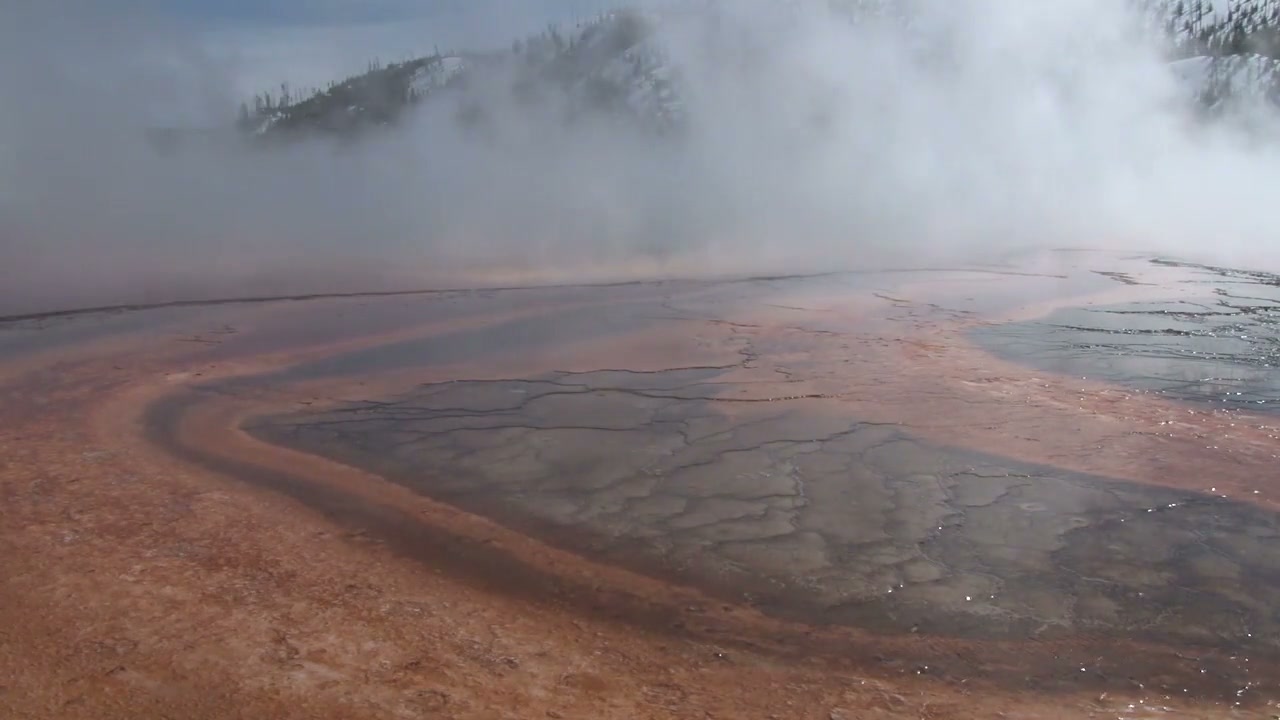
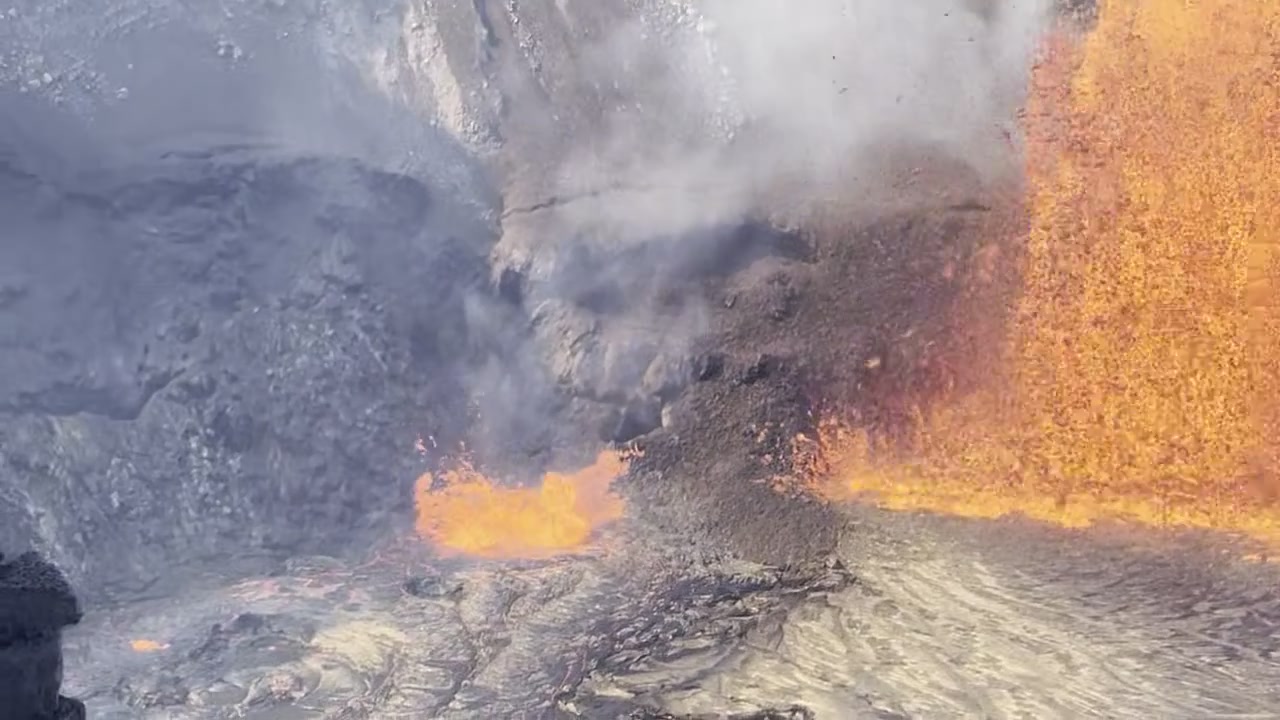
Distinguish terrestrial hot springs, shallow marine geothermal habitats and deep-sea hydrothermal vents. They are different environments. Lava footage is geological context, never evidence that an ingredient comes from lava.
Grand Prismatic Spring · filmed by NPS
Yellowstone, United States
A real geothermal landscape introduces the world. The type-strain history of Sulfolobus acidocaldarius refers to a Yellowstone acid hot spring; it does not identify this pool as the source of a future sample.
Heat-adapted organisms offer membranes, protective solutes and enzymes with unusual behaviour. The value depends on the exact preparation and conditions. A more stable molecule may also inhibit useful activity; resilience in nature must be translated through a meaningful comparison.
A geological observation
Volcanic energy. Biological questions.
Kīlauea’s summit, Hawaiʻi, 24 December 2024. This USGS film records lava fountains. The programme candidates concern heat-adapted life in separately documented habitats.
Each candidate dossier contains ten expanded chapters, from material identity to a buyer’s next decision. These are proposed research paths. Scientific leads, access, resources and terms must be agreed before a study becomes active.
The catalogue references are working identifiers, not available products or cleared commercial names. Published results belong to their investigators. Literature informs the starting point; the proposed work and commercial questions are VARUNÉ’s interpretation.
The scientific connection
An environment. A mechanism. A question.
The connection to beauty becomes specific when a biological idea leads to a comparison. The diagram connects each environment to a proposed development comparison.
01 | Environment
Heat & chemical extremes
02 | Biological mechanism
Membranes, solutes & enzymes
03 | Cosmetic comparison
Useful stability & selective processing
Conceptual illustrations | Research logic, not experimental results. Each proposed comparison needs a defined material, appropriate controls and an agreed decision.
Published evidence establishes the starting point. The programmes below are VARUNÉ proposals for further qualification, with a beauty application and a decision to resolve.
01 | Specialist materials and process research
Archaeal tetraether lipids: robust membranes
Bipolar tetraether membrane lipids studied in Sulfolobus acidocaldarius.
The published starting point
Primary liposome studies found distinctive thermal stability and permeability for S. acidocaldarius tetraether membranes. This is evidence about model membranes, not human skin.
Can a documented tetraether-containing carrier retain a cosmetic-compatible model payload more consistently than a conventional phospholipid carrier?
Could a carrier inspired by heat-adapted microbes hold a model cosmetic ingredient more reliably than a familiar carrier?
Beauty connection
A way to study retention and leakage of a formulation payload under temperature and pH stress.
First comparison to scope
A matched phosphatidylcholine liposome and unencapsulated payload, matching particle size and loading where feasible. Payload retention/leakage, particle size, aggregation and compatibility with the intended formulation.
Decision gate
Stop if the benefit disappears after size/loading matching, material purity or rights cannot be verified, or practical stability and cost are worse than the benchmark.
Wider biology and enzyme research
Carrier stability does not imply skin penetration, barrier repair or drug-delivery efficacy. Biomedical investigations are separate preclinical research, not a cosmetic product claim.
02 | Specialist materials and process research
Mannosylglycerate: stabilisation with a trade-off
Mannosylglycerate, a compatible solute studied in thermophilic organisms including Rhodothermus marinus.
The published starting point
Primary work links mannosylglycerate to thermal/osmotic adaptation. In an RNase A model, it improved thermal stability but also inhibited enzyme activity, demonstrating why stability alone is insufficient.
Can the molecule preserve useful function, rather than merely preserve protein structure?
Could a protective molecule help a protein keep doing its job under stress, rather than only keep its shape?
Beauty connection
Cell-free preservation of an enzyme or protein ingredient during storage or processing; any direct skin function remains unestablished here.
First comparison to scope
Trehalose, glycerol and no-additive controls, with matched pH and ionic conditions. Residual useful enzyme activity, aggregation and recovery after a defined storage or thermal challenge.
Decision gate
Stop if activity inhibition cancels the stability benefit, or if a conventional stabiliser performs equivalently at a lower practical cost.
Wider biology and enzyme research
Effects depend on protein, concentration and conditions. Do not translate thermal protection of an isolated protein into anti-ageing or skin resilience. Identity/anomer, purity, material origin and supply rights require verification.
03 | Specialist materials and process research
Thermophilic lipases: precision processing
Lipolytic enzymes from thermophilic bacterial isolates studied around Santorini.
The published starting point
The study examined 101 isolates and characterised nine stronger producers. Partially purified lipases had different activity and thermal-stability profiles; solid and liquid screening results did not agree reliably.
Can a documented heat-tolerant enzyme improve a specific cosmetic-lipid conversion relative to an established commercial catalyst?
Could a heat-tolerant enzyme make a cosmetic oil ingredient more effectively than an existing catalyst?
Beauty connection
A proposed biocatalytic route for modifying cosmetic lipids or making a defined ester, subject to substrate selectivity and economics.
First comparison to scope
An established commercial lipase with matched active units, plus a no-enzyme process control. Product identity/purity, conversion, selectivity, retained activity on reuse, energy demand and full process cost.
Decision gate
Stop if there is no reproducible selectivity/productivity advantage, or heating, purification and enzyme cost outweigh the process benefit.
Wider biology and enzyme research
The source characterised partially purified preparations, not a cosmetic manufacturing process. High-temperature activity is not automatically greener or cheaper. Access agreements precede material transfer.
The development route
A formulation context. A defined comparison.
Applications, source rights, scientific ownership, delivery capacity, and funding must be agreed before a proposed study becomes an active programme.
Sources were checked on 20 October 2026. Published findings belong to the original investigators. A material-level or laboratory observation does not establish efficacy, safety, or sustainability of a finished cosmetic.
Independent source for the cited preparation, study or strain history. Its findings do not establish a VARUNÉ result or an available company ingredient.
Independent source for the cited preparation, study or strain history. Its findings do not establish a VARUNÉ result or an available company ingredient.
Independent source for the cited preparation, study or strain history. Its findings do not establish a VARUNÉ result or an available company ingredient.
Independent source for the cited preparation, study or strain history. Its findings do not establish a VARUNÉ result or an available company ingredient.
Independent source for the cited preparation, study or strain history. Its findings do not establish a VARUNÉ result or an available company ingredient.
Independent source for the cited preparation, study or strain history. Its findings do not establish a VARUNÉ result or an available company ingredient.
Independent source for the cited preparation, study or strain history. Its findings do not establish a VARUNÉ result or an available company ingredient.