
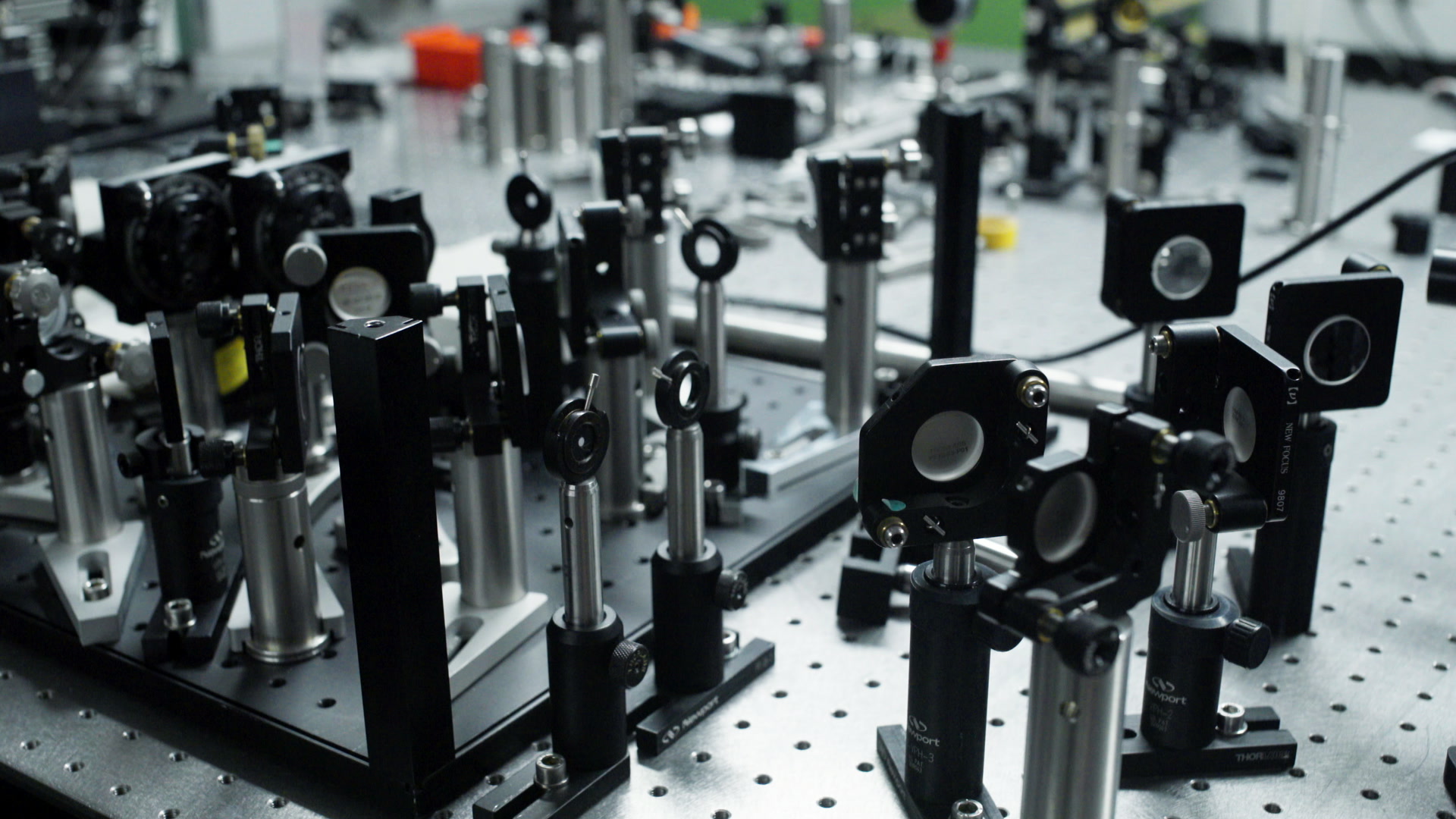
 Film credits
Molecular choices. Material consequences.
A research vision for UCLA: three questions connecting molecular design with useful formulation evidence.
Collaboration vision · Subject to institutional discussion and agreement.
A question worth resolving.
A prospective project becomes compelling when its scientific uncertainty can be resolved and its answer changes a real formulation-development decision.
A formulation team can see a material change without knowing which molecular choice caused it. A cloudy preparation may contain a useful liquid phase or an unwanted precipitate. A protein assay may suggest retained function while an additive changes the measurement itself. A light-responsive specimen may behave differently after its structure changes. Our UCLA vision begins with these uncertainties, because each could alter a development decision. The aim would be to connect one application, one comparison and one interpretable endpoint, rather than collect several impressive scientific themes under a university name.
This is a prospective direction informed by independent published research. A useful first conversation would ask whether an identified question offers genuine academic novelty and an application owner who can explain the value of resolving it.
(Deming, n.d.) | (Maynard Research Group, n.d.) | (García-Garibay, n.d.)
Examine the development decision
Molecular choices. Material consequences.
Open the sequence to examine what a development decision needs.
Identify the exact preparation, its source, and the properties a second laboratory must be able to reproduce.
Explanatory geometry · no simulated or measured performance
Three independent bodies of science.
Three independent research traditions offer distinct questions about how molecular design changes a material’s assembly, biochemical function or response to light.
UCLA’s published research interests provide three specific starting points. Deming’s profile describes biological and biomimetic polypeptide materials. Maynard’s group examines protein-polymer conjugates and protein stabilisation. García-Garibay’s group studies solid-state photochemistry and structure-dependent reactivity (Deming, n.d.; Maynard Research Group, n.d.; García-Garibay Research Group, n.d.). These are independent academic activities. Their relevance to Bio lies in the questions they make possible, rather than an assumed entitlement to a laboratory or discovery.
We would keep the directions distinct. Assembly research asks what phase forms and why. Protein research asks what remains functional after a defined stress. Photochemistry asks what absorbed light does within a specified structure. A result in one direction would not establish performance in the other two.
(Deming, n.d.) | (Maynard Research Group, n.d.) | (García-Garibay Research Group, n.d.)
An endpoint before choosing a story.
Choose the material state, biochemical readout or chemical transformation that would let an application owner act on the evidence.
For an assembly comparison, the endpoint could be the fraction of polymer in an identified liquid phase under agreed conditions. For a protein comparison, it could be retained catalytic activity in a qualified assay after a handling stress. For a photoresponsive material, it could be a measured chemical conversion relative to absorbed photons. These proposed endpoints are narrower than descriptions such as responsive, protective or intelligent. They allow a prospective partner to discuss what would count as a useful result and what would remain unresolved.
The commercial question would also be explicit: should a development team continue with a candidate preparation, change its processing conditions, or return to an established alternative? A small study should alter that choice before a larger programme is considered.
Examine the comparison
| Research direction | Proposed endpoint | Research contribution | Development decision |
|---|---|---|---|
| Polypeptide assembly | Polymer fraction in an independently identified phase | Explain disagreement between optical and phase measurements | Choose conditions or reject an unsuitable material state |
| Protein–polymer comparison | Qualified catalytic activity after a stated stress | Distinguish handling effects from matrix/readout effects | Progress a stabilisation comparison or change its method |
| Photochemistry | Specified product formation per absorbed photon amount | Separate photon delivery from specimen-dependent reaction | Justify a new state/structure comparison or stop transfer |
(Morrison et al., 2024) | (Lee et al., 2013) | (Paul et al., 2024)
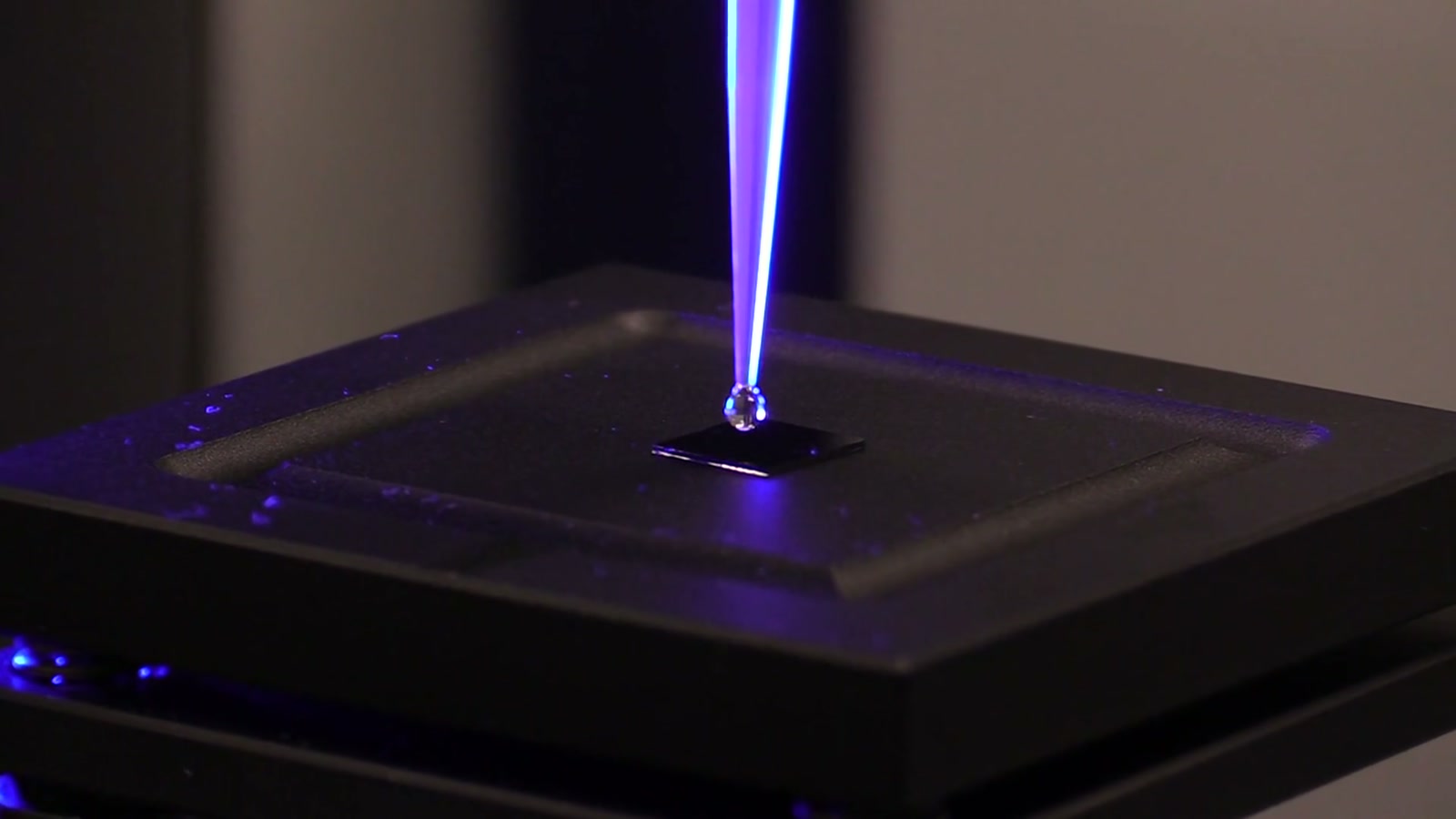
Build from the behaviour of molecules.
Assembly, protein stress and photochemistry give a material idea a molecular question to answer.
Giving researchers a contribution of their own.
A worthwhile contribution gives a researcher a method or mechanism to investigate, with an attributable intellectual output and agreed supervision.
A prospective student contribution could combine a versioned literature record, a testable model and a carefully bounded experiment. In the assembly direction, that might mean distinguishing optical changes from phase identity. In protein work, it might mean qualifying activity measurements in the presence of an additive. In photochemistry, it might mean separating photon delivery from material conversion. Each offers an identifiable methodological question rather than unpaid support for a company presentation.
The educational case would depend on supervision, access, time and academic suitability being agreed by the institution. A doctoral project would need a contribution broad enough for its research purpose; a shorter project would need a smaller endpoint. This vision does not advertise an available position or a defined degree project (UCLA Chemistry and Biochemistry, n.d.).
(UCLA Chemistry and Biochemistry, n.d.) | (UCLA Chemistry and Biochemistry, n.d.)
Making the first comparison inexpensive and decisive.
The first gate should establish whether the comparison can answer its question before committing resources to an extensive experimental programme.
The first proposed work package would assemble the exact source record, define a comparator and identify the measurement most likely to mislead. Before new synthesis, a researcher could test analysis on a documented reference preparation, compare alternative interpretations of a published result and specify the additional observations needed to discriminate them. If an assay cannot separate a matrix effect from the endpoint, that would be the first problem to solve. A cinematic material image would not resolve it.
The deliverable would be a decision brief containing the question, sample definition, controls, units, uncertainty plan and a justified next gate. A recommendation to stop could be commercially valuable if it avoids funding a comparison that cannot answer the buyer’s question.
(Morrison et al., 2024) | (Lee et al., 2014) | (Paul et al., 2024)
Enter the experiment · an interactive scientific lens
Where does the material go?
A small dense phase can contain a large share of the solute. Explore the mass balance before interpreting a cloudy sample.
The data, equations and controls remain available below if 3D cannot load.
Calculated comparison · illustrative inputs
Move a control to compare the selected condition with the defined reference curve.
Find the phase and composition measurements that make a state-change proposal testable.
The defined comparison
An ideal two-phase, additive-volume balance with dilute-phase concentration fixed at 1 g L⁻¹. Concentrations are assumed coexistence inputs at a single condition. The view scales phase heights with calculated volume fraction. It is not a phase diagram, phase identification, assembly pathway or prediction of the coexistence concentrations of any polypeptide.
Inspect the calculated values
Calculation grid, not measured observations. The source observation for the rheology reconstruction is stated above.
| Overall solute / g L⁻¹ | Dense-phase volume | Solute in dense phase |
|---|
Run mechanism and application in parallel.
Investigate the cause of a response alongside its application relevance, so neither scientific novelty nor practical usefulness has to stand in for the other.
A mechanism package would test why a response occurs and which model is supported. An application package would ask whether that response matters in the intended material state, handling process or viewing condition. These packages could share a sample record without sharing the same success criterion. For example, a reproducible assembly transition might be scientifically interesting but irrelevant if the intended application needs a stable homogeneous film. Conversely, a useful empirical comparison might support a development choice while leaving its molecular mechanism unresolved.
A prospective programme should preserve that distinction in its outputs. Research findings would be reported with their preparation and limits; a buyer-facing summary would state the decision they support. Neither document would convert external publications into Bio experimental results.
(Morrison et al., 2024) | (Lee et al., 2013) | (Paul et al., 2024)
Agree resources and rights before starting.
An agreed project would connect a responsible academic lead, the actual analytical resources and a rights route appropriate to the proposed work.
Any laboratory work would require an agreed academic lead, a responsible project owner, a costed scope and confirmation of the relevant facilities. The institutional agreement would determine how funding, materials, background rights, new results and publication were handled. UCLA TDG distinguishes sponsored research from material-transfer agreements (UCLA TDG, n.d.). That distinction is useful here: discussing a research direction does not transfer a sample, provide access or secure commercial rights to a paper’s chemistry.
Our proposed contribution would be a clearly specified application question and a documented comparison brief. A prospective partner would determine scientific suitability and the resources needed. Existing patents, material restrictions and third-party methods would be reviewed separately before any option or licensing discussion could become concrete.
Keeping doctoral applications with the university.
Use UCLA’s authoritative application instructions for admission; use the research vision to identify a scientific question you could help resolve.
Readers interested in doctoral study should use UCLA’s own programme and application records. The official instructions distinguish Chemistry from Biochemistry, Molecular and Structural Biology and describe the university’s application process (UCLA Chemistry and Biochemistry, n.d.). Requirements can change by cycle, so this vision links the authoritative instructions instead of repeating a future deadline, test policy or funding expectation. An enquiry to Bio would not submit an application, establish eligibility or secure supervision.
For a research conversation, a useful contribution is different: identify the question you find technically interesting, the method you could contribute and the output you would want to understand better. That can help assess scientific fit without implying that a place, stipend or institutional affiliation is available through this page.
(UCLA Chemistry and Biochemistry, n.d.) | (UCLA Chemistry and Biochemistry, n.d.)

A comparison worth making.
Define the preparation, the measurable difference and the decision the evidence could change.
Leave the discussion with one research proposition.
A focused proposition would connect one scientific contribution, one application decision and the minimum evidence needed to justify a next study.
The proposed endpoint for an initial discussion would be a short, non-confidential research proposition. It would identify one of the three directions, the published evidence behind it, the unresolved question and the minimum observations needed to answer it. It would also state the application owner’s decision, the prospective academic contribution and the resources still to be agreed. This document could support a subsequent institutional conversation; it would not establish an active study by itself.
For formulation developers, the value is a clearer route from molecular possibility to evidence they could use. For researchers, it is a question with a defined contribution and a meaningful application context. For Bio, the discipline is to progress only where the science, resources and rights support a focused programme.
(Morrison et al., 2024) | (Lee et al., 2013) | (Paul et al., 2024) | (UCLA TDG, n.d.)
A prospective study worth shaping
Molecular originality needs an application test.
Assembly, protected protein and light-responsive crystal research raise different development questions. A useful programme needs one selected behaviour, a preparation boundary and a reason that the mechanism would change an application choice.
Develop a narrow first comparison around molecular identity, stress history or photon accounting. Connect it to a longer material-development opportunity only if the evidence supports the next step.
What a first scope
could produce.
- A mechanism-to-application hypothesis
- A preparation and comparator boundary
- Primary and orthogonal endpoints
- A proposed feasibility-to-study route
Bring a real question.
Bring the current benchmark, the unanswered scientific question, sample or data access, and the result that would change your next development decision. An analytical partner can contribute method expertise; a researcher can challenge the mechanism; a sponsor can define the application constraint.
A possible first commission would be a bounded feasibility, protocol-design or evidence-analysis package, followed by a separately resourced experiment where warranted. Scope, costs, delivery capacity, rights and institutional participation would be agreed before work began. These are proposed opportunities, not an assertion that a laboratory service or joint programme is already available.
Shape a non-confidential research scopeIndependent VARUNÉ Bio proposal. University participation, resources, rights and deliverables remain subject to discussion and agreement. Confidential material can follow an appropriate agreement once the parties and purpose are defined.
Your contribution to the question
What could you
bring to the study?
Choose a scientific direction and the perspective closest to your work. Build a useful starting brief around the question, the measurement and the contribution that could move it forward.
The question
How does a controlled change in molecular or environmental conditions alter an assembled material state?
A state-comparison brief connecting molecular identity, preparation and the observable transition.
Read the scientific directionYour possible contribution
Develop a mechanism, distinguish competing explanations and define an interpretable measurement.
What makes the brief useful
Composition, preparation history, environmental conditions and a suitable phase or structural readout.
The relevant method, an accessible preparation or dataset, and the comparison your expertise could make more informative.
The next conversation
Shape a non-confidential scientific scope, then agree resources, responsibilities and permitted outputs with the appropriate parties.
Prepared in your browser. Saving a brief sends no enquiry and creates no application. These are prospective research visions; an agreed project would require institutional assessment, resources and appropriate arrangements.
Inside the UCLA research vision
Follow the
scientific question.
Explore another scientific context.
Sources and reading notes.
External work is identified below. Access notes describe the material inspected for this page; company research questions and proposed work are not presented as findings from these sources.
Deming, n.d.Deming, T.J. (n.d.) UCLA faculty research profile
Current published polypeptide-materials research interests and bibliography.
Scope and limitations: Faculty interest and publications establish independent research, not Bio involvement, access or supervision.
Open original sourceMaynard Research Group, n.d.Maynard Research Group (n.d.) Research and graduate routes
Current lab focus on protein-polymer conjugates and protein stabilisation; graduate route through UCLA admission.
Scope and limitations: No lab availability, funding or collaboration is promised. Biological efficacy of the group is not Bio evidence.
Open original sourceGarcía-Garibay, n.d.García-Garibay, M.A. (n.d.) UCLA faculty research profile
Current independent solid-state photochemistry interests and original-paper bibliography.
Scope and limitations: No Bio research, facility access or transfer of the reported effects is established.
Open original sourceGarcía-Garibay Research Group, n.d.García-Garibay Research Group (n.d.) Research
Published focus on solid-state photochemistry, kinetics and crystal structure.
Scope and limitations: Research interests do not establish booked methods, available instruments or Bio outcomes.
Open original sourceMorrison et al., 2024Morrison, C.A., Chan, E.P., Lee, T. and Deming, T.J. (2024) Switchable coacervate formation via amino acid functionalization of poly(dehydroalanine). Biomacromolecules, 25(4), pp. 2554–2562
Original polypeptide study: environment-dependent assembly, microscopy distinctions and defined phase measurements. DOI: 10.1021/acs.biomac.4c00048.
Scope and limitations: Selected full-text sections were inspected in the search-indexed primary record; direct PMC open presented a browser challenge. No raw data reanalysis, figures or Bio preparation is claimed.
Open original sourceLee et al., 2013Lee, J., Lin, E.-W., Lau, U.Y., Hedrick, J.L., Bat, E. and Maynard, H.D. (2013) Trehalose glycopolymers as excipients for protein stabilization. Biomacromolecules, 14(8), pp. 2561–2569
Original study record and abstract: enzyme activity after heat or lyophilisation with polymer, trehalose and no-additive comparisons. DOI: 10.1021/bm4003046.
Scope and limitations: Abstract and indexed primary text checked; experimental effects belong to the reported preparations. The 2014 structural correction must accompany interpretation.
Open original sourceLee et al., 2014Lee, J. et al. (2014) Correction to Trehalose glycopolymers as excipients for protein stabilization
Author correction of M3/P3 regioisomer structures and associated supplementary records. DOI: 10.1021/bm501365a.
Scope and limitations: Correction inspected directly; it does not prove a new Bio polymer, stability result or commercial right.
Open original sourcePaul et al., 2024Paul, I., Konieczny, K.A., Chavez, R. and García-Garibay, M.A. (2024) Reaction amplification with a gain: Triplet exciton-mediated quantum chain using mixed crystals with a tailor-made triplet sensitizer. PNAS, 121(14), e2401982121
Primary abstract and figure-caption record of a defined mixed-crystal quantum-chain study, including excited-photoproduct energy transfer and reaction quantum yield. DOI: 10.1073/pnas.2401982121.
Scope and limitations: PubMed abstract and captions inspected directly; PMC full-text open challenged. No numerical gain, raw data reanalysis or independent reproduction is presented. Full methods and SI require inspection before experiment; associated article has CC BY-NC-ND terms, not a commercial figure-reuse permission.
Open original sourceUCLA Chemistry and Biochemistry, n.d.UCLA Chemistry and Biochemistry (n.d.) How to apply
Official independent doctoral application route and distinction between programme choices.
Scope and limitations: Inspected page still contains Fall 2026 GRE guidance. No next-cycle deadline, score, fee or funded position is reproduced.
Open original sourceUCLA Chemistry and Biochemistry, n.d.UCLA Chemistry and Biochemistry (n.d.) Chemistry graduate programme
Official chemistry doctoral programme overview.
Scope and limitations: Bio has no admissions, degree-awarding or supervision authority.
Open original sourceUCLA TDG, n.d.UCLA Technology Development Group (n.d.) Agreement types
Institutional distinction between sponsored research and material-transfer agreements.
Scope and limitations: Old fiscal-year rates on this page are not current budgets; no agreement, licence or option is concluded.
Open original source