
 Film credits
A phase change is a decision point.
Could an identified polypeptide assembly remain useful as its environment and material state change?
Collaboration vision · Subject to institutional discussion and agreement.
Decide what the phase must do.
Define which material state the application needs, then investigate the environmental change that could make that state useful or unreliable.
A preparation can be visually striking and still be difficult to use. If its phase state changes during handling, the development question is whether the change helps an intended function or destroys a required one. Our proposed assembly direction would start with a defined state: a dispersed liquid phase, a continuous layer or a homogeneous solution. The application owner would specify which is needed and which transitions would be unacceptable. That choice would determine the scientific comparison.
The prospective value lies in locating an interpretable operating region before a candidate is treated as an ingredient opportunity. A researcher could ask which environmental change controls assembly and whether a reported solution behaviour remains relevant when the material is placed in a different geometry.
Examine the development decision
A phase change is a decision point.
Open the sequence to examine what a development decision needs.
Identify the exact preparation, its source, and the properties a second laboratory must be able to reproduce.
Explanatory geometry · no simulated or measured performance
Start from an attributable original study.
The original polypeptide study offers a specific structure–assembly question whose relevance to a new preparation would need its own comparison.
Morrison and colleagues investigated side-chain amino acid-functionalised polypeptides derived from poly(dehydroalanine), with environment-dependent coacervate formation (Morrison et al., 2024). Their study belongs to the authors and their defined preparations. It provides a specific structure–assembly question for this vision: how do molecular variation and the surrounding medium affect phase identity? Deming’s official UCLA profile places that question within a broader independent polypeptide-materials research programme (Deming, n.d.).
A proposed Bio discussion would not begin by claiming that the reported chemistry is available for commercial formulation. It would first establish the relevant rights, the scientific novelty of a new comparison and whether a qualified reference or candidate can be obtained through an authorised route.
Distinguish a liquid phase from a precipitate.
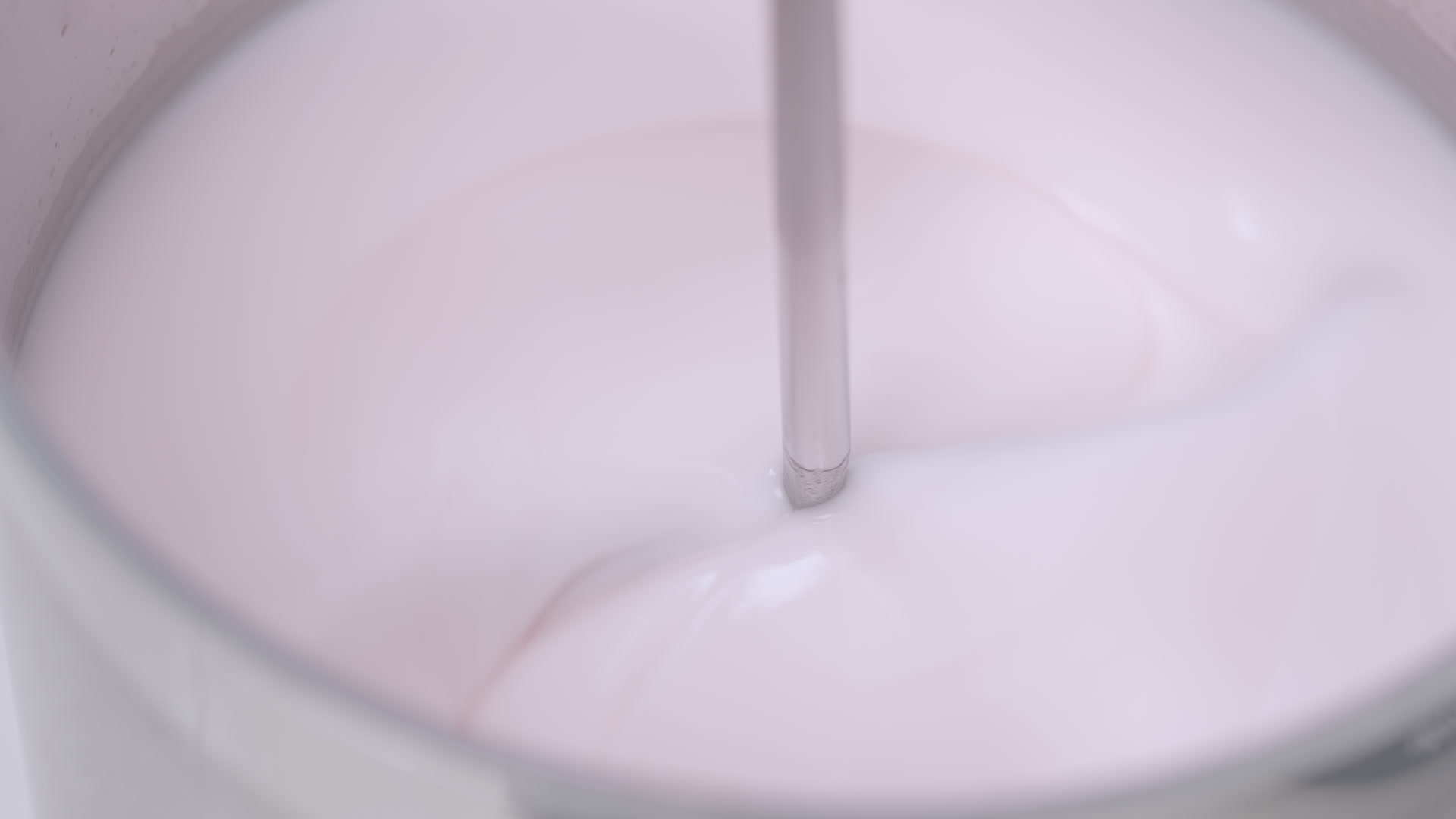
Combine optical change with independent phase observations, so a cloudy specimen is interpreted as a physical state rather than an attractive image.
The published study uses observations such as coalescing droplets and separated liquid layers to support coacervate identification; other preparations formed solid precipitates (Morrison et al., 2024). This distinction matters to the proposed question. A reduction in transmitted light could arise from several physical changes and should not be relabelled as formation of a useful liquid material without complementary observations. An attractive cloudy image would leave the application decision unresolved.
A prospective comparison would therefore combine an optical readout with a stated phase-identification method. Microscopy, settling behaviour and an appropriate mechanical measurement would be considered according to the specimen. The observations required to call two states different would be declared before viewing the candidate results, including how ambiguous specimens would be recorded.
Build from the behaviour of molecules.
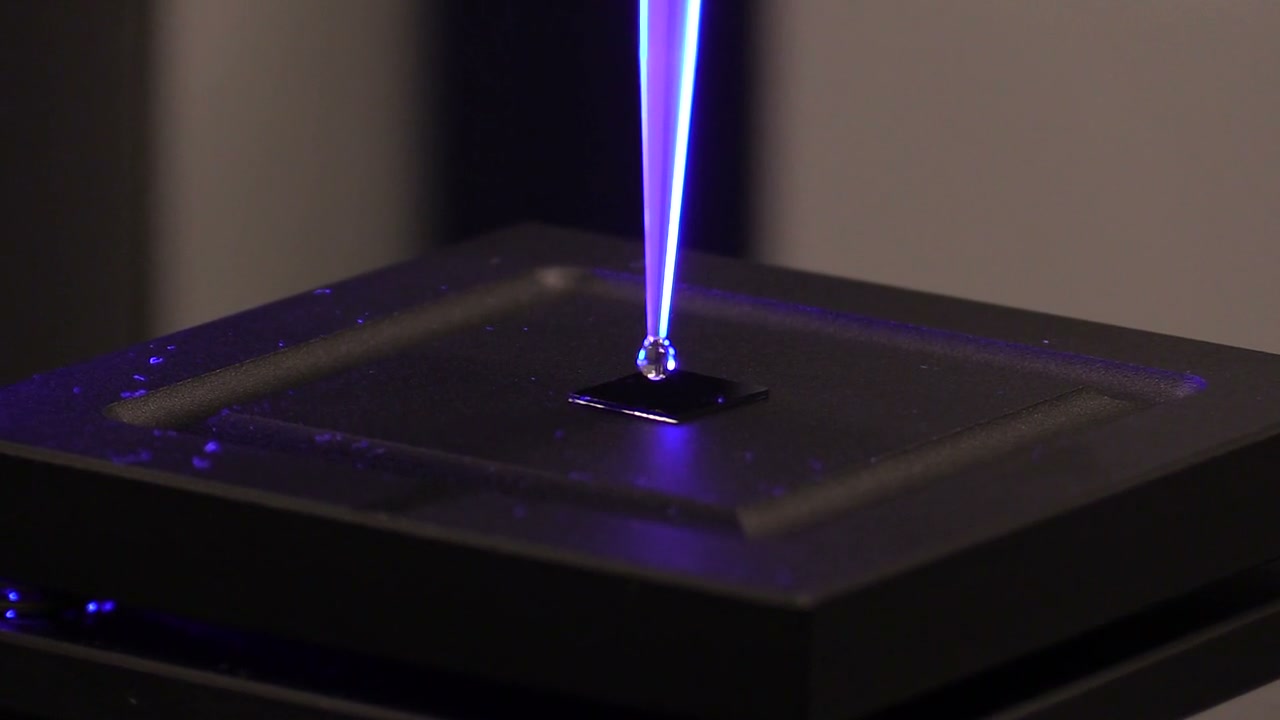
Assembly, protein stress and photochemistry give a material idea a molecular question to answer.
Measure the fraction that matters.
Polymer mass accounting could distinguish how much material enters an identified phase from how strongly a suspension scatters the measurement light.
For an identified coacervate, a useful proposed endpoint is the fraction of total polymer assigned to that phase. This requires measuring polymer mass rather than assuming that a darker suspension contains more assembled material. The two quantities can be related only after a measurement model is established. Sampling, separation and recovery could themselves shift the apparent fraction, so their effects would need to be included in the study record.
The equation here is a mass-accounting definition for the proposed comparison. The numerator excludes solvent and any non-polymer material unless the endpoint is explicitly redefined. Total recovery would be checked across the measured phases, with unaccounted material retained as a limitation. No Bio phase-fraction values are supplied on this page.
Mass-fraction accounting for the proposed phase comparison; not an optical calibration or a supplied Bio result.
- Fraction of measured total polymer mass in the identified coacervate phase1
- Polymer mass assigned to the coacervate phasekg
- Total polymer mass within the declared specimen boundarykg
Model conditions. The phase is independently identified; numerator and denominator use the same polymer assay and mass basis; solvent is excluded; phase recovery and unaccounted mass are reported. A non-zero denominator is required.
Changing one explanatory variable at a time.
Separating molecular variation from environmental variation would help identify the cause of a phase boundary and the limits of its interpretation.
A first model study could hold polymer concentration, specimen history and temperature constant while changing one environmental feature. A second comparison could hold the environment constant while changing a justified molecular feature. Combining both changes in the same specimen would be tempting, but it would make the cause of a difference harder to identify. The design would need enough independent preparations to distinguish preparation variability from repeated readings of the same vial.
The source study provides evidence that conditions and molecular identity matter within its system (Morrison et al., 2024). Our prospective question is narrower than universal responsiveness: which change explains an observed phase boundary in the proposed preparation? Conditions outside that boundary would remain untested, even if a smooth graphic makes the transition look continuous.
Enter the experiment · an interactive scientific lens
Where does the material go?
A small dense phase can contain a large share of the solute. Explore the mass balance before interpreting a cloudy sample.
The data, equations and controls remain available below if 3D cannot load.
Calculated comparison · illustrative inputs
Move a control to compare the selected condition with the defined reference curve.
Find the phase and composition measurements that make a state-change proposal testable.
The defined comparison
An ideal two-phase, additive-volume balance with dilute-phase concentration fixed at 1 g L⁻¹. Concentrations are assumed coexistence inputs at a single condition. The view scales phase heights with calculated volume fraction. It is not a phase diagram, phase identification, assembly pathway or prediction of the coexistence concentrations of any polypeptide.
Inspect the calculated values
Calculation grid, not measured observations. The source observation for the rheology reconstruction is stated above.
| Overall solute / g L⁻¹ | Dense-phase volume | Solute in dense phase |
|---|
What survives the move into a layer?
A layer introduces a new geometry and history, making transfer from a suspension result a scientific comparison rather than a presentation choice.
A formulation or material developer may ultimately care about a layer rather than a suspension. The prospective project would therefore treat transfer into a layer as a second gate, with thickness, substrate, drying history and exposure conditions specified. A liquid phase observed in a vial does not establish adhesion, durability or retained function after application. The first question could be whether the state remains identifiable at all under the proposed layer conditions.
A researcher’s contribution could be to connect a simple transport or phase model with observations from the new geometry. If the layer becomes heterogeneous or loses the relevant state, the output should explain that failure rather than stretch a suspension result into a surface-performance claim. That would guide a realistic reformulation decision.
Giving the student a tractable method question.
A qualified state map could reveal where optical and phase observations agree, giving a researcher an interpretable method contribution.
A prospective research contribution could focus on disagreement between two measurement approaches: optical transmission and direct phase assignment. A student could build a versioned source record, define common specimen conditions, test how sample handling changes the observed boundary and report where the readouts agree or diverge. The output would be a reproducible comparison method and a state map with explicit unmeasured regions. That is a scientific contribution with a possible formulation use, rather than a catalogue of attractive microscopy images.
Any academic project would depend on institutional supervision and access being agreed. UCLA Bioengineering lists a Polypeptide Laboratory, but a directory entry is not confirmation of access or an available project (UCLA Bioengineering, n.d.). The proposed role would be scoped only after those arrangements were established.
Resource the work before naming a collaboration.
A feasible first comparison needs suitable material, independent phase identification and an authorised resource and rights plan for the proposed work.
The proposed first gate would confirm a suitable reference, analytical capability and a costed plan for phase assignment. New synthesis would follow only if it were necessary to answer the question and supported by the appropriate expertise. Where materials would move between organisations, an authorised transfer route would be required; funded academic work would require its own agreed research scope (UCLA TDG, n.d.). Neither arrangement is implied by citing a paper.
The rights discussion would distinguish background chemistry, newly generated observations, analysis software and any proposed commercial evaluation. Public reporting, authorship and the treatment of negative results would also be agreed. An initial non-confidential comparison brief could identify the scientific question without publishing a proprietary formulation or promising exclusive rights that have not been secured.

A comparison worth making.
Define the preparation, the measurable difference and the decision the evidence could change.
Making the outcome useful to both sides.
A useful phase map would guide a processing or preparation decision while preserving ambiguous states and the next unresolved measurement question.
The intended output would be a decision record stating which preparation, conditions and geometry support the required state; where observations are ambiguous; and what comparison should come next. A developer could use that record to choose a processing window, reject a fragile candidate or justify a more focused study. A prospective academic partner could judge whether the mechanism and measurement problem merit further investigation. A negative operating region would remain part of the evidence.
For doctoral audiences, this is a research vision rather than an advertised position. Applications belong with UCLA’s official process (UCLA Chemistry and Biochemistry, n.d.). For a Bio discussion, the useful starting point is one material-state problem and the decision its resolution would change, with supervision, resources and rights still subject to agreement.
A prospective study worth shaping
Choose the state worth developing.
Cloudiness, phase separation and irreversible aggregation can look similar on visual inspection. A material proposition becomes stronger when its state, composition and reversibility are tested independently.
Map a limited composition and environmental window, retain preparation history and combine a structural method with composition measurement. Test reversibility and a use-relevant response before broader formulation work.
What a first scope
could produce.
- A molecular-identity and preparation boundary
- A justified state-comparison matrix
- Orthogonal phase or structural evidence
- A reversibility and next-function proposal
Bring a real question.
Bring the current benchmark, the unanswered scientific question, sample or data access, and the result that would change your next development decision. An analytical partner can contribute method expertise; a researcher can challenge the mechanism; a sponsor can define the application constraint.
A possible first commission would be a bounded feasibility, protocol-design or evidence-analysis package, followed by a separately resourced experiment where warranted. Scope, costs, delivery capacity, rights and institutional participation would be agreed before work began. These are proposed opportunities, not an assertion that a laboratory service or joint programme is already available.
Shape a non-confidential research scopeIndependent VARUNÉ Bio proposal. University participation, resources, rights and deliverables remain subject to discussion and agreement. Confidential material can follow an appropriate agreement once the parties and purpose are defined.
Inside the UCLA research vision
Follow the
scientific question.
Return to the UCLA visionExplore another scientific context.
Sources and reading notes.
External work is identified below. Access notes describe the material inspected for this page; company research questions and proposed work are not presented as findings from these sources.
Deming, n.d.Deming, T.J. (n.d.) UCLA faculty research profile
Current published polypeptide-materials research interests and bibliography.
Scope and limitations: Faculty interest and publications establish independent research, not Bio involvement, access or supervision.
Open original sourceMorrison et al., 2024Morrison, C.A., Chan, E.P., Lee, T. and Deming, T.J. (2024) Switchable coacervate formation via amino acid functionalization of poly(dehydroalanine). Biomacromolecules, 25(4), pp. 2554–2562
Original polypeptide study: environment-dependent assembly, microscopy distinctions and defined phase measurements. DOI: 10.1021/acs.biomac.4c00048.
Scope and limitations: Selected full-text sections were inspected in the search-indexed primary record; direct PMC open presented a browser challenge. No raw data reanalysis, figures or Bio preparation is claimed.
Open original sourceUCLA Bioengineering, n.d.UCLA Bioengineering (n.d.) Research laboratories
Institutional listing of the Polypeptide Laboratory and other research laboratories.
Scope and limitations: Directory listing is not an access commitment or an available project.
Open original sourceUCLA TDG, n.d.UCLA Technology Development Group (n.d.) Agreement types
Institutional distinction between sponsored research and material-transfer agreements.
Scope and limitations: Old fiscal-year rates on this page are not current budgets; no agreement, licence or option is concluded.
Open original sourceUCLA Chemistry and Biochemistry, n.d.UCLA Chemistry and Biochemistry (n.d.) How to apply
Official independent doctoral application route and distinction between programme choices.
Scope and limitations: Inspected page still contains Fall 2026 GRE guidance. No next-cycle deadline, score, fee or funded position is reproduced.
Open original source