
 Film credits
The path through the photon. Explain the change.
Which part of a light-driven material response belongs to molecular structure, photon delivery or the specimen state?
Collaboration vision · Subject to institutional discussion and agreement.
Giving a light response a defined purpose.
Identify the useful change and its intended specimen state, then ask whether a measured light-driven response supports that development purpose.
A light-responsive material concept becomes useful only when its response supports a specified decision or function. Our prospective photochemistry direction would ask whether an observed chemical change depends on a controlled material structure and an interpretable light exposure. The application owner would identify the intended specimen state and the reason an externally triggered change would be valuable. A visually dramatic response would not, by itself, establish a useful formulation property.
The first proposed comparison would be nonclinical and analytical: a declared preparation, a reference and an endpoint linking exposure with conversion. It would ask whether further material development is justified. Skin protection, biological benefit and finished-product suitability would require different evidence and would not be inferred from the light response.
(García-Garibay, n.d.) | (García-Garibay Research Group, n.d.)
Examine the development decision
The path through the photon. Explain the change.
Open the sequence to examine what a development decision needs.
Identify the exact preparation, its source, and the properties a second laboratory must be able to reproduce.
Explanatory geometry · no simulated or measured performance
Using crystal photochemistry for the question it answers.
Solid-state photochemistry offers a way to investigate how molecular arrangement affects response, making structure part of the proposed comparison.
García-Garibay’s official research pages describe solid-state photochemistry, kinetics and the relationship between crystal structure and reactivity (García-Garibay Research Group, n.d.; García-Garibay, n.d.). That offers a specific scientific interest for this vision: molecular identity alone may be insufficient to explain what a specimen does under illumination. Its arrangement and physical state belong in the proposed comparison. These published interests are not an agreement to investigate a Bio preparation.
A prospective researcher could ask which structural observation is necessary to interpret a response, and whether the relevant state persists during the measurement. The practical output would connect a declared specimen to a reaction model and observations. It would not treat the university’s wider research activity as proof that a proposed formulation already works.
(García-Garibay, n.d.) | (García-Garibay Research Group, n.d.)
Keeping reaction amplification separate from emitted light.
A quantum-chain study counts chemical transformations per absorbed photon; distinguishing that endpoint from emission prevents an appealing but misleading material story.
Paul and colleagues reported a triplet-exciton-mediated quantum-chain study using mixed crystals and a tailored sensitiser (Paul et al., 2024). In the reported mechanism, an excited photoproduct transfers energy to another reactant, allowing a reaction chain within the specified crystal system. This page does not reproduce its gain values or extend its results to another material. The distinction is essential for the proposed Bio direction: chemical transformations counted per absorbed photon and photons emitted by a specimen are different endpoints.
A research brief would therefore name the effect being investigated before selecting a visual story. A chain reaction would not establish bioluminescence, create energy or demonstrate an ingredient benefit. A candidate response would need its own reaction identity and evidence that any comparison uses the same physical and measurement basis.
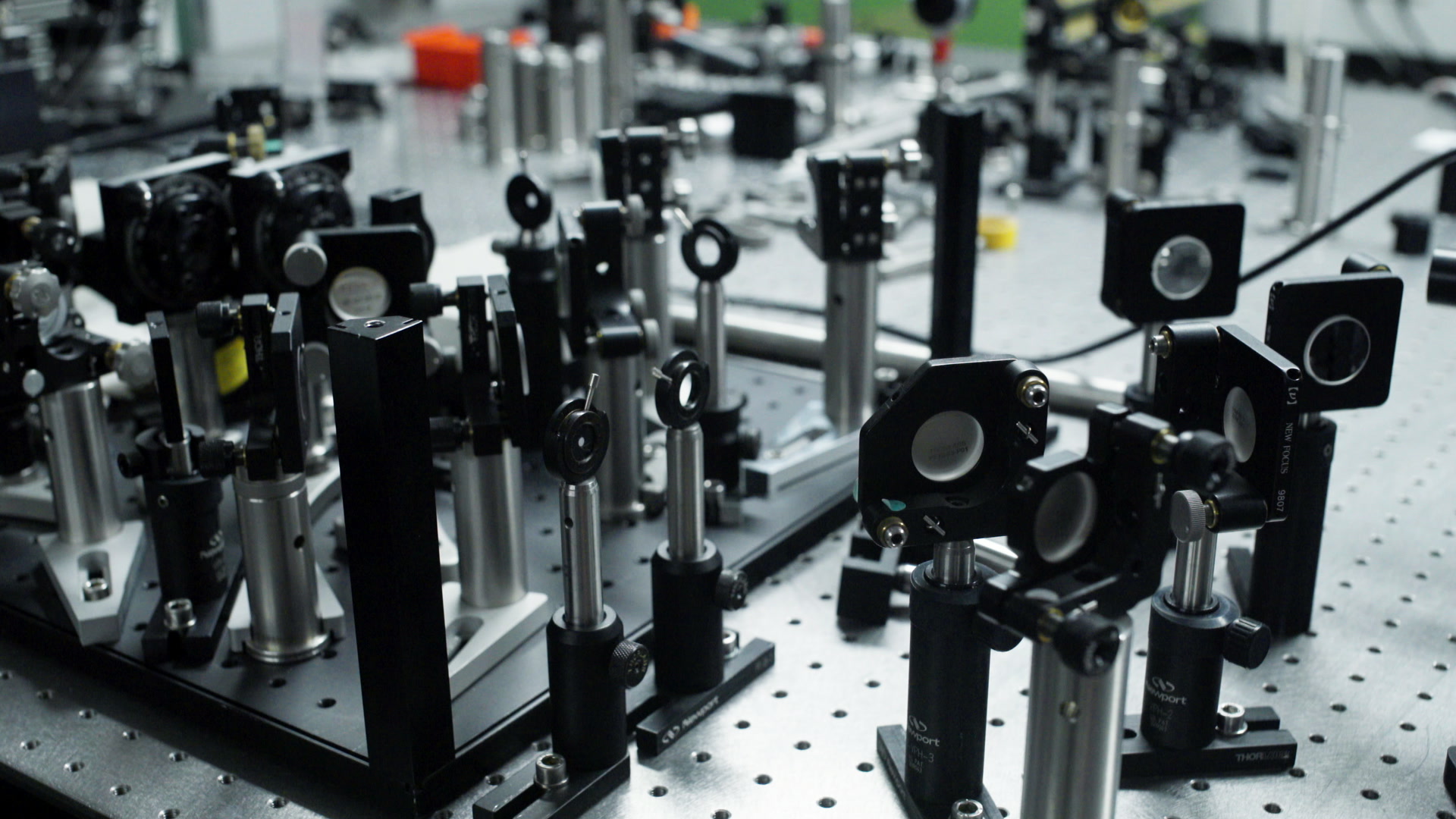
Build from the behaviour of molecules.
Assembly, protein stress and photochemistry give a material idea a molecular question to answer.
Count absorbed light, not just lamp settings.
Relate qualified chemical conversion to absorbed-photon amount, with geometry, spectrum and changing specimen absorption retained in the measurement boundary.
The proposed quantum-yield endpoint relates product formation to the amount of absorbed photons within a declared observation interval. A lamp power setting or exposure duration is insufficient to supply that denominator. Geometry, spectrum, beam stability, transmission and the specimen’s changing optical properties could alter absorption. If absorption changes during the reaction, a static estimate would need justification or a time-dependent measurement model.
The equation is the conventional amount-based reaction quantum-yield definition used here to frame a prospective comparison. It supplies no Bio value or expectation of amplification. Product formation would require a qualified chemical measurement, including correction for any starting product and competing pathways. The absorbed-photon estimate and its uncertainty would be reported independently, allowing a reader to see which part limits interpretation.
Conventional reaction quantum-yield definition framing the proposed comparison; it is distinct from emitted-photon yield and supplies no Bio result.
- Net specified product amount formed per absorbed photon amount during the declared intervalmol mol⁻¹ (dimensionless)
- Net amount of the specified reaction product formed, measured chemicallymol
- Amount of photons absorbed by the declared specimen/reactive system in the intervalmol of photons
Model conditions. Specific product and interval declared; starting product and relevant competing contributions accounted for; absorption estimated over the relevant spectrum and geometry with time dependence addressed; denominator non-zero. Chemical chain events can exceed one per absorbed photon; this is not emitted-light yield or energy creation.
Separate optical delivery from material response.
Independent comparisons of optical delivery and material structure could distinguish a different photon budget from a genuinely different reaction process.
A first comparison could hold the exposure geometry and spectral interval constant while changing one justified structural feature. A second could hold the material definition constant while testing the influence of optical delivery. Changing both together could make an apparent improvement impossible to interpret. Appropriate dark controls and specimen-history records would help distinguish the selected light-driven change from an unrelated transformation during handling.
A prospective researcher could model how much of a difference is consistent with changed absorption and how much requires a changed reaction process. That analysis would need measured inputs or declared assumptions, with identifiability tested rather than assumed. A better-fitting curve alone would not demonstrate a mechanism if several models could explain the same observations equally well.
Enter the experiment · an interactive scientific lens
Count what the sample absorbs.
More power and more absorbance change different parts of a photochemical experiment. Keep that distinction visible.
The data, equations and controls remain available below if 3D cannot load.
Calculated comparison · illustrative inputs
Move a control to compare the selected condition with the defined reference curve.
Build a photon-to-product comparison that a development team can interpret.
The defined comparison
A 450 nm monochromatic beam and 60 s exposure, with absorbance supplied as an assumption. Reflection, scattering, spatial gradients, spectral bandwidth and time-dependent absorbance are omitted. The 3D beam is a schematic path, not a field calculation. Absorbed photons alone do not establish product conversion, reaction quantum yield, emitted light or a useful material response.
Inspect the calculated values
Calculation grid, not measured observations. The source observation for the rheology reconstruction is stated above.
| Optical absorbance / dimensionless | Absorbed fraction | Transmitted fraction |
|---|
Treat the move from crystal to film as a new gate.
Moving a mechanism into a film introduces a new structural question, which should be resolved before transferring conclusions from a crystalline specimen.
An application may need a layer, dispersion or blended preparation rather than the crystalline specimen in a source study. The proposed project would treat this change of state as a new comparison, with its own structure and optical measurements. A result from a defined mixed crystal would not establish a quantum-chain effect in a soft film. The question would be whether a relevant arrangement exists, remains stable and can be investigated under the proposed conditions.
If those requirements were not met, a useful output could be a reasoned decision to stop transferring the mechanism. If they were met, the next gate would connect structure with reaction observations in that specimen. This prevents an attractive source result becoming a disconnected promise about a formulation with different physical constraints.
Making the student contribution a measurement argument.
A researcher could identify which additional observation separates competing models, connecting a literature record with a testable and resource-conscious measurement argument.
A prospective student contribution could begin with a structured review of the original preparation, optical conditions, chemical endpoint and interpretation limits. The model work could then compare hypotheses involving absorption, reaction progression and specimen-state change. Its output would identify which additional observation makes two competing explanations distinguishable. Where an agreed laboratory study were appropriate, the comparison would test that prediction using a qualified reference and recorded specimen history.
The contribution would be analytical and scientific rather than a rendering of an imagined material. Required capabilities could include calibrated optical measurements, chemical conversion analysis and structural characterisation appropriate to the specimen. Their availability and supervision would need confirmation. No instrument access, doctoral role or institutional participation is established by this research vision.
(García-Garibay Research Group, n.d.) | (Paul et al., 2024) | (UCLA Chemistry and Biochemistry, n.d.)
Agree safety, resources and publication at the outset.
A competent experimental lead and agreed analytical scope would make the exposure–conversion comparison feasible while preserving publication and material rights.
Before experiments, the prospective partners would need an agreed academic lead, competent assessment of the chosen chemicals and illumination, analytical resources and a costed plan. The source study is a scientific reference, not a procedure offered for unsupervised reproduction. Any funded institutional work or transfer of specimens would follow its authorised agreement route (UCLA TDG, n.d.). A comparison would start only when the controls needed to interpret it were resourced.
The rights discussion would cover background molecular designs, source materials, new observations, analysis and the scope for later commercial evaluation. Public figures would require their own reuse review; this vision uses citations rather than borrowed experimental images. Publication, credit and handling of an unsuccessful transfer would be agreed without suggesting that Bio already holds a licence to the reported science.

A comparison worth making.
Define the preparation, the measurable difference and the decision the evidence could change.
Whether the mechanism earns its next study?
The intended brief would show whether structure, absorption and conversion observations justify another application study or expose a simpler explanation.
The intended output would be a structure–exposure–conversion brief. It would state the specimen tested, how absorption was estimated, which chemical change was measured and whether the observations discriminate the proposed mechanism from simpler explanations. A development team could decide whether to continue a material concept, qualify the optical measurement or choose an alternative trigger. A researcher could assess whether the unresolved mechanism merits a larger investigation. Neither decision would require an unsupported finished-product claim.
For doctoral audiences, the independent university application process remains the route for admission (UCLA Chemistry and Biochemistry, n.d.). For a prospective Bio discussion, the starting point is one useful light-driven change, one specimen state and a defensible measurement boundary. Collaboration, access and commercial rights would remain subject to institutional discussion and agreement.
A prospective study worth shaping
From absorbed light to a useful change.
Illumination, emitted light and chemically formed product describe different quantities. An attractive optical response does not by itself quantify a reaction or justify a development choice.
Match an absorbed-photon interval to a chemically measured conversion interval, retaining spectrum, sample path and time history. Establish the film or crystal geometry and preparation controls before interpreting reaction quantum yield.
What a first scope
could produce.
- A spectral and geometry record
- An absorbed-photon measurement strategy
- A matched chemical-conversion endpoint
- A reaction and application feasibility question
Bring a real question.
Bring the current benchmark, the unanswered scientific question, sample or data access, and the result that would change your next development decision. An analytical partner can contribute method expertise; a researcher can challenge the mechanism; a sponsor can define the application constraint.
A possible first commission would be a bounded feasibility, protocol-design or evidence-analysis package, followed by a separately resourced experiment where warranted. Scope, costs, delivery capacity, rights and institutional participation would be agreed before work began. These are proposed opportunities, not an assertion that a laboratory service or joint programme is already available.
Shape a non-confidential research scopeIndependent VARUNÉ Bio proposal. University participation, resources, rights and deliverables remain subject to discussion and agreement. Confidential material can follow an appropriate agreement once the parties and purpose are defined.
Inside the UCLA research vision
Follow the
scientific question.
Return to the UCLA visionExplore another scientific context.
Sources and reading notes.
External work is identified below. Access notes describe the material inspected for this page; company research questions and proposed work are not presented as findings from these sources.
García-Garibay, n.d.García-Garibay, M.A. (n.d.) UCLA faculty research profile
Current independent solid-state photochemistry interests and original-paper bibliography.
Scope and limitations: No Bio research, facility access or transfer of the reported effects is established.
Open original sourceGarcía-Garibay Research Group, n.d.García-Garibay Research Group (n.d.) Research
Published focus on solid-state photochemistry, kinetics and crystal structure.
Scope and limitations: Research interests do not establish booked methods, available instruments or Bio outcomes.
Open original sourcePaul et al., 2024Paul, I., Konieczny, K.A., Chavez, R. and García-Garibay, M.A. (2024) Reaction amplification with a gain: Triplet exciton-mediated quantum chain using mixed crystals with a tailor-made triplet sensitizer. PNAS, 121(14), e2401982121
Primary abstract and figure-caption record of a defined mixed-crystal quantum-chain study, including excited-photoproduct energy transfer and reaction quantum yield. DOI: 10.1073/pnas.2401982121.
Scope and limitations: PubMed abstract and captions inspected directly; PMC full-text open challenged. No numerical gain, raw data reanalysis or independent reproduction is presented. Full methods and SI require inspection before experiment; associated article has CC BY-NC-ND terms, not a commercial figure-reuse permission.
Open original sourceUCLA TDG, n.d.UCLA Technology Development Group (n.d.) Agreement types
Institutional distinction between sponsored research and material-transfer agreements.
Scope and limitations: Old fiscal-year rates on this page are not current budgets; no agreement, licence or option is concluded.
Open original sourceUCLA Chemistry and Biochemistry, n.d.UCLA Chemistry and Biochemistry (n.d.) How to apply
Official independent doctoral application route and distinction between programme choices.
Scope and limitations: Inspected page still contains Fall 2026 GRE guidance. No next-cycle deadline, score, fee or funded position is reproduced.
Open original source