
 Film credits
Order changes what you recover.
Compare enzyme and physical treatment order around the functional fraction you actually want to preserve.
Proposed VARUNÉ Bio development direction. The studies cited are external research; programme capacity, deliverables and commercial terms would be agreed for a defined project.
A hybrid process needs a reason
What does each added treatment contribute?
Combining an enzyme with ultrasound or another physical treatment can sound advanced while leaving the central development question unanswered. The intended role of each step must be stated: improve access, solubilise a target, alter molecular size or remove a competing component.
A sequence chosen for maximum extraction may damage the property needed by the buyer. We propose comparing treatment order against the functional fraction specification, with a simpler route included as the comparator. That makes a hybrid extraction earn its complexity and gives a supplier a clearer basis for the next process decision.
Examine the development decision
Order changes what you recover.
Open the sequence to examine what a development decision needs.
Identify the exact preparation, its source, and the properties a second laboratory must be able to reproduce.
Explanatory geometry · no simulated or measured performance
Distinguish access from chemical change
Is the route improving access or changing the target?
An enzyme can change a matrix and, depending on specificity, the target itself. Physical treatment can alter dispersion, accessibility or temperature history. These mechanisms should be distinguished in the proposed hypothesis.
Kabawa et al. (2026) compared ultrasound and enzymatic treatment sequence in purified pectin and fruit-derived matrices. The distinction between a purified substrate and a complex source is valuable for study design. A future Bio comparison would avoid assuming that a response observed in a clean model transfers unchanged to a side stream containing minerals, proteins and multiple polysaccharides.
Select the enzyme around the fraction
Which enzyme preserves the intended material?
If intact high-molecular-weight polysaccharide is the intended product, extensive cleavage may be undesirable even when soluble recovery increases. If a lower-molecular-weight fraction is needed, controlled cleavage may be central to the design. Protein hydrolysis introduces another set of questions about peptide distribution and residual functionality.
Calcinai et al. (2022) showed matrix- and enzyme-dependent immunoreactivity in their legume hydrolysates. That result should guide targeted qualification questions; it cannot establish safety of a new ingredient. The proposed sequence brief would therefore specify enzyme identity, reaction termination and the analytical endpoint used to judge structural change.
Recover a fraction someone has a use for.
Bring feedstock identity, recovery and formulation relevance into the same ingredient-development question.
Separate productive release from retained function
Does extra recovery retain useful function?
A planning relationship can multiply recovered fraction mass by a retained-function factor defined against a selected assay or application endpoint. The factor must have a meaningful, declared basis; it is not a universal material constant.
This accounting view makes a trade-off visible: more material in solution may be less useful if the required property has been lost. We would plot gross recovery and retained function separately before presenting the combined planning metric. A product team can then decide whether the method is attractive without being forced into a single opaque optimisation score.
Planning identity distinguishing recovered mass from a declared retained-function endpoint.
- Function-adjusted recovered mass for comparisonkg-equivalent on declared basis
- Recovered fraction masskg
- Retained-function factor relative to declared comparatordimensionless
Model conditions. The retained-function factor is application-specific, not a material constant; no Bio coefficients fitted; report both components separately.
Change the conditions · examine the reference
Which kilogram are we discussing?
Follow target material from feed to accepted output. Change two retentions and see why recovered mass alone does not settle the proposition.
The data, equations and controls remain available below if 3D cannot load.
Defined model · illustrative conditions
Initial target 3 kg in 20 kg dry matter. Extraction, purification and qualification use different retained-mass boundaries.
Identify the recovery or qualification uncertainty that could change usable output before discussing process economics.
The defined comparison
Illustrative accounting: 100 kg wet feed, dry fraction 20%, target fraction in dry feed 15%, purification retention 80%; extraction and qualification retentions are selected. Qualification retention means the fraction of target mass meeting a stated criterion, not a probability of regulatory approval. Bar lengths use one common target-mass scale; losses are the differences between stages. Wet feed, dry feed and target mass are distinct denominators. No Bio yield, process price, environmental benefit or scale-up result is implied.
Inspect the calculated values
Calculation grid, not measured observations. Inputs and assumptions are stated above.
| Extraction retention / % | Extracted target | Accepted target |
|---|
Controls make sequence interpretable
Which controls distinguish the proposed mechanism?
The proposed comparison would include untreated or conventionally extracted material, enzyme-only treatment, physical-treatment-only material and the candidate sequences where justified. Controls should share an appropriate conditioning and analysis history. Heat exposure needs recording because a nominally physical effect can be confounded by temperature.
Residual enzyme or extraction components may also interfere with a functional assay. Lee et al. (2020) demonstrated preparation-dependent properties in lignin extraction and particle formation; this reinforces the need to track the full chain to the material tested. Controls would be selected around the specific ambiguity, rather than copied mechanically.
Read the fraction in more than one way
Which measurements identify the recovered fraction?
A soluble-solids measurement cannot reveal which components were released or retained. The proposed endpoints could combine target-marker analysis, size distribution, composition and an application-relevant property. A pectin route might need molecular-size and esterification context alongside rheology; a protein route might need soluble fraction identity alongside interfacial behaviour.
The deliverable would explain which measurement changes the next decision. We would avoid expanding the analytical list merely because instruments are available. The purpose is to establish whether the sequence creates the intended material and whether its extra complexity has a functional justification.
A stage gate for process complexity
When is process complexity justified?
Before an extended experiment, the decision brief would examine substrate identity, plausible enzyme access, likely target damage and the practical means of terminating or removing the treatment. A short qualified screen could then identify which sequence deserves a more detailed study.
If the simple comparator already meets the requirement, the programme could stop or redirect towards specification rather than extraction innovation. This keeps novelty subordinate to the application. Subsequent scale questions would address residence-time distribution, mixing, enzyme consumption and cleaning with an experienced process partner rather than inferring scale-up from a small vessel.
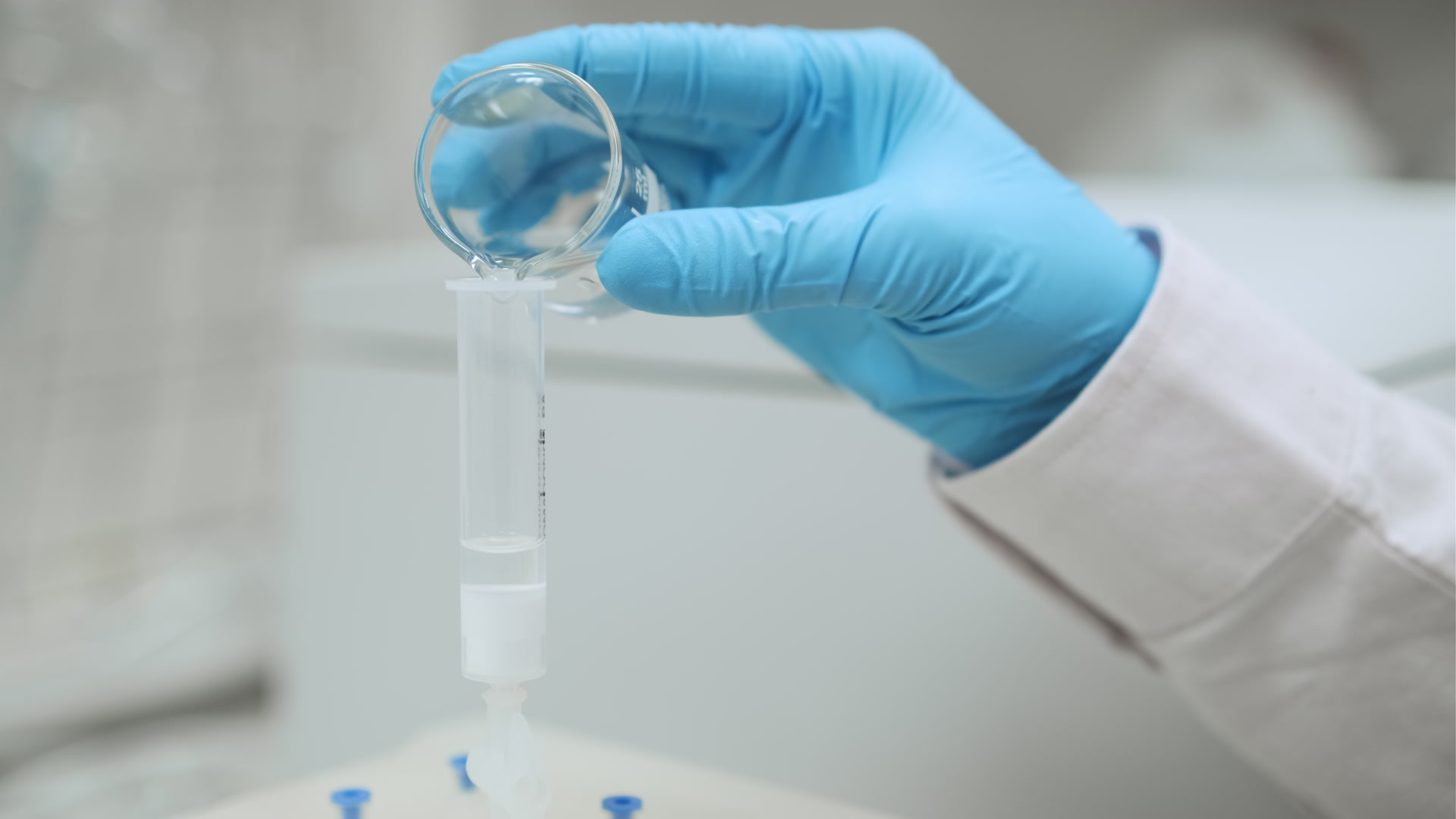
The next proposed comparison.
Sequence comparison with structural and application endpoints
A supplier discussion with a clear output
What would the supplier commission next?
An informative enquiry describes the target fraction, the current extraction route and the property that the present method fails to preserve. We could then scope a proposed sequence comparison and define its evidence outputs, partner requirements and stop criteria.
Potential value lies in selecting a process that a buyer can qualify, rather than announcing a new technology before it has been tested. The commercial route would begin with a paid decision package and move to a separately resourced study only where the hypothesis and material access are credible. No available process licence or laboratory capability is claimed.
Circular bioingredients · Proposed development discussion
A development path
for this research.
Which treatment sequence releases the target while preserving its required structure?
The people this could serve.Ingredient-process developers and qualified research laboratories.
The decision behind the project.
Your intended application, present alternative and the constraint behind “Extraction sequence”. A useful starting point is the change that would justify another development step.
A proposed scope centred on sequence comparison with structural and application endpoints.
Agree the comparison, acceptance basis and responsible expertise before discussing a paid package.
Specialist methods and a defined contribution.
Bring relevant analytical or experimental expertise, a comparator suggestion, and the conditions under which your method could resolve this question.
A jointly scoped proposal could connect your contribution with sequence comparison with structural and application endpoints.
Define contributions, required access, independent preparations and permitted outputs before work or protected information is shared.
The commercial purpose of the next milestone.
Bring the application or asset thesis, the buyer you expect to value it, and the scientific or commercial uncertainty that must be resolved before another commitment.
The proposed decision record would connect the buyer question with sequence comparison with structural and application endpoints. It would identify what a subsequent comparison needs to demonstrate.
Demand, development cost, resources, rights and a decision-changing milestone would need examination. No financing terms or investment outcome are represented here.
What a useful comparison
would record.
- Record source identity, treatment order, temperature and the declared process-energy basis.
- Account for recovered fractions and any change in preparation identity.
- Compare structure and the intended application endpoint under matched loading and conditions.
What the proposed
brief could leave behind.
- Sequence comparison with structural and application endpoints
- A preparation, comparator and endpoint record tied to this question.
- A source-linked account of the evidence gaps, study assumptions and next review point.
The proposed discussion brief
A brief you
can take away.
Use non-confidential notes to connect this topic with your own decision. Entries stay in this browser tab; saving creates a text file on your device. Nothing is submitted.
Paid process-decision brief and scoped partner-led experimental study
Notes are optional. The brief includes this page’s proposed question and public source links.
Proposed scope; resources, methods, rights and delivery terms would be agreed before work. Begin with non-confidential information.
Sources and reading notes.
External work is identified below. Access notes describe the material inspected for this page; company research questions and proposed work are not presented as findings from these sources.
Kabawa et al, 2026Kabawa et al. (2026). Unveiling synergy in ultrasound-assisted enzymatic extraction: Role of treatment sequence and biomass complexity. DOI: 10.1016/j.ultsonch.2026.107749.
The authors’ preparation, process conditions and reported measurements; application-specific limitations are discussed in the text.
Scope and limitations: This is an open access article under the CC BY license (http://creativecommons.org/licenses/by/4.0/). Article access is not material supply, process permission or patent clearance. Figures and raw data are not reproduced here.
Open original sourceCalcinai et al, 2022Calcinai et al. (2022). Effectiveness of enzymatic hydrolysis for reducing the allergenic potential of legume by-products. DOI: 10.1038/s41598-022-21296-z.
The authors’ preparation, process conditions and reported measurements; application-specific limitations are discussed in the text.
Scope and limitations: https://creativecommons.org/licenses/by/4.0/Open Access This article is licensed under a Creative Commons Attribution 4.0 International License, which permits use, sharing, adaptation, distribution and reproduction in any medium or format, as long as you give appropriate credit to the original author(s) and the source, provide a link to the Creative Commons licence, and indicate if changes were made. The images or other third party material in this article are included in the article's Creative Commons licence, unless indicated otherwise in a credit line to the material. If material is not included in the article's Creative Commons licence and your intended use is not permitted by statutory regulation or exceeds the permitted use, you will need to obtain permission directly from the copyright holder. To view a copy of this licence, visit http://creativecommons.org/licenses/by/4.0/. Article access is not material supply, process permission or patent clearance. Figures and raw data are not reproduced here.
Open original sourceLee et al, 2020Lee et al. (2020). Preparation and Application of Light-Colored Lignin Nanoparticles for Broad-Spectrum Sunscreens. DOI: 10.3390/polym12030699.
The authors’ preparation, process conditions and reported measurements; application-specific limitations are discussed in the text.
Scope and limitations: Licensee MDPI, Basel, Switzerland. This article is an open access article distributed under the terms and conditions of the Creative Commons Attribution (CC BY) license (http://creativecommons.org/licenses/by/4.0/). Article access is not material supply, process permission or patent clearance. Figures and raw data are not reproduced here.
Open original source