
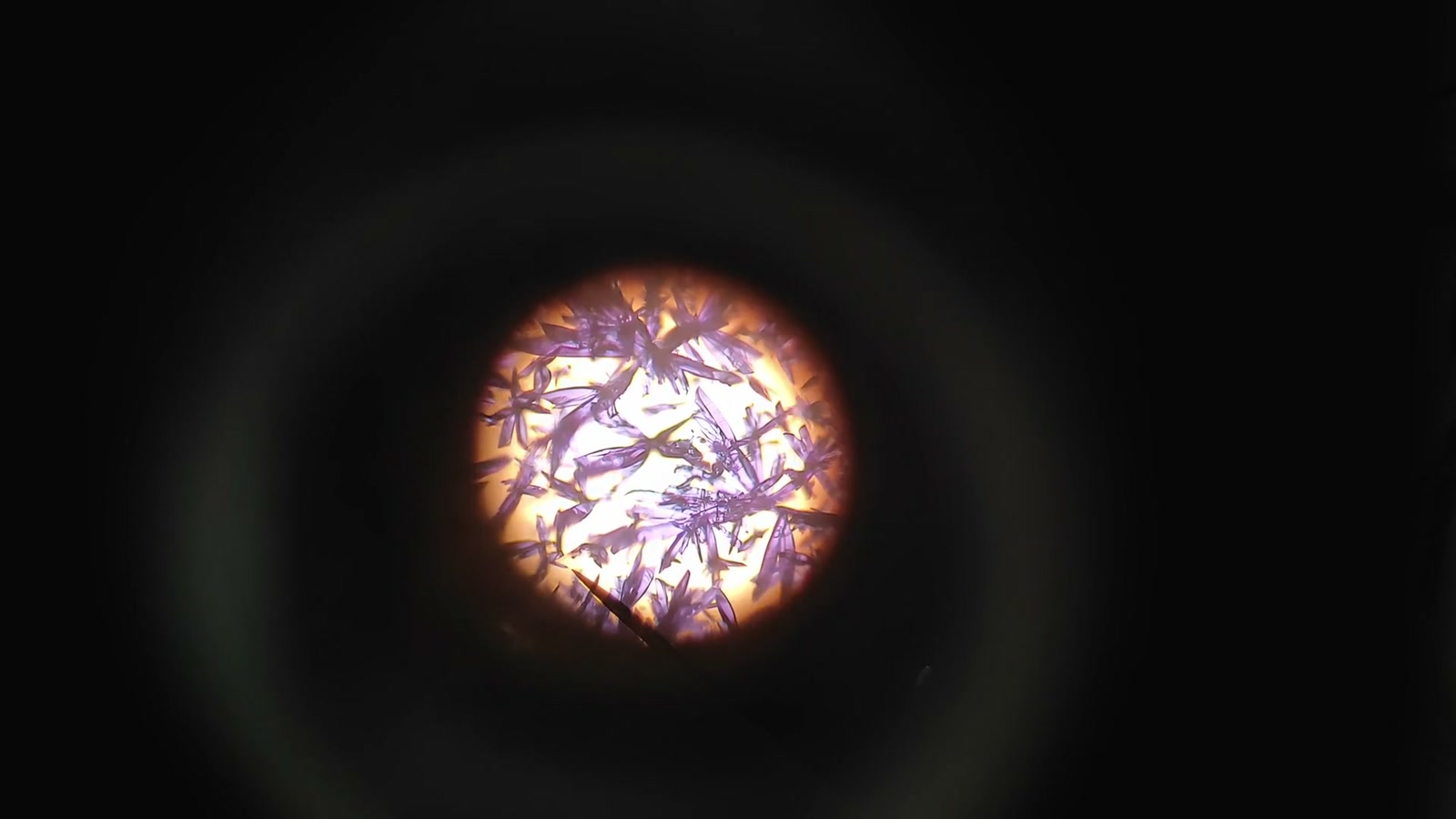
 Film credits
Light changes what a material means.
Which optical property would make a material more useful in one defined application?
Proposed optical-materials research direction | Study design, resources and permissions would be agreed before work.
Giving light a commercial job.
An optical programme begins with the action its evidence should change.
A formulation can have the right composition and still present the wrong appearance. A clear layer may become cloudy after application, a pearlescent finish may disappear under a different lamp, or a fluorescent research signal may be mistaken for a change in concentration. These are different development problems with different buyers. Our proposed optical-materials programme would begin with the decision behind the image: what must stay visible, what must remain stable and what evidence would let a team choose the next preparation. The intended application sets the question before an instrument or visual effect is selected.
Examine the development decision
Light changes what a material means.
Open the sequence to examine what a development decision needs.
Identify the exact preparation, its source, and the properties a second laboratory must be able to reproduce.
Explanatory geometry · no simulated or measured performance
Separate appearance from emission.
Reflection, transmission and emission answer different development questions.
This candidate programme extends beyond biochemical light. It would examine light passing through, reflecting from or changing a material, alongside laboratory reporters that require external excitation. A reflective finish does not produce its own light; a fluorescent probe is not a bioluminescent reaction. Keeping those mechanisms separate makes a brief more useful. For a packaging developer the important endpoint might be spectral transmission. For a formulation team it might be a retained finish after drying. For a research partner it might be whether emission can be read without disturbing the preparation being examined.
Start from methods you can inspect.
The proposed programme joins optical modelling, colorimetry and calibration traditions.
The source base connects three established measurement traditions. Germer’s SCATMECH documentation describes scattering and film models; CIE’s colorimetry record identifies observer and illumination context; DeRose’s guide record frames fluorescence calibration (Germer, n.d.; CIE, 2018; DeRose, 2008). They support the choice of a method, rather than evidence that Bio has produced an optical ingredient. Our programme question is where those methods can resolve a specific formulation uncertainty. A review would retain the actual material state, geometry and signal definition rather than borrowing an attractive result from an unrelated preparation.
A finish. A signal. A measurable difference.
Connect transmission, reflection, appearance and stability with a material or packaging question worth developing.
Account for the light you collect.
A declared collection boundary makes the optical comparison interpretable.
A useful comparison needs an explicit measurement boundary. Where appropriate, reflected, transmitted and absorbed fractions can be considered together, but an uncollected beam must not silently become absorption. The equation here is a starting energy balance for a non-emitting sample, not a complete fluorescent or turbid-film description. We would specify the wavelength interval, collection geometry, substrate contribution and sample thickness before calculating an endpoint. This gives the buyer something more precise than a claim of brightness: a record of the light entering, the light counted and the uncertainty in the difference.
Established optical energy accounting under the stated elastic, non-emitting and complete-collection assumptions; no Bio measurement is supplied.
- Absorptance1
- Total reflectance1
- Total transmittance1
Model conditions. Elastic, non-emitting measurement at one wavelength; all relevant reflected/transmitted power collected. Missing collection is not absorption.
Change the conditions · examine the reference
Follow the energy.
Separate reflection, through-path transmission and absorption in one defined optical path.
The data, equations and controls remain available below if 3D cannot load.
Defined model · illustrative conditions
Move a control to compare the selected condition with the defined reference curve.
Choose a measurement that can distinguish an interface effect from a change in the absorbing path.
The defined comparison
One interface at normal incidence, non-magnetic media with real refractive indices, n₁ = 1 and selected internal absorbance. Absorbed fraction is 1−R−T. No scattering, interference or multiple reflections. Absorbance and absorbed energy fraction are distinct quantities. This model does not calculate haze, gloss, colour, emission, SPF or human protection.
Inspect the calculated values
Calculation grid, not measured observations. Inputs and assumptions are stated above.
| Internal-path absorbance / dimensionless | Reflection | Transmission | Absorption |
|---|
Building around distinct work packages.
Separate work packages can share provenance without claiming one universal material.
The programme would separate four potential packages: appearance under relevant illumination, optical change after a declared exposure, measurement qualification for a reporter, and evidence transfer between instruments or organisations. Each could start with a small comparison against an established alternative. A failure to discriminate two samples would itself guide the next choice: improve the method, revise the material or stop that application. The packages would share provenance and reporting conventions without becoming a promise that one material can deliver clarity, protection, colour and sensing simultaneously. Capability should grow from a useful first result.
Making the comparison belong to the application.
A relevant loading and viewing condition give the comparator its purpose.
A supplier evaluating a transparent film needs a comparator at a meaningful deposited loading, while a luxury team considering a changing finish needs a viewing sequence that resembles its intended setting. We would ask the buyer to name the unacceptable change and the action it would trigger. A single photograph can establish an observation but cannot define spectral stability or repeatability. The proposed record would join visual context with measurements that answer the buying question. Where subjective appearance matters, an appropriately designed assessment would remain distinct from instrumental quantities and avoid claiming universal preference.
Return a decision, not an optical catalogue.
A versioned brief would connect observations with the next experiment.
An initial output could be a versioned optical brief containing the application boundary, source appraisal, comparator rationale, measurement model and proposed acceptance logic. A separately resourced study could then produce raw readings, corrected quantities, uncertainty and a concise recommendation about the next experiment. The public layer would explain the method and the question; preparations, enabling process details and confidential buyer constraints would need an agreed disclosure route. This is a proposed route to evidence, rather than an available laboratory service or an ingredient already qualified for cosmetic, clinical or protective use.

The next proposed comparison.
A proposed programme connecting appearance, exposure stability and qualified optical measurement.
The first funded question carefully.
The first commitment should fund an informative question, not an undefined effect.
The strongest first conversation would bring one surface or formulation, one optical problem and one decision owner. A scoped paid brief or qualified collaboration could be considered after access, expertise, rights and delivery capacity are established. That commercial route gives the programme a reason to exist: reducing uncertainty before a buyer commits to a larger development effort. We would favour work that can distinguish credible alternatives with a modest first check. A spectacular appearance that cannot be prepared repeatedly or compared honestly would remain a design reference, rather than the foundation of an investable material proposition.
Optical materials · Proposed development discussion
A development path
for this research.
Which optical property would make a material more useful in one defined application?
The people this could serve.Formulators, ingredient developers and luxury-material teams.
The decision behind the project.
Your intended application, present alternative and the constraint behind “Optical materials”. A useful starting point is the change that would justify another development step.
A proposed scope centred on a proposed programme connecting appearance, exposure stability and qualified optical measurement.
Agree the comparison, acceptance basis and responsible expertise before discussing a paid package.
Specialist methods and a defined contribution.
Bring relevant analytical or experimental expertise, a comparator suggestion, and the conditions under which your method could resolve this question.
A jointly scoped proposal could connect your contribution with a proposed programme connecting appearance, exposure stability and qualified optical measurement.
Define contributions, required access, independent preparations and permitted outputs before work or protected information is shared.
The commercial purpose of the next milestone.
Bring the application or asset thesis, the buyer you expect to value it, and the scientific or commercial uncertainty that must be resolved before another commitment.
The proposed decision record would connect the buyer question with a proposed programme connecting appearance, exposure stability and qualified optical measurement. It would identify what a subsequent comparison needs to demonstrate.
Demand, development cost, resources, rights and a decision-changing milestone would need examination. No financing terms or investment outcome are represented here.
What a useful comparison
would record.
- Record absorptance (1) with the preparation, method and conditions needed to interpret it.
- Record total reflectance (1) with the preparation, method and conditions needed to interpret it.
- Record total transmittance (1) with the preparation, method and conditions needed to interpret it.
What the proposed
brief could leave behind.
- A proposed programme connecting appearance, exposure stability and qualified optical measurement
- A preparation, comparator and endpoint record tied to this question.
- A source-linked account of the evidence gaps, study assumptions and next review point.
The proposed discussion brief
A brief you
can take away.
Use non-confidential notes to connect this topic with your own decision. Entries stay in this browser tab; saving creates a text file on your device. Nothing is submitted.
Discuss a scoped decision brief, qualified comparison study or versioned evidence package; delivery and fees require agreed resources and terms.
Notes are optional. The brief includes this page’s proposed question and public source links.
Proposed scope; resources, methods, rights and delivery terms would be agreed before work. Begin with non-confidential information.
Sources and reading notes.
External work is identified below. Access notes describe the material inspected for this page; company research questions and proposed work are not presented as findings from these sources.
Germer, n.d.Germer (n.d.). SCATMECH introduction
Measurement framing and source scope identified in the associated discussion; proposed Bio design choices remain proposals.
Scope and limitations: Official full documentation inspected; scattering, particle and film-model scope. Experimental software is not validation. Public-domain software notice inspected; no source figures copied.
Open original sourceCIE, 2018CIE (2018). Colorimetry, 4th edition
Measurement framing and source scope identified in the associated discussion; proposed Bio design choices remain proposals.
Scope and limitations: Official technical-report description inspected; observers, illuminants and viewing conditions. Full paid report and purchaser tables not acquired; no conformity claim.
Open original sourceDeRose, 2008DeRose (2008). Fluorescence instrument calibration and validation
Measurement framing and source scope identified in the associated discussion; proposed Bio design choices remain proposals.
Scope and limitations: NIST publication record and abstract inspected; spectral/wavelength calibration and performance verification. Full guide unavailable in this pass; no certification or detailed protocol inferred.
Open original sourceHanssen, 2001Hanssen (2001). Integrating-sphere measurement of transmittance, reflectance and absorptance
Measurement framing and source scope identified in the associated discussion; proposed Bio design choices remain proposals.
Scope and limitations: NIST publication abstract inspected; original infrared specular-sample investigation. No full-text reproduction, sample results or uncertainty transferred to cosmetic films.
Open original source
