
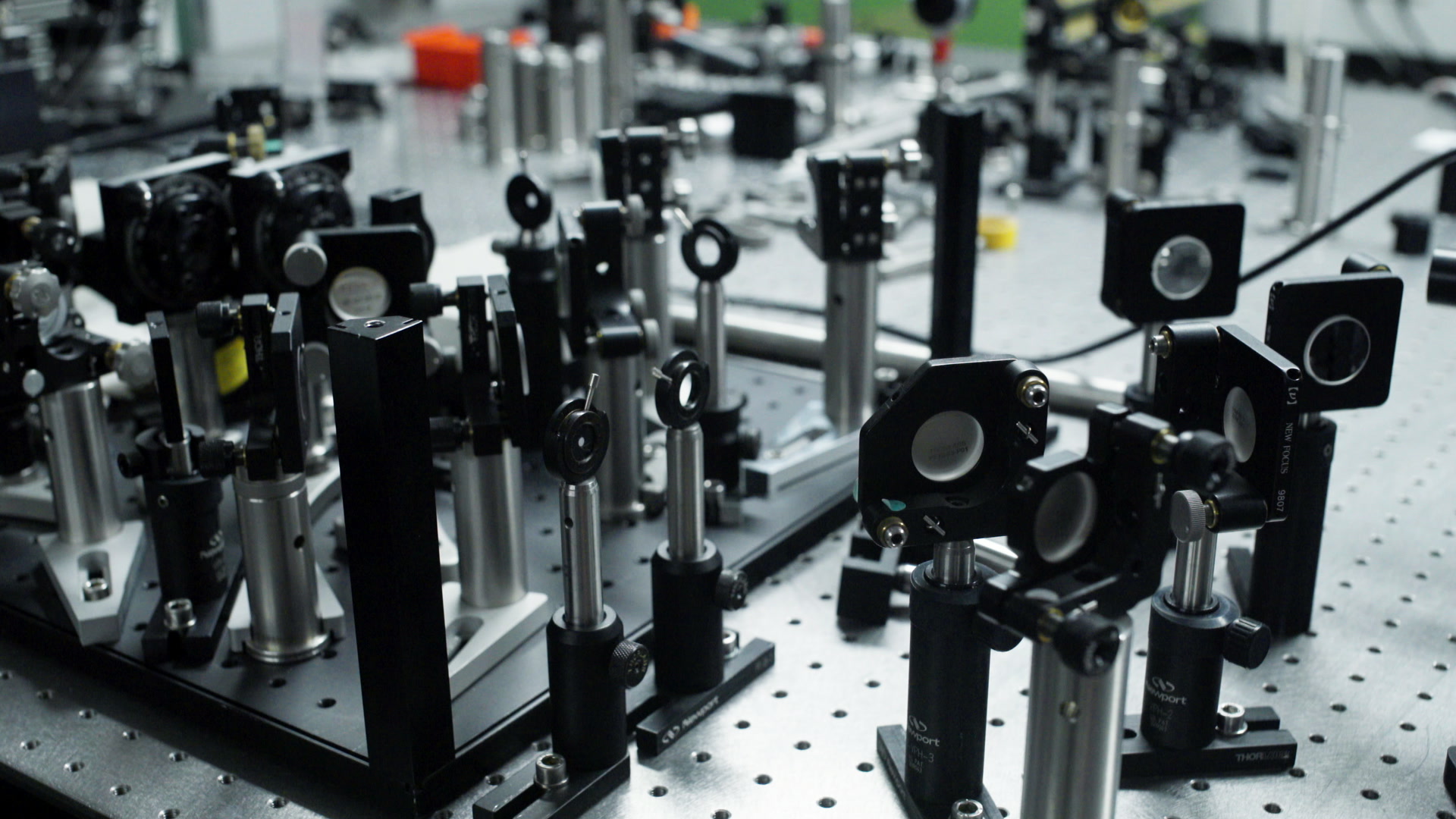
 Film credits
Does observing it change the answer?
How much signal change belongs to the observation schedule rather than the property being followed?
Proposed optical-materials research direction | Study design, resources and permissions would be agreed before work.
The reading can become the experiment.
Repeated reading can contribute exposure as well as information.
A time series may show a declining fluorescent signal while the material property being followed remains unchanged. Alternatively, both may change together. For a developer choosing a reporter, that distinction determines whether the readout is useful at all. Our proposed photobleaching and readout work would compare observation schedules alongside appropriate controls, asking how much change is introduced by collecting the data. The aim is not to find a universal stable dye. It is to establish a usable schedule for a defined preparation and decision, before the team commits to a larger experiment whose measurement could obscure its own result.
(DeRose, 2008) | (Fonin et al, 2014) | (Lankone et al, 2020)
Examine the development decision
Does observing it change the answer?
Open the sequence to examine what a development decision needs.
Identify the exact preparation, its source, and the properties a second laboratory must be able to reproduce.
Explanatory geometry · no simulated or measured performance
Record the exposure from every observation.
Record illumination accumulated during observation.
A repeated reading contributes illumination as well as information. We would retain excitation conditions, duration, intervals and the number of observations, including any focus or preview illumination that reaches the sample. Detector gain can change a displayed signal without changing emitted photons, so those settings belong in the record too. If a specimen moves between positions, the sampled region should be tracked where relevant. The proposed brief would distinguish elapsed experiment time from accumulated observation exposure. This gives a later reader a way to ask whether the apparent material trajectory could instead follow the way it was observed.
(DeRose, 2008) | (Fonin et al, 2014) | (Lankone et al, 2020)
Using sources for separate parts of the problem.
Calibration, optical interference and exposure design remain separate source roles.
DeRose’s guide record frames instrument performance, while Fonin and colleagues show why emission intensity needs optical interpretation (DeRose, 2008; Fonin et al., 2014). The NIST polymer report supplies a broader exposure-design warning about assuming response follows dose alone (Lankone et al., 2020). These records do not validate a photobleaching law for a Bio reporter. We use them to organise controls and avoid importing a mechanism from an unrelated material. A proposed study would qualify the specific reading conditions before a fading signal is used to infer transport, release or degradation.
(DeRose, 2008) | (Fonin et al, 2014) | (Lankone et al, 2020)
A finish. A signal. A measurable difference.
Connect transmission, reflection, appearance and stability with a material or packaging question worth developing.
Treat a decay descriptor as a descriptor.
A decay descriptor needs a justified form and a working window.
An empirical loss coefficient can summarise matched positive signals and radiant exposure under an explicitly chosen first-order assumption. The displayed relationship would not become a universal photochemical rate or a guarantee of future brightness. We would examine whether the curve supports the assumed form and retain deviations rather than force them into the fit. A specimen with changing background, optical density or geometry may need a different explanation. The useful output is a transparent description of the readout’s operating window, including when the descriptor fails, so that the buyer can decide whether to alter the reporter or the observation schedule.
(DeRose, 2008) | (Fonin et al, 2014) | (Lankone et al, 2020)
A conditional first-order empirical dose-loss descriptor; fitting this form would not establish a universal photobleaching mechanism.
- Empirical dose-loss descriptorm^2 J^{-1}
- Background-corrected signal after exposurecounts s^{-1}
- Initial corrected signalcounts s^{-1}
- Radiant exposureJ m^{-2}
Model conditions. Positive matched signals; first-order descriptor is a candidate fit, not a universal mechanism or validated lifetime.
Compare frequent and sparse observation.
Sparse and frequent reading can test observation-associated change.
One informative design could compare otherwise matched specimens read often, read sparingly and measured only at the endpoint. Preparation and storage conditions would need to be aligned, with any unavoidable difference stated. This can help expose a measurement-associated effect without requiring a large mechanistic programme. A reference signal could also reveal instrument drift where suitable. Repeated readings of one specimen should not be counted as independent preparations. The proposed design would allocate effort according to the question: enough evidence to choose a schedule, before collecting a dense time series that merely amplifies the same unresolved interference.
(DeRose, 2008) | (Fonin et al, 2014) | (Lankone et al, 2020)
Whether recovery changes the interpretation?
An intermittent response needs a conditional interpretation.
A signal observed after a dark interval may differ from one read continuously, but recovery alone does not identify its cause. We would treat such a comparison as a diagnostic observation and examine other contributors such as background, temperature and specimen movement. If the application requires intermittent activation, an intermittent schedule may be the relevant study rather than an artificial continuous challenge. If it requires one terminal reading, repeated illumination may be unnecessary. The commercial choice is the readout that preserves enough interpretable information for the buyer’s endpoint, not the method that produces the longest or most visually dramatic sequence.
(DeRose, 2008) | (Fonin et al, 2014) | (Lankone et al, 2020)
Return a usable observation budget.
A usable schedule is more valuable than an unexplained trajectory.
The proposed package would state the qualified reading schedule, signal and background behaviour, preparation variability and the conditions where interpretation becomes unreliable. It could recommend a maximum candidate observation exposure for further qualification, clearly separated from a guaranteed limit or formal validation. Raw spectra and settings would allow review by another team. A development note would explain whether the next step is a less disruptive schedule, a different reporter or an orthogonal method. Public content would describe the research problem, while any enabling preparation details or confidential application constraints would follow an agreed disclosure route.
(DeRose, 2008) | (Fonin et al, 2014) | (Lankone et al, 2020)

The next proposed comparison.
A proposed readout-budget study separating measurement exposure from material time dependence.
The time series you need.
The required time resolution defines the commercial readout question.
A partner should describe the required duration, temporal resolution and material property, together with the present reporter and reading arrangement. We could consider a scoped method-design brief and, where justified, a separately resourced schedule comparison. Facilities, permissions and delivery would need agreement before work. The proposed commercial value is avoiding a misleading trajectory and making a larger study more interpretable. A credible first milestone is a schedule whose observation effect is measured within the chosen preparation, rather than an unexplained fluorescence animation that appears to show material performance while concealing the exposure used to produce each frame.
(DeRose, 2008) | (Fonin et al, 2014) | (Lankone et al, 2020)
Optical materials · Proposed development discussion
A development path
for this research.
How much signal change belongs to the observation schedule rather than the property being followed?
The people this could serve.Researchers planning time-resolved fluorescent material studies.
The decision behind the project.
Your intended application, present alternative and the constraint behind “Photobleaching and readout schedules”. A useful starting point is the change that would justify another development step.
A proposed scope centred on a proposed readout-budget study separating measurement exposure from material time dependence.
Agree the comparison, acceptance basis and responsible expertise before discussing a paid package.
Specialist methods and a defined contribution.
Bring relevant analytical or experimental expertise, a comparator suggestion, and the conditions under which your method could resolve this question.
A jointly scoped proposal could connect your contribution with a proposed readout-budget study separating measurement exposure from material time dependence.
Define contributions, required access, independent preparations and permitted outputs before work or protected information is shared.
The commercial purpose of the next milestone.
Bring the application or asset thesis, the buyer you expect to value it, and the scientific or commercial uncertainty that must be resolved before another commitment.
The proposed decision record would connect the buyer question with a proposed readout-budget study separating measurement exposure from material time dependence. It would identify what a subsequent comparison needs to demonstrate.
Demand, development cost, resources, rights and a decision-changing milestone would need examination. No financing terms or investment outcome are represented here.
What a useful comparison
would record.
- Record empirical dose-loss descriptor (m^2 J^{-1}) with the preparation, method and conditions needed to interpret it.
- Record background-corrected signal after exposure (counts s^{-1}) with the preparation, method and conditions needed to interpret it.
- Record initial corrected signal (counts s^{-1}) with the preparation, method and conditions needed to interpret it.
What the proposed
brief could leave behind.
- A proposed readout-budget study separating measurement exposure from material time dependence
- A preparation, comparator and endpoint record tied to this question.
- A source-linked account of the evidence gaps, study assumptions and next review point.
The proposed discussion brief
A brief you
can take away.
Use non-confidential notes to connect this topic with your own decision. Entries stay in this browser tab; saving creates a text file on your device. Nothing is submitted.
Discuss a scoped decision brief, qualified comparison study or versioned evidence package; delivery and fees require agreed resources and terms.
Notes are optional. The brief includes this page’s proposed question and public source links.
Proposed scope; resources, methods, rights and delivery terms would be agreed before work. Begin with non-confidential information.
Sources and reading notes.
External work is identified below. Access notes describe the material inspected for this page; company research questions and proposed work are not presented as findings from these sources.
DeRose, 2008DeRose (2008). Fluorescence instrument calibration and validation
Measurement framing and source scope identified in the associated discussion; proposed Bio design choices remain proposals.
Scope and limitations: NIST publication record and abstract inspected; spectral/wavelength calibration and performance verification. Full guide unavailable in this pass; no certification or detailed protocol inferred.
Open original sourceFonin et al, 2014Fonin et al. (2014). Fluorescence of dyes in solutions with high absorbance
Measurement framing and source scope identified in the associated discussion; proposed Bio design choices remain proposals.
Scope and limitations: Full primary paper inspected; NATA/ATTO-425 preparations, geometry-specific inner-filter analysis. CC BY attribution notice inspected. No instrument-independent correction or film mechanism claimed.
Open original sourceLankone et al, 2020Lankone et al. (2020). Polymer Surface/Interface Consortium 2018 workshop report
Measurement framing and source scope identified in the associated discussion; proposed Bio design choices remain proposals.
Scope and limitations: Official full report inspected, especially sections3.1–3.5 and figure3-2: exposure, reciprocity and uncertainty context. Workshop material is not a cosmetic efficacy study; source figure not reproduced.
Open original source
