
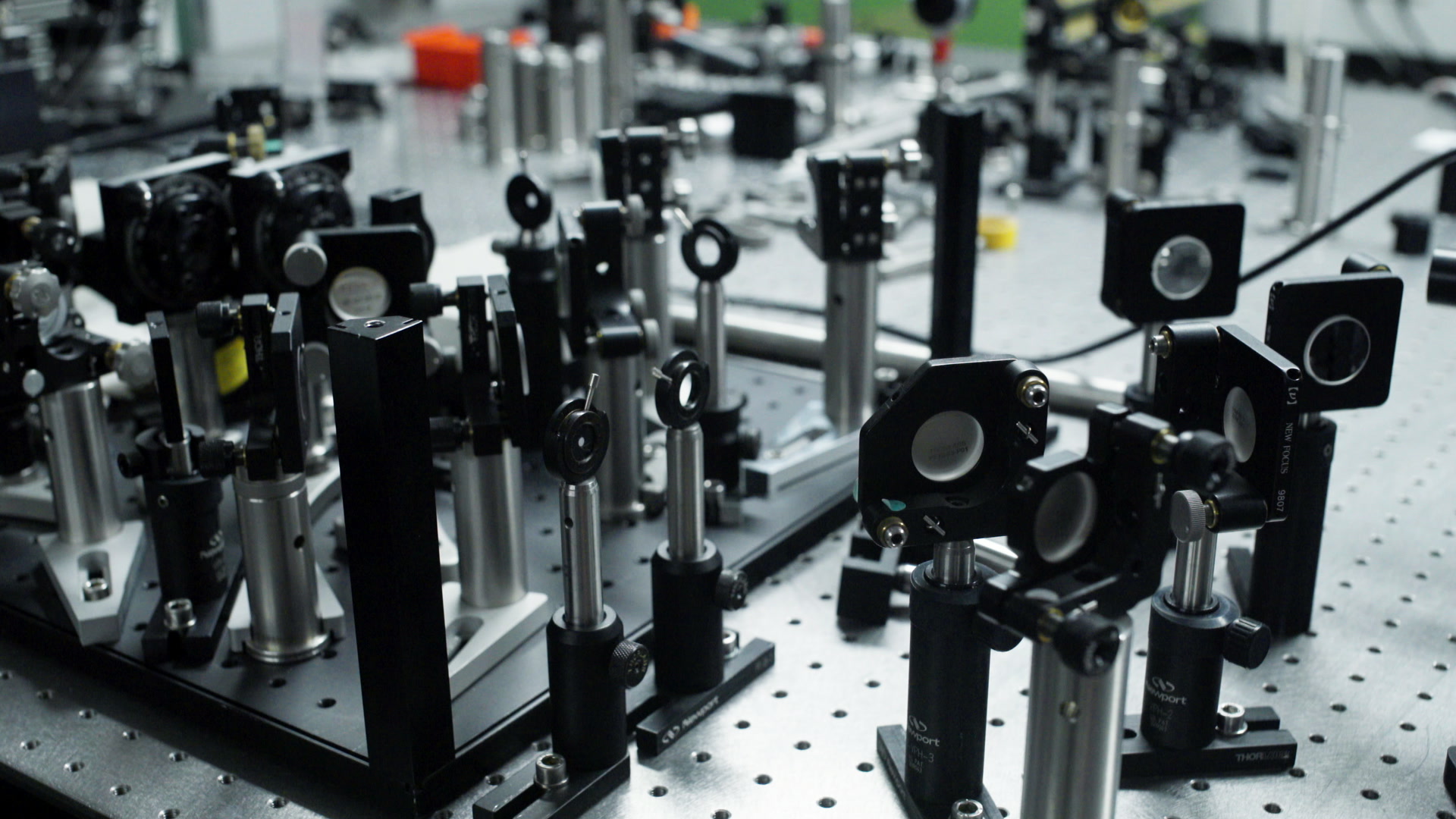
 Film credits
The same light. A different surrounding.
Does atmosphere alter the light-associated response enough to change the application or study design?
Proposed optical-materials research direction | Study design, resources and permissions would be agreed before work.
A material does not meet light alone.
Atmosphere is a candidate factor within a defined light-response study.
An optical preparation operates within an atmosphere, a support and a physical state. If a developer compares light-exposed samples without documenting those surroundings, a difference may be assigned to the wrong factor. Our proposed atmosphere study would ask whether changing the surrounding oxygen condition changes the response relevant to a buyer’s application. It would remain a controlled materials question rather than a claim of a protective ingredient or a specific photochemical mechanism. The useful decision is whether the next study must control atmosphere, whether packaging deserves attention or whether that factor is unimportant within the tested boundary.
(Lankone et al, 2020) | (DeRose, 2008) | (NIST/SEMATECH, n.d.)
Examine the development decision
The same light. A different surrounding.
Open the sequence to examine what a development decision needs.
Identify the exact preparation, its source, and the properties a second laboratory must be able to reproduce.
Explanatory geometry · no simulated or measured performance
Making atmosphere a measured factor.
Establish and check the environment at the specimen.
A nominally sealed vessel is not a known oxygen condition. We would specify how the environment is established, how it is checked and which parts of the specimen can equilibrate with it. Temperature, humidity, vessel transmission and headspace geometry may also change when the environment changes. Those differences need to be considered before treating atmosphere as the only perturbation. The planned brief would identify the atmosphere at the specimen, not just the gas named in a protocol. For a deposited layer, the support and accessible faces would be recorded because the surrounding boundary belongs to the physical system.
(Lankone et al, 2020) | (DeRose, 2008) | (NIST/SEMATECH, n.d.)
Using exposure and calibration references separately.
The proposed effect remains a hypothesis until a relevant comparison exists.
The NIST polymer report connects exposure design with environmental conditions and interpretation limits (Lankone et al., 2020). DeRose’s guide record provides fluorescence instrument context where an emissive endpoint is selected (DeRose, 2008). NIST’s uncertainty guidance frames propagated inputs and covariance (NIST/SEMATECH, n.d.). These sources support the measurement design; they do not establish atmosphere sensitivity for the proposed preparation. We would formulate the atmosphere effect as a hypothesis to be tested. An observed optical difference would be reported with competing explanations rather than described as proof of an oxygen-mediated mechanism before suitable evidence exists.
(Lankone et al, 2020) | (DeRose, 2008) | (NIST/SEMATECH, n.d.)
A finish. A signal. A measurable difference.
Connect transmission, reflection, appearance and stability with a material or packaging question worth developing.
Defining the interaction the buyer needs.
A factorial contrast describes interaction without identifying a reaction pathway.
The displayed contrast asks whether the difference between light and dark conditions changes when the atmosphere changes. It is a proposed factorial comparison derived from the chosen study design. Its endpoint could be a spectral change or a qualified emission quantity, with units specified before analysis. The contrast is not a molecular model and cannot identify a reaction pathway by itself. We would retain the component readings so that a net interaction does not hide opposite changes in different conditions. Preparation and measurement uncertainty must accompany it, particularly when the relevant differences are small.
(Lankone et al, 2020) | (DeRose, 2008) | (NIST/SEMATECH, n.d.)
Author-proposed factorial interaction contrast; it tests a difference between matched light effects rather than identifying a chemical pathway.
- Difference of matched light effectsunit of Y
- Declared optical endpointspecified per study
Model conditions. Factorial comparison with matched preparation, temperature and exposure; low oxygen must be measured. This derived contrast describes interaction, not a mechanism.
Controls that expose the boundary.
Controls should expose the differences introduced with the atmosphere.
A matched dark condition in each atmosphere can help distinguish light-associated change from storage or handling effects. If altering atmosphere also changes temperature or moisture, the design should address that difference or narrow the interpretation accordingly. The first study could focus on one candidate and a relevant alternative, rather than a broad screen whose atmosphere records are weak. Independent preparations would be allocated where they can reveal whether the effect can be made again. A strong control is one that tests the proposed explanation, not simply another sample added to make the study appear comprehensive.
(Lankone et al, 2020) | (DeRose, 2008) | (NIST/SEMATECH, n.d.)
Connecting the condition to the actual application.
An extreme condition must still have a reason to inform development.
A formulation stored in a closed package and a layer exposed on an open surface present different development questions. The buyer should identify which boundary matters and whether the tested atmosphere resembles it. An extreme low-oxygen comparison may be useful mechanistically while remaining commercially irrelevant if the application cannot maintain that condition. We would distinguish those purposes in the proposal. If atmosphere changes the ranking of candidates, that can inform a packaging or process discussion. If the ranking is stable, the team may be able to simplify a later study, provided the tested window covers the intended use.
(Lankone et al, 2020) | (DeRose, 2008) | (NIST/SEMATECH, n.d.)
Deliver an environmental decision record.
Join environmental records with the declared optical endpoint.
The proposed output would join measured atmosphere, exposure history, specimen preparation and the declared optical endpoint. It would describe whether the evidence supports an interaction within the tested conditions, without claiming a universal material mechanism or a lifetime benefit. A recommendation could identify the next discriminating check, an application boundary or a reason to stop controlling a factor that does not affect the decision. Such a record can support a qualified partner study or packaging brief. It does not establish a Bio laboratory, an existing atmosphere-sensitive technology or a supply-ready ingredient.
(Lankone et al, 2020) | (DeRose, 2008) | (NIST/SEMATECH, n.d.)

The next proposed comparison.
A proposed exposure–atmosphere comparison with measured conditions and defined interaction.
The surrounding as well as the sample.
The first discussion should specify the surrounding encountered in use.
A useful initial enquiry describes where the material is used, how it is illuminated and whether its surroundings are controlled in practice. Existing storage and optical records can help determine whether an atmosphere comparison is worth scoping. Resources, suitable measurement access and sample rights would be agreed before work, with confidential preparations disclosed through an appropriate route. The potential commercial value lies in avoiding a misplaced formulation change or specifying a condition that makes a material usable. The first milestone is a reproducible, interpretable environmental comparison that changes a real development choice rather than a dramatic light experiment detached from the buyer’s application.
(Lankone et al, 2020) | (DeRose, 2008) | (NIST/SEMATECH, n.d.)
Optical materials · Proposed development discussion
A development path
for this research.
Does atmosphere alter the light-associated response enough to change the application or study design?
The people this could serve.Material teams assessing atmosphere-sensitive optical change.
The decision behind the project.
Your intended application, present alternative and the constraint behind “Atmosphere and light response”. A useful starting point is the change that would justify another development step.
A proposed scope centred on a proposed exposure–atmosphere comparison with measured conditions and defined interaction.
Agree the comparison, acceptance basis and responsible expertise before discussing a paid package.
Specialist methods and a defined contribution.
Bring relevant analytical or experimental expertise, a comparator suggestion, and the conditions under which your method could resolve this question.
A jointly scoped proposal could connect your contribution with a proposed exposure–atmosphere comparison with measured conditions and defined interaction.
Define contributions, required access, independent preparations and permitted outputs before work or protected information is shared.
The commercial purpose of the next milestone.
Bring the application or asset thesis, the buyer you expect to value it, and the scientific or commercial uncertainty that must be resolved before another commitment.
The proposed decision record would connect the buyer question with a proposed exposure–atmosphere comparison with measured conditions and defined interaction. It would identify what a subsequent comparison needs to demonstrate.
Demand, development cost, resources, rights and a decision-changing milestone would need examination. No financing terms or investment outcome are represented here.
What a useful comparison
would record.
- Record difference of matched light effects (unit of Y) with the preparation, method and conditions needed to interpret it.
- Record declared optical endpoint (specified per study) with the preparation, method and conditions needed to interpret it.
- Record the wavelength range, substrate, layer loading and measurement geometry.
What the proposed
brief could leave behind.
- A proposed exposure–atmosphere comparison with measured conditions and defined interaction
- A preparation, comparator and endpoint record tied to this question.
- A source-linked account of the evidence gaps, study assumptions and next review point.
The proposed discussion brief
A brief you
can take away.
Use non-confidential notes to connect this topic with your own decision. Entries stay in this browser tab; saving creates a text file on your device. Nothing is submitted.
Discuss a scoped decision brief, qualified comparison study or versioned evidence package; delivery and fees require agreed resources and terms.
Notes are optional. The brief includes this page’s proposed question and public source links.
Proposed scope; resources, methods, rights and delivery terms would be agreed before work. Begin with non-confidential information.
Sources and reading notes.
External work is identified below. Access notes describe the material inspected for this page; company research questions and proposed work are not presented as findings from these sources.
Lankone et al, 2020Lankone et al. (2020). Polymer Surface/Interface Consortium 2018 workshop report
Measurement framing and source scope identified in the associated discussion; proposed Bio design choices remain proposals.
Scope and limitations: Official full report inspected, especially sections3.1–3.5 and figure3-2: exposure, reciprocity and uncertainty context. Workshop material is not a cosmetic efficacy study; source figure not reproduced.
Open original sourceDeRose, 2008DeRose (2008). Fluorescence instrument calibration and validation
Measurement framing and source scope identified in the associated discussion; proposed Bio design choices remain proposals.
Scope and limitations: NIST publication record and abstract inspected; spectral/wavelength calibration and performance verification. Full guide unavailable in this pass; no certification or detailed protocol inferred.
Open original sourceNIST/SEMATECH, n.d.NIST/SEMATECH (n.d.). Uncertainty budgets and sensitivity coefficients
Measurement framing and source scope identified in the associated discussion; proposed Bio design choices remain proposals.
Scope and limitations: Official statistical handbook page inspected; propagation and sensitivity coefficients. Independence/covariance and sample design still need justification.
Open original source
