
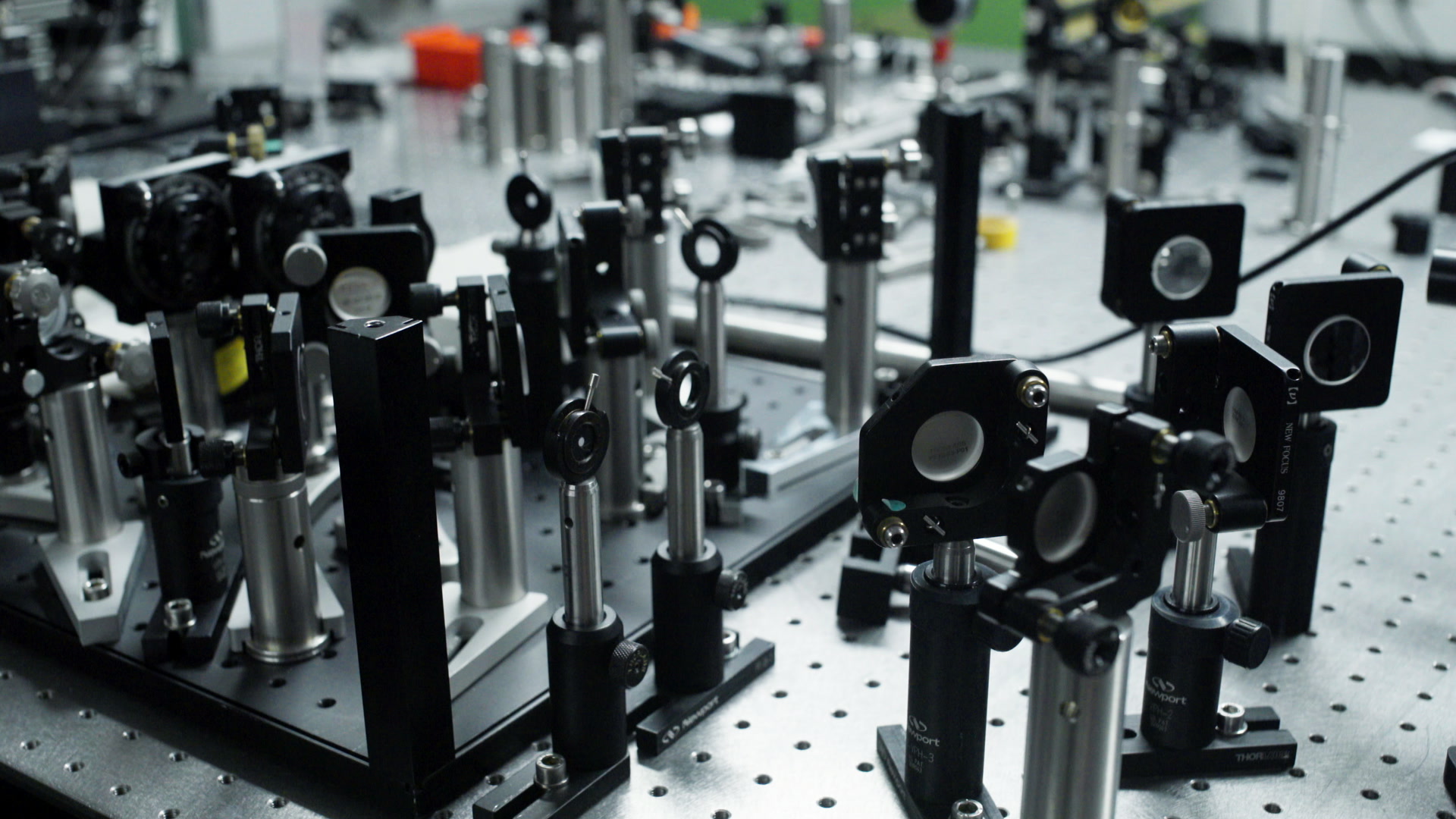
 Film credits
Water changes the optical boundary.
Does a change in hydration alter the interface or appearance enough to change the relevant test state?
Proposed optical-materials research direction | Study design, resources and permissions would be agreed before work.
The wet sample may answer the wrong question.
The relevant conditioned state should define the optical comparison.
A preparation can look clear while wet and develop a different appearance as its water state changes. For an applied-film developer, the useful decision is which conditioned state should define the formulation comparison. Our proposed hydration–appearance work would connect that choice with a defined optical endpoint. It would not assign every change to refractive index or claim water control from a visual effect. The aim is to establish when the layer should be read, what state it has reached and whether its observed appearance supports the next application study at a loading the buyer can use.
Examine the development decision
Water changes the optical boundary.
Open the sequence to examine what a development decision needs.
Identify the exact preparation, its source, and the properties a second laboratory must be able to reproduce.
Explanatory geometry · no simulated or measured performance
Separate interface and structure changes.
Hydration can change several specimen properties at once.
A hydration change can alter more than the medium surrounding a component. The specimen may change thickness, surface shape or internal structure, and those contributors need to remain distinguishable in the proposed interpretation. We would define whether the sample is a liquid preparation, a supported layer or a conditioned film. Its environment and conditioning interval would be recorded rather than reduced to a wet or dry label. A simple interface model can help frame one hypothesis, but it cannot identify the actual cause of a cloudy or reflective appearance without appropriate specimen evidence and a comparison designed to test that explanation.
Using film modelling as a guide to questions.
Film models guide the next measurement, not an unmeasured index assignment.
NIST’s pySCATMECH tutorial explicitly separates optical constants and film thickness as model inputs (NIST, n.d.). CIE’s report record identifies the viewing context of a colour comparison, while NIST’s uncertainty guidance frames measured inputs (CIE, 2018; NIST/SEMATECH, n.d.). We would use these inspected sources to design a hydration comparison without assigning unmeasured optical constants to a Bio material. The modelling question is which plausible input change could matter enough to justify a measurement. It is not whether a visually appealing curve can be generated from assumptions that nobody has established for the preparation.
A finish. A signal. A measurable difference.
Connect transmission, reflection, appearance and stability with a material or packaging question worth developing.
Expose the limits of the ideal interface.
An ideal interface is different from a complete real-film response.
The displayed Fresnel relationship describes an ideal, planar, lossless interface at normal incidence. It is useful for understanding why an index boundary can affect reflection, but it is not the complete response of a scattering or absorbing film. We would state those assumptions with any illustration and use consistent wavelength-specific indices where a calculation is warranted. If thickness and multiple interfaces matter, the model must expand appropriately. A calculated interface reflection should not be compared directly with an instrument’s integrated signal unless the measurement boundary is compatible. That keeps an explanatory equation from becoming an unsupported performance prediction.
Established normal-incidence Fresnel relation for an ideal lossless planar interface; not a complete real-film prediction.
- Interface reflectance1
- Refractive index of first medium1
- Refractive index of second medium1
Model conditions. Ideal planar lossless isotropic interface at normal incidence; not a full absorbing/scattering film model.
Change the conditions · examine the reference
A small layer can move the spectrum.
Change a coating’s thickness and refractive index. Inspect a full calculated reflectance spectrum, rather than infer performance from a colour.
The data, equations and controls remain available below if 3D cannot load.
Defined model · illustrative conditions
The guide marks the 550 nm probe. Changing thickness or index changes the spectrum; the three outputs use exact probe wavelengths.
Specify the coating, substrate and measurement geometry that deserve a reproducible optical comparison.
The defined comparison
One coherent flat nonabsorbing layer at normal incidence; n₀ = 1 and semi-infinite substrate nₛ = 1.5. Real indices are assumed constant with wavelength. No roughness, thickness distribution, angular spread, absorption or diffuse scattering. The three schematic beams represent 450, 550 and 650 nm probes; their display colours do not predict perceived coating colour, SPF or human protection. rᵢⱼ = (nᵢ − nⱼ)/(nᵢ + nⱼ). Layer separation is magnified for inspection.
Inspect the calculated values
Calculation grid, not measured observations. Inputs and assumptions are stated above.
| Vacuum wavelength / nm | Single-layer coherent reflectance |
|---|
Condition specimens with a decision in mind.
Condition specimens with the intended decision and handling sequence in view.
The study could compare specified conditioning states of the same preparation, alongside an established alternative prepared on the same support. We would record the relevant mass, thickness or other state indicator where it helps distinguish the hypotheses. Repeated readings should not replace independent preparations when the buyer needs reproducibility. Handling between conditioning and observation may change the specimen, so the sequence needs to be defined. The first check could be deliberately small: determine whether the chosen optical endpoint has stabilised enough to support a later comparison. It need not become a comprehensive moisture-transport study unless that additional question changes the application decision.
Connecting appearance to the state encountered in use.
The application determines when appearance needs to be judged.
A buyer should identify whether the layer is judged immediately after application, after a specified interval or under repeated environmental changes. Those situations can require different comparisons. We would not choose the clearest state simply because it improves the public image. The relevant state is the one that influences the use or specification. If appearance changes strongly before stabilising, that trajectory may be commercially important even when the final value is acceptable. If the differences remain within uncertainty, another material property may deserve attention first. The proposed design would let that application logic decide which optical observations are worth collecting.
Return a state-qualified optical comparison.
A state-qualified result preserves competing physical explanations.
The proposed package would join preparation, conditioning, state indicators and optical readings with the model assumptions used to interpret them. It would identify where an interface explanation remains plausible and where additional structure or thickness evidence is needed. A decision note could recommend the test state for a later formulation comparison or propose a discriminating measurement. No hydration performance, controlled release or consumer benefit would be inferred from appearance alone. This creates a useful collaboration route between formulation and optical expertise, subject to access and resources, rather than suggesting a finished Bio film whose wet and dry behaviour is already known.

The next proposed comparison.
A proposed hydration–appearance study distinguishing interface models from measured film behaviour.
The time and state that matter.
Bring the interval and material state that matter to use.
A partner can start with the preparation, intended application interval and observed change, including any conditioning or mass records it already holds. We could consider a scoped brief to define a state-qualified comparison before a larger experimental programme. Sample permissions, expertise and delivery capacity would need agreement. The potential value is choosing the right material state for a buying or development decision and avoiding a false comparison between layers that have not reached equivalent conditions. The first milestone is an interpretable state record and optical endpoint, not a generic statement that water changes appearance or a model presented as an observed Bio result.
Optical materials · Proposed development discussion
A development path
for this research.
Does a change in hydration alter the interface or appearance enough to change the relevant test state?
The people this could serve.Formulators and film researchers comparing wet and conditioned layers.
The decision behind the project.
Your intended application, present alternative and the constraint behind “Hydration and interface reflection”. A useful starting point is the change that would justify another development step.
A proposed scope centred on a proposed hydration–appearance study distinguishing interface models from measured film behaviour.
Agree the comparison, acceptance basis and responsible expertise before discussing a paid package.
Specialist methods and a defined contribution.
Bring relevant analytical or experimental expertise, a comparator suggestion, and the conditions under which your method could resolve this question.
A jointly scoped proposal could connect your contribution with a proposed hydration–appearance study distinguishing interface models from measured film behaviour.
Define contributions, required access, independent preparations and permitted outputs before work or protected information is shared.
The commercial purpose of the next milestone.
Bring the application or asset thesis, the buyer you expect to value it, and the scientific or commercial uncertainty that must be resolved before another commitment.
The proposed decision record would connect the buyer question with a proposed hydration–appearance study distinguishing interface models from measured film behaviour. It would identify what a subsequent comparison needs to demonstrate.
Demand, development cost, resources, rights and a decision-changing milestone would need examination. No financing terms or investment outcome are represented here.
What a useful comparison
would record.
- Declare wavelength, angle, substrate and collection geometry before comparing the samples.
- Record the relevant transmitted, reflected, diffuse or absorbed component on a common basis.
- Retain loading, thickness and a matched reference rather than infer mechanism from visual appearance.
What the proposed
brief could leave behind.
- A proposed hydration–appearance study distinguishing interface models from measured film behaviour
- A preparation, comparator and endpoint record tied to this question.
- A source-linked account of the evidence gaps, study assumptions and next review point.
The proposed discussion brief
A brief you
can take away.
Use non-confidential notes to connect this topic with your own decision. Entries stay in this browser tab; saving creates a text file on your device. Nothing is submitted.
Discuss a scoped decision brief, qualified comparison study or versioned evidence package; delivery and fees require agreed resources and terms.
Notes are optional. The brief includes this page’s proposed question and public source links.
Proposed scope; resources, methods, rights and delivery terms would be agreed before work. Begin with non-confidential information.
Sources and reading notes.
External work is identified below. Access notes describe the material inspected for this page; company research questions and proposed work are not presented as findings from these sources.
NIST/SEMATECH, n.d.NIST (n.d.). Using the pySCATMECH Fresnel module
Measurement framing and source scope identified in the associated discussion; proposed Bio design choices remain proposals.
Scope and limitations: Official tutorial inspected; optical constants, thickness and film stacks. Specified planar models, not a Bio film measurement. No notebook images reproduced.
Open original sourceCIE, 2018CIE (2018). Colorimetry, 4th edition
Measurement framing and source scope identified in the associated discussion; proposed Bio design choices remain proposals.
Scope and limitations: Official technical-report description inspected; observers, illuminants and viewing conditions. Full paid report and purchaser tables not acquired; no conformity claim.
Open original sourceNIST/SEMATECH, n.d.NIST/SEMATECH (n.d.). Uncertainty budgets and sensitivity coefficients
Measurement framing and source scope identified in the associated discussion; proposed Bio design choices remain proposals.
Scope and limitations: Official statistical handbook page inspected; propagation and sensitivity coefficients. Independence/covariance and sample design still need justification.
Open original source
