
 Film credits
The portion must represent the question.
How much analytical uncertainty comes from the material sampled rather than the instrument?
Proposed research direction. External studies are attributed; no original VARUNÉ Bio analytical results or validated assay are claimed.
Sampling can dominate the answer
Sampling can dominate the answer.
A precise detector measures the submitted portion, not an entire batch by magic. If the material is heterogeneous, different portions may contain different amounts or states of the marker. The proposed question is how much uncertainty comes from sampling and preparation before the instrument makes a reading. This matters to a customer interpreting a lot comparison, and to an assay developer evaluating a complex food matrix. The useful first decision is whether the sampling design represents the intended question well enough to justify further detector optimisation or a claimed difference between materials.
Examine the development decision
The portion must represent the question.
Open the sequence to examine what a development decision needs.
Identify the exact preparation, its source, and the properties a second laboratory must be able to reproduce.
Explanatory geometry · no simulated or measured performance
Specify the population of interest
Specify the population of interest.
A research scope should say whether it concerns one homogenised laboratory preparation, multiple portions from one product, several production lots or a broader class of matrices. Those populations support different conclusions. Pilolli et al. (2023; issue 2024) use characterised chocolate material and distinguish sample preparations from instrumental repeats. Monaci et al. (2020) examine incurred cookie materials. These examples motivate a documented sampling basis; they do not establish homogeneity of a new Bio or customer sample. A named population is essential before a result can be used to justify a specification or broader development decision.
Keeping the hierarchy visible
Keep the hierarchy visible.
The illustrative variance decomposition separates between-lot, between-preparation and repeated-reading components under explicit random-effects assumptions. It is a proposed analysis structure, not estimated Bio variability. A study needs replicated levels capable of identifying those components; otherwise several terms may be inseparable. The data record should retain lot and portion identifiers, preparation lineage and reading sequence. Treating every instrument reading as an independent sample can make uncertainty appear artificially small. The buyer should be able to see which part of the chain has been replicated and which part remains supported by only one material observation.
A proposed additive random-effects model separates independent material lots, preparations and repeated readings.
- Total variance on the chosen response scaleresponse units²
- Between-lot variance componentresponse units²
- Between-preparation variance within lotresponse units²
- Instrument reading variance within preparationresponse units²
Model conditions. Independent zero-mean random effects and appropriate nesting. Not valid without sufficient replicated levels or under unexplained correlated effects. Log-scale analyses require interpreting variance on that scale.
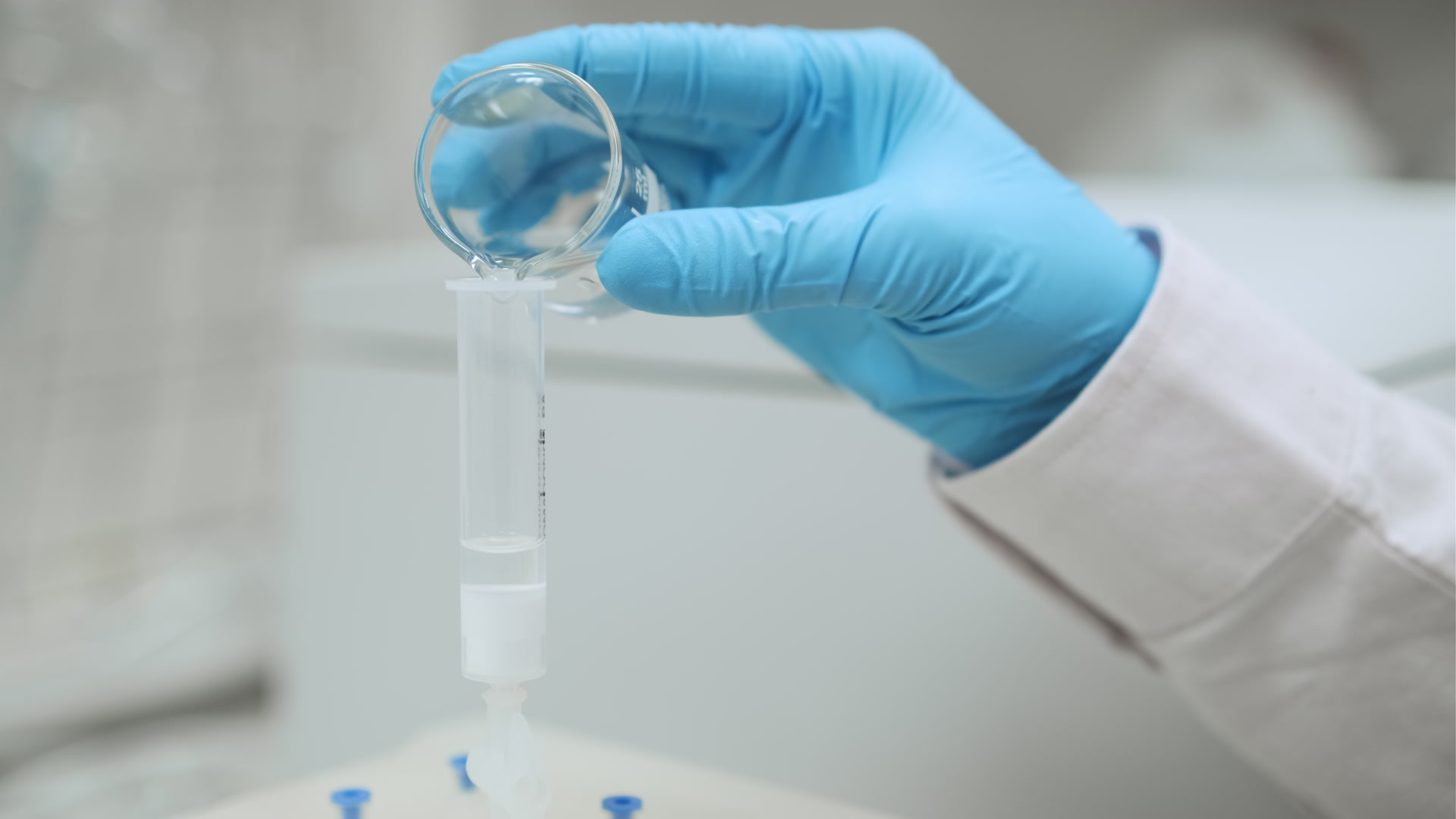
A signal that survives the question.
Define the marker, matrix and measurement that could change an ingredient or materials development decision.
Homogenisation changes the scope
Homogenisation changes the scope.
Homogenising material can improve portion comparability while changing physical state or marker accessibility. The scope should document the treatment and whether it represents the decision of interest. For a particle-containing formulation, testing a homogenised extract may answer a composition question but not how the intact formulation distributes or behaves. For chocolate, preparation temperature and handling may affect the material presented to extraction. A proposed study would therefore evaluate or document suitable preparation rather than assume homogeneity from a neat appearance. The relevant comparator must concern the same defined material state or preserve the difference explicitly.
Examine the comparison
| Unit | Replicated question | Cannot establish alone |
|---|---|---|
| Independent lot | Material variability between lots | Broader manufacturing coverage from a few lots |
| Preparation within lot | Preparation variation | Between-lot reproducibility |
| Repeated reading | Instrument/readout variation | Independent material replication |
Change the conditions · examine the reference
More readings—or more evidence?
Change the independent preparations and repeat readings. See which source of variation the next measurement can actually reduce.
The data, equations and controls remain available below if 3D cannot load.
Defined model · illustrative conditions
Points are discrete design calculations, joined for comparison. No experimental observations or confidence intervals are shown.
Fund the preparation or repeat that addresses the uncertainty relevant to the development decision.
The defined comparison
Balanced random-intercept scenario with between-preparation SD 10 response AU and within-preparation SD 6 response AU. Preparations are independent; residual readings are independent with common variance. The naive estimate treats all BR readings as independent and ignores clustering. The 3D groups depict a design count, not measured sample values. No confidence interval, power or precision guarantee is calculated. Drift, pairing, operators, serial correlation and unequal group sizes need additional structure.
Inspect the calculated values
Calculation grid, not measured observations. Inputs and assumptions are stated above.
| Independent preparations / count | Hierarchical design | All readings treated as independent |
|---|
Portion size is part of the method
Portion size is part of the method.
A small test portion may be affordable and easy to process but miss local variation relevant to the buyer’s question. A larger portion may require different extraction or mixing conditions. The proposed design should justify portion size and how it relates to the population, rather than copy a published mass without examining the new matrix. Xie et al. (2024) provide another preparation-specific analytical example. None of the external portion choices is automatically a representative sampling plan for a customer batch. The experiment should distinguish sampling feasibility from a later validated routine procedure.
Randomisation reduces avoidable confounding
Randomisation reduces avoidable confounding.
If all samples from one lot are measured first and all from another later, drift can resemble a lot difference. A qualified comparison should consider randomised or balanced preparation and reading order, with controls to identify temporal changes. The record needs to preserve that order rather than store only final means. An apparent material effect may instead reflect operator, day or instrument conditions. Separating those explanations is commercially valuable because a buyer should not reject a supplier lot or redesign a formulation on a comparison that cannot distinguish material identity from the sequence in which it was measured.
The uncertain level
Start with the uncertain level.
The least expensive informative experiment depends on the dominant uncertainty. If repeated readings are stable but portions differ, additional instrument repeats add little value. If preparations vary from a uniform material, preparation robustness deserves attention. The proposed scope would choose replication around that uncertainty, while keeping resources and actual quotations explicit. A small pilot can help estimate which level merits further work, but it does not establish full manufacturing variability. The report should preserve limited coverage and stop conditions rather than claim a broad lot specification from a conveniently uniform laboratory sample.
The next proposed comparison.
A sampling-to-decision map
A sampling-to-decision map
A sampling-to-decision map.
The proposed output would connect population, portion selection, homogenisation, preparation and readings to the interpretation. It would identify what the current sample design can establish and which additional independent materials are needed. A potential ingredient customer could use the map to commission a more defensible lot comparison; an assay developer could use it to distinguish sampling limits from detector limits. Any original results would carry their actual experimental hierarchy and uncertainty. The programme does not offer batch-release assurance or a food-safety sampling service; it proposes a funded research comparison designed around the buyer’s defined question.
Analytical detection · Proposed development discussion
A development path
for this research.
How much analytical uncertainty comes from the material sampled rather than the instrument?
The people this could serve.Research and analytical development teams.
The decision behind the project.
Your intended application, present alternative and the constraint behind “Sampling and heterogeneity”. A useful starting point is the change that would justify another development step.
A proposed scope centred on a sampling-to-decision map.
Agree the comparison, acceptance basis and responsible expertise before discussing a paid package.
Specialist methods and a defined contribution.
Bring relevant analytical or experimental expertise, a comparator suggestion, and the conditions under which your method could resolve this question.
A jointly scoped proposal could connect your contribution with a sampling-to-decision map.
Define contributions, required access, independent preparations and permitted outputs before work or protected information is shared.
The commercial purpose of the next milestone.
Bring the application or asset thesis, the buyer you expect to value it, and the scientific or commercial uncertainty that must be resolved before another commitment.
The proposed decision record would connect the buyer question with a sampling-to-decision map. It would identify what a subsequent comparison needs to demonstrate.
Demand, development cost, resources, rights and a decision-changing milestone would need examination. No financing terms or investment outcome are represented here.
What a useful comparison
would record.
- Define the record needed for “Sampling can dominate the answer” and identify what is currently missing.
- Check the evidence behind “Specify the population of interest” against the proposed buyer decision.
- Retain the applicable source links, versions, method limits and the exact evidence needed before another commitment.
What the proposed
brief could leave behind.
- A sampling-to-decision map
- A preparation, comparator and endpoint record tied to this question.
- A source-linked account of the evidence gaps, study assumptions and next review point.
The proposed discussion brief
A brief you
can take away.
Use non-confidential notes to connect this topic with your own decision. Entries stay in this browser tab; saving creates a text file on your device. Nothing is submitted.
Potential scoped analytical feasibility or method-comparison discussion
Notes are optional. The brief includes this page’s proposed question and public source links.
Proposed scope; resources, methods, rights and delivery terms would be agreed before work. Begin with non-confidential information.
Sources and reading notes.
External work is identified below. Access notes describe the material inspected for this page; company research questions and proposed work are not presented as findings from these sources.
Pilolli et al, 2023Pilolli et al. (2023; issue 2024). In-house validation of an LC–MS method for the multiplexed quantitative determination of total allergenic food in chocolate
Chocolate preparation, marker conversion, matrix-matched calibration, independent preparation versus instrumental replicates.
Scope and limitations: External research in the authors’ stated preparations and conditions. No VARUNÉ Bio results, rights, laboratory capacity or analytical validation established. No figure or dataset is reproduced here.
Open original sourceMonaci et al, 2020Monaci et al. (2020). Validation of a MS Based Proteomics Method for Milk and Egg Quantification in Cookies at the Lowest VITAL Levels
Processing-dependent marker recovery and incurred versus post-extraction standards. Clinical/label-management conclusions are not adopted.
Scope and limitations: External research in the authors’ stated preparations and conditions. No VARUNÉ Bio results, rights, laboratory capacity or analytical validation established. No figure or dataset is reproduced here.
Open original sourceXie et al, 2024Xie et al. (2024). Development of an Indirect Competitive ELISA Based on a Stable Epitope of β-Lactoglobulin for Its Detection in Hydrolyzed Formula Milk Powder
Epitope-dependent response, competitive assay, processed proteins, analytical comparator limitations.
Scope and limitations: External research in the authors’ stated preparations and conditions. No VARUNÉ Bio results, rights, laboratory capacity or analytical validation established. No figure or dataset is reproduced here.
Open original source