
 Film credits
The target may have changed.
How does processing alter the state a recognition or peptide method actually measures?
Proposed research direction. External studies are attributed; no original VARUNÉ Bio analytical results or validated assay are claimed.
Processing belongs in the question
Processing belongs in the question.
A reagent may recognise purified protein well and respond differently after the protein is heated, aggregated or hydrolysed. The proposed question is how relevant processing changes the marker state that an analytical method measures. This matters for a food-matrix feasibility study and for ingredient developers comparing processing routes. A result should not jump from detectable marker to unchanged functional molecule. The commercial decision is whether the selected marker can support the intended comparison after actual processing, or whether preparation, recognition or reporting units need to change before a larger study is commissioned.
Examine the development decision
The target may have changed.
Open the sequence to examine what a development decision needs.
Identify the exact preparation, its source, and the properties a second laboratory must be able to reproduce.
Explanatory geometry · no simulated or measured performance
Defining state rather than a vague identity
Define state rather than a vague identity.
Native protein, an aggregated structure, a retained epitope and a digestion-derived peptide are distinct targets for analytical purposes. A research scope should name which states matter and which method transformations occur before detection. Xie et al. (2024) investigate a stable-epitope competitive approach for processed β-lactoglobulin, while Monaci et al. (2020) examine processing effects on peptide detection in cookies. Neither paper establishes that all processed proteins remain detectable by all methods. Their external evidence motivates a state-aware comparison and a careful account of what a positive or weak response actually means.
Using recovery comparisons cautiously
Use recovery comparisons cautiously.
An incremental recovery ratio is interpretable only when added, native and measured material share a justified measurand basis. A purified spike introduced after processing does not experience the same history as material incorporated beforehand. A proposed design should distinguish those arms and avoid using one as a universal correction for the other. Pilolli et al. (2023; issue 2024) use characterised incurred chocolate within their analytical chain. That design demonstrates why processing history matters; it does not provide a correction factor for a new preparation or show that an observed marker equals unchanged total protein.
A same-measurand response ratio. It combines preparation and response effects unless experimental arms separate them.
- Incremental apparent recoverydimensionless
- Measured concentration in spiked preparationµg/mL
- Measured concentration in matched unspiked preparationµg/mL
- Known added concentration on the same final-volume basisµg/mL
Model conditions. Same units, preparation basis and calibrated measurand. Spike stability, blank subtraction and representative matrix are checked. Not proof of recovery of incurred or processed material.
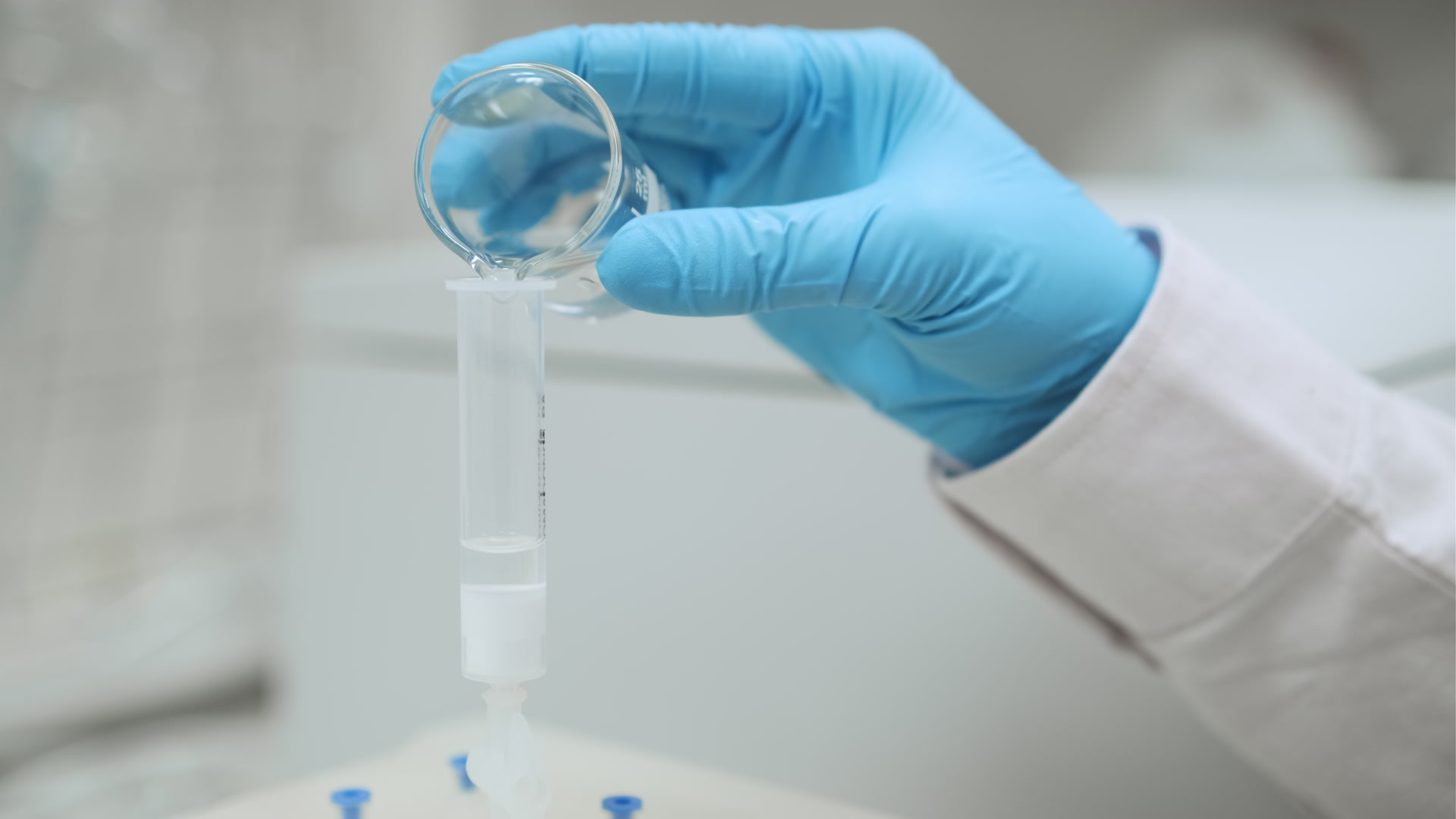
A signal that survives the question.
Define the marker, matrix and measurement that could change an ingredient or materials development decision.
Recognition sites may not track total material
Recognition sites may not track total material.
An epitope can become inaccessible or remain detectable within a fragment. Both changes alter interpretation. A sandwich assay may require two accessible recognition sites, whereas a competitive format can answer a different question about one site. The candidate comparison would state this distinction and test relevant positive materials rather than equate assay disagreement with an error by one platform. Eissa and Zourob (2017) provide an aptamer-selection example against specific β-lactoglobulin variants; selection against a purified form alone does not establish recognition of every processed state or related milk-derived material.
Change the conditions · examine the reference
What disappeared before detection?
Compare a spiked result with its unspiked reference. Keep recovery, matrix response and an incurred marker as separate questions.
The data, equations and controls remain available below if 3D cannot load.
Defined model · illustrative conditions
Move a control to compare the selected condition with the defined reference curve.
Define where the spike enters, how dilution is accounted for and what a qualified recovery experiment could establish.
The defined comparison
Hypothetical concentration results on the same original-sample-equivalent and dilution basis, with 10 μg L⁻¹ added. Negative increments or recovery above 100% are retained to expose background, interference or uncertainty. A fresh spike need not behave like a processed, incurred or bound marker; pre- and post-extraction spikes test different effects. No automatic recovery correction, assay validation, allergen-safety conclusion or selected analyte is represented. Vessel heights are schematic; the graph is the quantitative comparison.
Inspect the calculated values
Calculation grid, not measured observations. Inputs and assumptions are stated above.
| Spiked result / μg L⁻¹ | Background-subtracted spike recovery | Added-concentration reference |
|---|
Digestion can clarify and complicate
Digestion can clarify and complicate.
A targeted peptide method transforms the sample before measurement. That can make sequence-specific markers accessible, but incomplete or variable digestion can introduce another source of uncertainty. Processing may also affect extraction and the availability of cleavage sites. A proposed study should retain preparation and digestion controls compatible with its scope and avoid treating a peptide standard added near the detector as evidence of complete protein processing. An isotope-labelled peptide can help interpret part of the analytical chain without necessarily tracking every earlier extraction or digestion loss. Its addition point determines what it controls.
Relevant process comparisons
Choose relevant process comparisons.
A useful first experiment might compare an authenticated unprocessed preparation with a defined processed counterpart, alongside matrix blanks and an appropriate comparator. The conditions should reflect the intended development question rather than an arbitrary harsh challenge selected to produce dramatic differences. Independent preparation or processing units must be identified. Repeated readings of one processed sample cannot establish manufacturing robustness. A buyer deciding on a process change needs evidence about reproducible marker response and reporting validity, with uncertainty attached, rather than a single before-and-after image or an unqualified statement that processing destroys the target.
Preserve the limits of interpretation
Preserve the limits of interpretation.
A decreased analytical response may reflect reduced accessibility, extraction loss or altered target state; it does not by itself establish reduced biological activity or allergenic potential. Likewise, detecting a marker does not demonstrate clinical potency or food safety. Those inferences are outside this candidate programme. The proposed analysis would make the unresolved mechanisms explicit and identify the cheapest comparison that could distinguish them. Qualified resources and current quotations would determine whether a state-specific experiment is feasible. No processed Bio material, safety result or validated marker method is asserted on this page.

The next proposed comparison.
A marker-state decision record
A marker-state decision record
A marker-state decision record.
The proposed output would connect authenticated material, processing history, preparation transformations, recognition basis and comparator observations. It would state which marker remains suitable for a limited analytical comparison and where the evidence requires another target or method. An assay customer could use that record to fund a more relevant recognition study; an ingredient business could use it to design a process-comparison question. The deliverable would preserve negative or ambiguous responses, because they can prevent an inappropriate specification. Any public original results would require their own provenance, uncertainty, rights and release approval.
Analytical detection · Proposed development discussion
A development path
for this research.
How does processing alter the state a recognition or peptide method actually measures?
The people this could serve.Research and analytical development teams.
The decision behind the project.
Your intended application, present alternative and the constraint behind “Processed marker states”. A useful starting point is the change that would justify another development step.
A proposed scope centred on a marker-state decision record.
Agree the comparison, acceptance basis and responsible expertise before discussing a paid package.
Specialist methods and a defined contribution.
Bring relevant analytical or experimental expertise, a comparator suggestion, and the conditions under which your method could resolve this question.
A jointly scoped proposal could connect your contribution with a marker-state decision record.
Define contributions, required access, independent preparations and permitted outputs before work or protected information is shared.
The commercial purpose of the next milestone.
Bring the application or asset thesis, the buyer you expect to value it, and the scientific or commercial uncertainty that must be resolved before another commitment.
The proposed decision record would connect the buyer question with a marker-state decision record. It would identify what a subsequent comparison needs to demonstrate.
Demand, development cost, resources, rights and a decision-changing milestone would need examination. No financing terms or investment outcome are represented here.
What a useful comparison
would record.
- Record incremental apparent recovery (dimensionless) with the preparation, method and conditions needed to interpret it.
- Record measured concentration in spiked preparation (µg/mL) with the preparation, method and conditions needed to interpret it.
- Record measured concentration in matched unspiked preparation (µg/mL) with the preparation, method and conditions needed to interpret it.
What the proposed
brief could leave behind.
- A marker-state decision record
- A preparation, comparator and endpoint record tied to this question.
- A source-linked account of the evidence gaps, study assumptions and next review point.
The proposed discussion brief
A brief you
can take away.
Use non-confidential notes to connect this topic with your own decision. Entries stay in this browser tab; saving creates a text file on your device. Nothing is submitted.
Potential scoped analytical feasibility or method-comparison discussion
Notes are optional. The brief includes this page’s proposed question and public source links.
Proposed scope; resources, methods, rights and delivery terms would be agreed before work. Begin with non-confidential information.
Sources and reading notes.
External work is identified below. Access notes describe the material inspected for this page; company research questions and proposed work are not presented as findings from these sources.
Xie et al, 2024Xie et al. (2024). Development of an Indirect Competitive ELISA Based on a Stable Epitope of β-Lactoglobulin for Its Detection in Hydrolyzed Formula Milk Powder
Epitope-dependent response, competitive assay, processed proteins, analytical comparator limitations.
Scope and limitations: External research in the authors’ stated preparations and conditions. No VARUNÉ Bio results, rights, laboratory capacity or analytical validation established. No figure or dataset is reproduced here.
Open original sourceMonaci et al, 2020Monaci et al. (2020). Validation of a MS Based Proteomics Method for Milk and Egg Quantification in Cookies at the Lowest VITAL Levels
Processing-dependent marker recovery and incurred versus post-extraction standards. Clinical/label-management conclusions are not adopted.
Scope and limitations: External research in the authors’ stated preparations and conditions. No VARUNÉ Bio results, rights, laboratory capacity or analytical validation established. No figure or dataset is reproduced here.
Open original sourcePilolli et al, 2023Pilolli et al. (2023; issue 2024). In-house validation of an LC–MS method for the multiplexed quantitative determination of total allergenic food in chocolate
Chocolate preparation, marker conversion, matrix-matched calibration, independent preparation versus instrumental replicates.
Scope and limitations: External research in the authors’ stated preparations and conditions. No VARUNÉ Bio results, rights, laboratory capacity or analytical validation established. No figure or dataset is reproduced here.
Open original sourceEissa and Zourob, 2017Eissa and Zourob (2017). In vitro selection of DNA aptamers targeting β-lactoglobulin and their integration in graphene-based biosensor
A/B variant selection, affinity characterisation and graphene-mediated electrochemical recognition; spiked extracts only within inspected scope.
Scope and limitations: External research in the authors’ stated preparations and conditions. No VARUNÉ Bio results, rights, laboratory capacity or analytical validation established. Only the inspected abstract/record is used; full protocol was not reviewed.
Open original source