
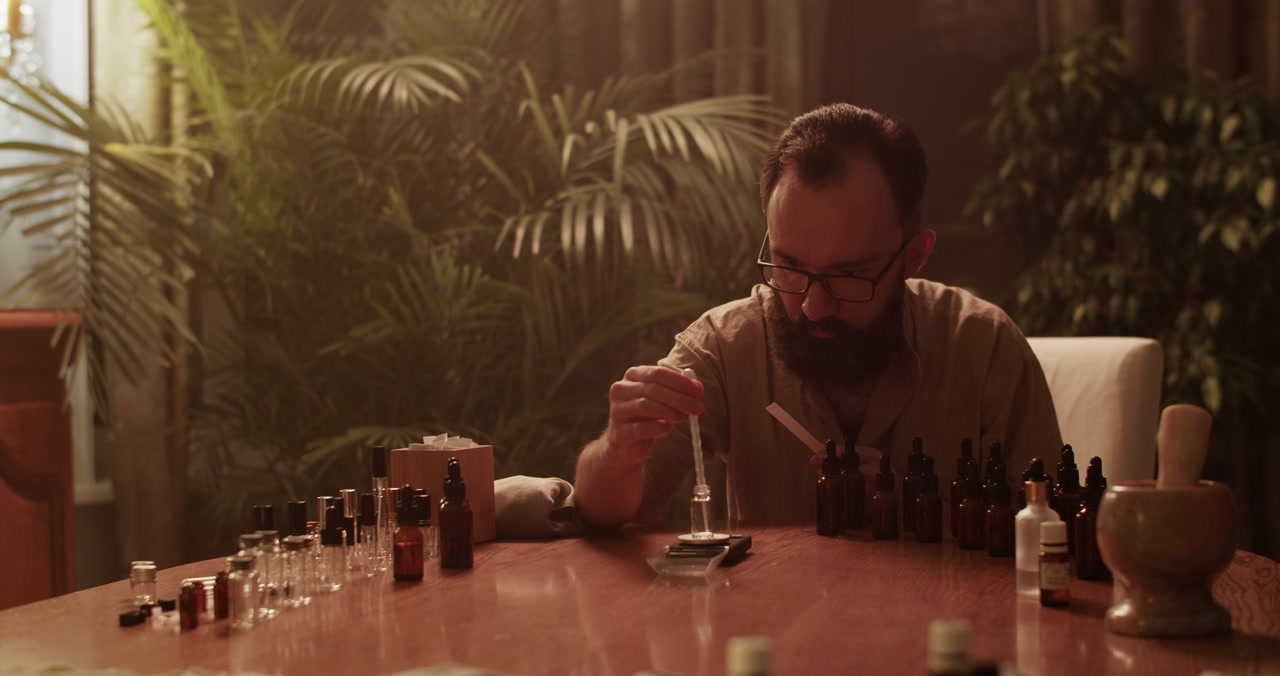
 Film credits
The ingredient has to be identifiable.
What analytical evidence would help a beauty R&D buyer decide whether an ingredient merits a formulation evaluation?
Proposed research direction. External studies are attributed; no original VARUNÉ Bio analytical results or validated assay are claimed.
Luxury value still needs a measurable basis
Luxury value still needs a measurable basis.
A biological ingredient can have a compelling story and remain difficult to evaluate. A beauty R&D buyer needs to know what preparation is being discussed, whether it is reproducible and which evidence supports its proposed role. This candidate concerns an analytical evidence scope that could help a buyer decide whether to fund a formulation evaluation. It does not claim a luxury-house collaboration or a finished skincare ingredient. The commercial entry point is a defined technical uncertainty—identity, lot comparability or assay suitability—rather than an unsupported promise that an unusual origin will deliver consumer benefit or brand differentiation.
Examine the development decision
The ingredient has to be identifiable.
Open the sequence to examine what a development decision needs.
Identify the exact preparation, its source, and the properties a second laboratory must be able to reproduce.
Explanatory geometry · no simulated or measured performance
Authenticate the material first
Authenticate the material first.
Material identity includes source, preparation history, composition and permitted access. A molecular-size trace alone cannot supply all of those facts. Striegel, Isenberg and Côté (2009) examine analytical alteration of alternan; Pitkänen and Striegel (2015) investigate complementary polysaccharide characterisation. Their external studies reinforce the need to check method suitability, not assume a proposed ingredient shares a known polymer’s behaviour. A candidate buyer scope would begin with available authentication and preparation records, then identify which missing measurement could change the evaluation decision. No biological-material rights or supplier relationship are established by the public research proposition.
(Striegel, Isenberg and Côté, 2009) | (Pitkänen and Striegel, 2015)
Compare lots on an appropriate basis
Compare lots on an appropriate basis.
Repeat dispersion can help assess a defined response, but it must refer to independently relevant units. Multiple readings of one prepared lot cannot establish consistency across production. The proposed comparison would distinguish lots, preparation repeats and instrument readings, and explain why the selected endpoint matters to the buyer. Molecular size, assay-equivalent content and formulation performance are different quantities. If only a single authenticated preparation exists, the report should state that limitation. A precise result can support a next study without proving supply reproducibility, a manufacturing specification or readiness for a luxury customer’s product development programme.
Repeat dispersion is separate from bias and must name the independent experimental unit.
- Coefficient of variation%
- Sample standard deviationresponse units
- Positive sample mean on a ratio scaleresponse units
Model conditions. Mean is nonzero and sufficiently positive; use absolute uncertainty near blank. Repetitions come from the reported hierarchy, not pooled pseudo-independent readings.

A signal that survives the question.
Define the marker, matrix and measurement that could change an ingredient or materials development decision.
Using composition checks for their actual purpose
Use composition checks for their actual purpose.
Smith et al. (1985) describe a BCA protein-measurement mechanism. That can provide context for a suitably checked composition question, but it cannot identify a polysaccharide or validate a cosmetic extract by itself. A proposed evaluation would select complementary methods around the ingredient’s actual uncertainty and matrix. Assay response should remain labelled according to the calibration standard and interference assessment. Total content is not automatically identified ingredient mass. This distinction is commercially useful because the buyer needs a trustworthy technical record before judging incorporation, compatibility or a proposed claim; a flattering undifferentiated purity number can create the wrong development decision.
Do not transfer identity into skin performance
Do not transfer identity into skin performance.
An authenticated ingredient and an interpretable molecular measurement do not establish hydration, barrier function, sensory preference or lasting performance. Those endpoints need their own relevant formulation comparisons and appropriate evidence. A retained chemical marker likewise does not prove an intact functional film. The candidate analytical scope would therefore hand over a narrower record for the next formulation question, rather than inflate its conclusion into efficacy. A beauty R&D team can then judge whether a proposed physical or sensory comparison is worth funding. That separation protects the scientific case and makes the commercial conversation more credible.
A paid evaluation needs an actual brief
A paid evaluation needs an actual brief.
Subject to resources and agreement, a potential paid scope could define the buyer’s comparator, available material, analytical endpoint and decision report. Laboratory work would depend on qualified delivery and current quotations. The customer could ask whether an authenticated preparation differs from its reference ingredient or whether a proposed matrix assay is suitable. The scope should preserve confidential formulation detail and specify permitted use of results. This page establishes no current client, fee, turnaround or available service. It describes a commercial route that becomes concrete only when both parties approve a bounded technical question and a feasible delivery plan.
A milestone earned by delivery
A milestone earned by delivery.
A paid luxury-beauty research collaboration is a target that would need a signed scope, actual payment or agreed commercial terms, delivery evidence and permission for any named public statement. A good scientific discussion alone is not that milestone. The analytical contribution should be judged by whether it changes the buyer’s next decision, including a reason not to evaluate the ingredient further. If authentication or method suitability is inadequate, narrowing or stopping the scope may be the strongest recommendation. Neither a prestigious prospect nor attractive visual design should substitute for the material and evidence required for a defensible R&D evaluation.

The next proposed comparison.
A buyer-readable ingredient evidence dossier
A buyer-readable ingredient evidence dossier
A buyer-readable ingredient evidence dossier.
The proposed output would connect authentication, preparation, analytical method suitability, independent units and interpretation to the buyer’s defined evaluation question. It would separate measured identity evidence from proposed formulation benefits and identify the next qualified comparison. A potential beauty customer could review that dossier before committing to a larger paid study; a research collaborator could use it to address a specific characterisation gap. External evidence remains attributed, and no original Bio lot or performance result is claimed. The next discussion should concern one ingredient preparation, one comparator and one development decision that an affordable evidence scope could change.
Analytical detection · Proposed development discussion
A development path
for this research.
What analytical evidence would help a beauty R&D buyer decide whether an ingredient merits a formulation evaluation?
The people this could serve.Beauty and luxury-house R&D teams and ingredient evaluation buyers.
The decision behind the project.
Your intended application, present alternative and the constraint behind “Analytical evidence for luxury ingredient evaluation”. A useful starting point is the change that would justify another development step.
A proposed scope centred on a buyer-readable ingredient evidence dossier.
Agree the comparison, acceptance basis and responsible expertise before discussing a paid package.
Specialist methods and a defined contribution.
Bring relevant analytical or experimental expertise, a comparator suggestion, and the conditions under which your method could resolve this question.
A jointly scoped proposal could connect your contribution with a buyer-readable ingredient evidence dossier.
Define contributions, required access, independent preparations and permitted outputs before work or protected information is shared.
The commercial purpose of the next milestone.
Bring the application or asset thesis, the buyer you expect to value it, and the scientific or commercial uncertainty that must be resolved before another commitment.
The proposed decision record would connect the buyer question with a buyer-readable ingredient evidence dossier. It would identify what a subsequent comparison needs to demonstrate.
Demand, development cost, resources, rights and a decision-changing milestone would need examination. No financing terms or investment outcome are represented here.
What a useful comparison
would record.
- Record coefficient of variation (%) with the preparation, method and conditions needed to interpret it.
- Record sample standard deviation (response units) with the preparation, method and conditions needed to interpret it.
- Record positive sample mean on a ratio scale (response units) with the preparation, method and conditions needed to interpret it.
What the proposed
brief could leave behind.
- A buyer-readable ingredient evidence dossier
- A preparation, comparator and endpoint record tied to this question.
- A source-linked account of the evidence gaps, study assumptions and next review point.
The proposed discussion brief
A brief you
can take away.
Use non-confidential notes to connect this topic with your own decision. Entries stay in this browser tab; saving creates a text file on your device. Nothing is submitted.
Potential paid buyer-defined ingredient evidence evaluation; no named customer or available capacity implied
Notes are optional. The brief includes this page’s proposed question and public source links.
Proposed scope; resources, methods, rights and delivery terms would be agreed before work. Begin with non-confidential information.
Sources and reading notes.
External work is identified below. Access notes describe the material inspected for this page; company research questions and proposed work are not presented as findings from these sources.
Striegel, Isenberg and Côté, 2009Striegel, Isenberg and Côté (2009). An SEC/MALS study of alternan degradation during size-exclusion chromatographic analysis
Alternan flow-dependent molar mass and size; analytical alteration is material- and condition-specific.
Scope and limitations: External research in the authors’ stated preparations and conditions. No VARUNÉ Bio results, rights, laboratory capacity or analytical validation established. Only the inspected abstract/record is used; full protocol was not reviewed.
Open original sourcePitkänen and Striegel, 2015Pitkänen and Striegel (2015). Polysaccharide characterization by hollow-fiber flow field-flow fractionation with MALS and differential refractometry
HF5 separation, multi-detector interpretation and recovery for specified polysaccharides.
Scope and limitations: External research in the authors’ stated preparations and conditions. No VARUNÉ Bio results, rights, laboratory capacity or analytical validation established. Only the inspected abstract/record is used; full protocol was not reviewed.
Open original sourceSmith et al, 1985Smith et al. (1985). Measurement of protein using bicinchoninic acid
BCA copper/chromophore measurement mechanism and matrix compatibility context; not polymer identity or formulation validation.
Scope and limitations: External research in the authors’ stated preparations and conditions. No VARUNÉ Bio results, rights, laboratory capacity or analytical validation established. Only the inspected abstract/record is used; full protocol was not reviewed.
Open original source