
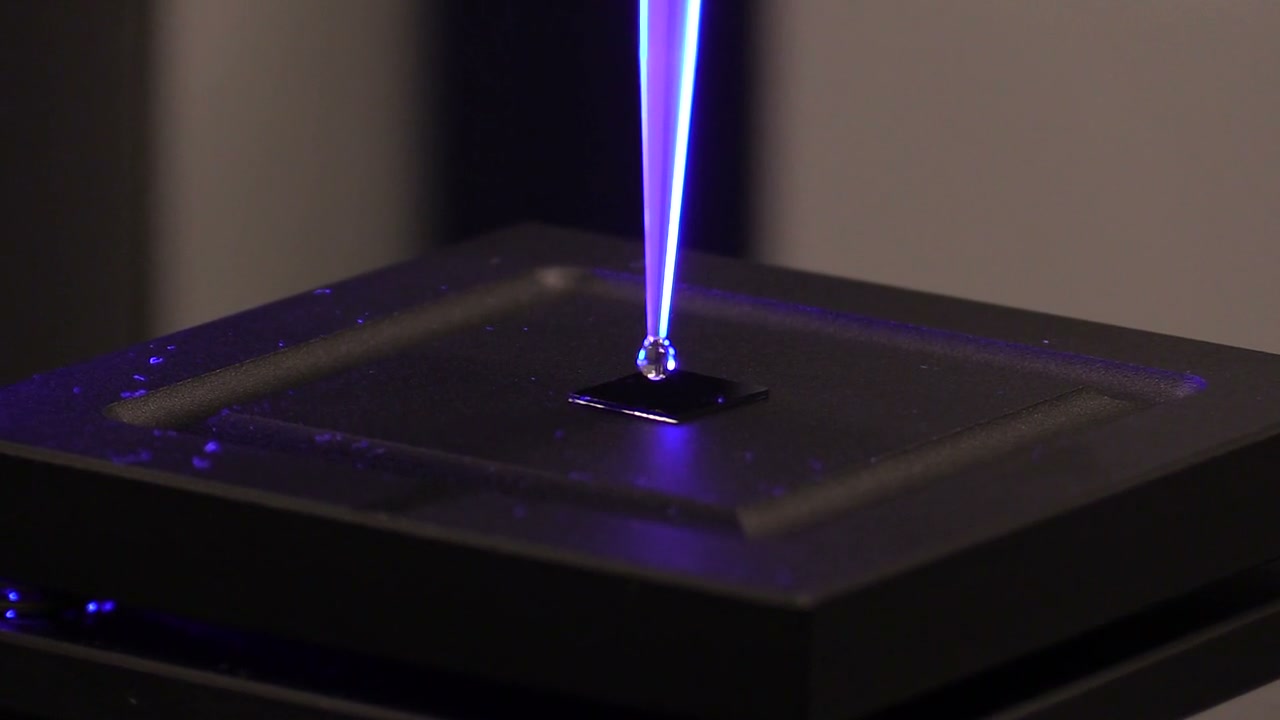
 Film credits
A small channel. A deliberate assembly.
Investigate flow, mixing and lipid identity as linked process variables, with throughput qualified separately from particle formation.
Proposed programme | Application, materials, capacity and rights to be qualified.
A channel needs a product reason.
Microfluidic assembly can offer controlled mixing, but a development programme should begin with the structure it needs to produce.
Microfluidic assembly can offer controlled mixing, but a development programme should begin with the structure it needs to produce. The target may involve size distribution, membrane composition or a reproducible loading method. A visually compelling chip does not establish that the process is the best route for the buyer’s formulation.
The proposed question is whether a particular channel and flow regime create a useful preparation with manageable solvent, downstream and throughput requirements. An ingredient team might compare it with extrusion or bulk mixing. The incumbent should remain a credible option, with the new route assessed for a specific function and reproducibility requirement.
Examine the development decision
A small channel. A deliberate assembly.
Open the sequence to examine what a development decision needs.
Identify the exact preparation, its source, and the properties a second laboratory must be able to reproduce.
Explanatory geometry · no simulated or measured performance
Composition and mixing are coupled.
Kotouček et al.
Kotouček et al. (2020) investigated lipid fluidity and morphology in a herring-bone mixing system. Their findings show why the same flow settings do not imply the same vesicle for every composition. A process comparison needs lipid identity, temperature, concentration and solvent history beside the channel description.
Woo et al. (2021) explored an arrayed microchannel device with flow-dependent liposome formation. The article contains an unresolved saline/NaOH description, so it should not be reused as a preparation instruction. Its engineering concept remains a research reference; a Bio route would need independently qualified materials, chemistry and device access before any practical reproduction or commercial claim.
Defining the flow variables unambiguously.
The flow-rate ratio must state which stream is in the numerator.
The flow-rate ratio must state which stream is in the numerator. The displayed expression uses aqueous flow divided by organic flow, alongside their summed total flow. Different papers or instruments can use different conventions. A process record that omits the definition is difficult to reproduce or compare.
The reader experience could visualise two labelled streams and the resulting ratio without pretending to simulate real assembly. Actual particle formation also depends on geometry, concentration, viscosity and diffusion. A flow ratio alone cannot predict size or loading, and a solvent-removal step may be required before a preparation can be compared within the intended final formulation.
Aqueous-to-organic convention; these variables do not independently predict assembly.
- aqueous-to-organic volumetric flow ratio1
- aqueous stream flowmL min⁻¹
- organic stream flowmL min⁻¹
- total inlet flowmL min⁻¹
Model conditions. Positive organic flow; two incompressible streams; steady inlet readings. Geometry, composition, temperature and downstream processing independently assessed.
The carrier and its contribution.
Compare a structured carrier with a simpler vehicle around loading, availability, handling and the intended formulation.
Measure the structure, not only the output volume.
A higher collected volume is not useful throughput if a substantial fraction fails the required preparation quality.
A higher collected volume is not useful throughput if a substantial fraction fails the required preparation quality. The proposed record would pair flow conditions with suitable size, distribution and morphology measurements. Active recovery and solvent content may be equally important when the intended deliverable is an ingredient concentrate.
The NIST protocol provides a reporting basis for light-scattering measurements (Hackley and Clogston, 2015). It does not qualify the device or prove membrane structure. Complementary methods should be selected according to the question, with intensity-weighted size kept distinct from converted number distributions and with the measurement preparation preserved in the evidence ledger.
Plan the downstream route early.
A process can create the intended structure while leaving unacceptable solvent, dilution or purification requirements.
A process can create the intended structure while leaving unacceptable solvent, dilution or purification requirements. The development brief should include solvent removal, concentration and incorporation into the final base, because those steps may change the carrier. The sample collected at the chip outlet is only one point in the process.
A proposed transfer comparison would examine the preparation before and after the relevant downstream step. If structure or loading changes, the process window needs to include that transition rather than celebrate an outlet measurement alone. The sponsor should be able to see where yield, quality or handling creates the practical constraint and which check can resolve it.
Making scale a separate evidence question.
Parallel channels and longer operation can introduce flow maldistribution, blockage, cleaning and start-up effects.
Parallel channels and longer operation can introduce flow maldistribution, blockage, cleaning and start-up effects. Woo et al. (2021) propose an arrayed design, but its reported experiment is not a guarantee of linear commercial output for another lipid preparation. The buyer needs an engineering qualification path tied to acceptable product quality.
The proposed paid output is a process-variable map and staged assembly/transfer study brief. Delivery would require qualified engineering and analytical capacity, suitable materials and device rights. A later method evaluation or licence could be considered if the contribution is reproducible and commercially useful. Neither a model nor external chip footage establishes a Bio manufacturing platform.
A transfer milestone that can fail.
The sponsor should specify the required structure and the incumbent route, then define an acceptable preparation after downstream handling.
The sponsor should specify the required structure and the incumbent route, then define an acceptable preparation after downstream handling. A useful first milestone might demonstrate repeatable assembly across independently prepared input lots. The next could assess a sustained run or transferred process under qualified conditions.
Bring the lipid composition, active, solvent constraints, available device and intended batch requirement. The cheapest useful check may compare outlet and post-processing samples before any throughput expansion. If the downstream route destroys the intended function, the programme should reframe the process rather than invest in a larger chip. The discussion begins with that concrete scientific and manufacturing decision.

The next proposed comparison.
A mixing-and-assembly process brief with a staged transfer comparison.
Colloidal delivery · Proposed development discussion
A development path
for this research.
Can a microfluidic route produce the required structure reproducibly within a realistic solvent and throughput envelope?
The people this could serve.Formulation, ingredient and application development teams.
The decision behind the project.
Your intended application, present alternative and the constraint behind “Microfluidic assembly”. A useful starting point is the change that would justify another development step.
A proposed scope centred on a mixing-and-assembly process brief with a staged transfer comparison.
Agree the comparison, acceptance basis and responsible expertise before discussing a paid package.
Specialist methods and a defined contribution.
Bring relevant analytical or experimental expertise, a comparator suggestion, and the conditions under which your method could resolve this question.
A jointly scoped proposal could connect your contribution with a mixing-and-assembly process brief with a staged transfer comparison.
Define contributions, required access, independent preparations and permitted outputs before work or protected information is shared.
The commercial purpose of the next milestone.
Bring the application or asset thesis, the buyer you expect to value it, and the scientific or commercial uncertainty that must be resolved before another commitment.
The proposed decision record would connect the buyer question with a mixing-and-assembly process brief with a staged transfer comparison. It would identify what a subsequent comparison needs to demonstrate.
Demand, development cost, resources, rights and a decision-changing milestone would need examination. No financing terms or investment outcome are represented here.
What a useful comparison
would record.
- Record aqueous-to-organic volumetric flow ratio (1) with the preparation, method and conditions needed to interpret it.
- Record aqueous stream flow (mL min⁻¹) with the preparation, method and conditions needed to interpret it.
- Record organic stream flow (mL min⁻¹) with the preparation, method and conditions needed to interpret it.
What the proposed
brief could leave behind.
- A mixing-and-assembly process brief with a staged transfer comparison
- A preparation, comparator and endpoint record tied to this question.
- A source-linked account of the evidence gaps, study assumptions and next review point.
The proposed discussion brief
A brief you
can take away.
Use non-confidential notes to connect this topic with your own decision. Entries stay in this browser tab; saving creates a text file on your device. Nothing is submitted.
Scoped paid evidence brief, then separately qualified comparison; evaluation or licensing only after reproducibility, capacity and rights review.
Notes are optional. The brief includes this page’s proposed question and public source links.
Proposed scope; resources, methods, rights and delivery terms would be agreed before work. Begin with non-confidential information.
Sources and reading notes.
External work is identified below. Access notes describe the material inspected for this page; company research questions and proposed work are not presented as findings from these sources.
Kotouček et al, 2020Kotouček et al. (2020) Preparation of nanoliposomes by microfluidic mixing in herring-bone channel and the role of membrane fluidity in liposomes formation
Lipid composition, membrane fluidity, particle size and morphology in a specific microfluidic system.
Scope and limitations: CC BY 4.0 full text inspected. Composition-dependent external findings; purchased device, company ownership and freedom to operate not implied.
Open original sourceWoo et al, 2021Woo et al. (2021) High-Throughput Synthesis of Liposome Using an Injection-Molded Plastic Micro-Fluidic Device
Parallel microchannel design and reported flow-dependent liposome formation.
Scope and limitations: CC BY 4.0 full XML inspected. Authors describe saline as 0.85% NaOH; unresolved source inconsistency prevents reuse as a formulation instruction. No device licence or scale-up guarantee.
Open original sourceHackley and Clogston, 2015Hackley and Clogston (2015) Measuring the Size of Nanoparticles in Aqueous Media Using Batch-Mode Dynamic Light Scattering
Stokes–Einstein relation, measurement medium, intensity weighting and reporting.
Scope and limitations: Physical measurement guidance. No qualification of Bio equipment; no universal particle-size threshold or stability conclusion.
Open original source