
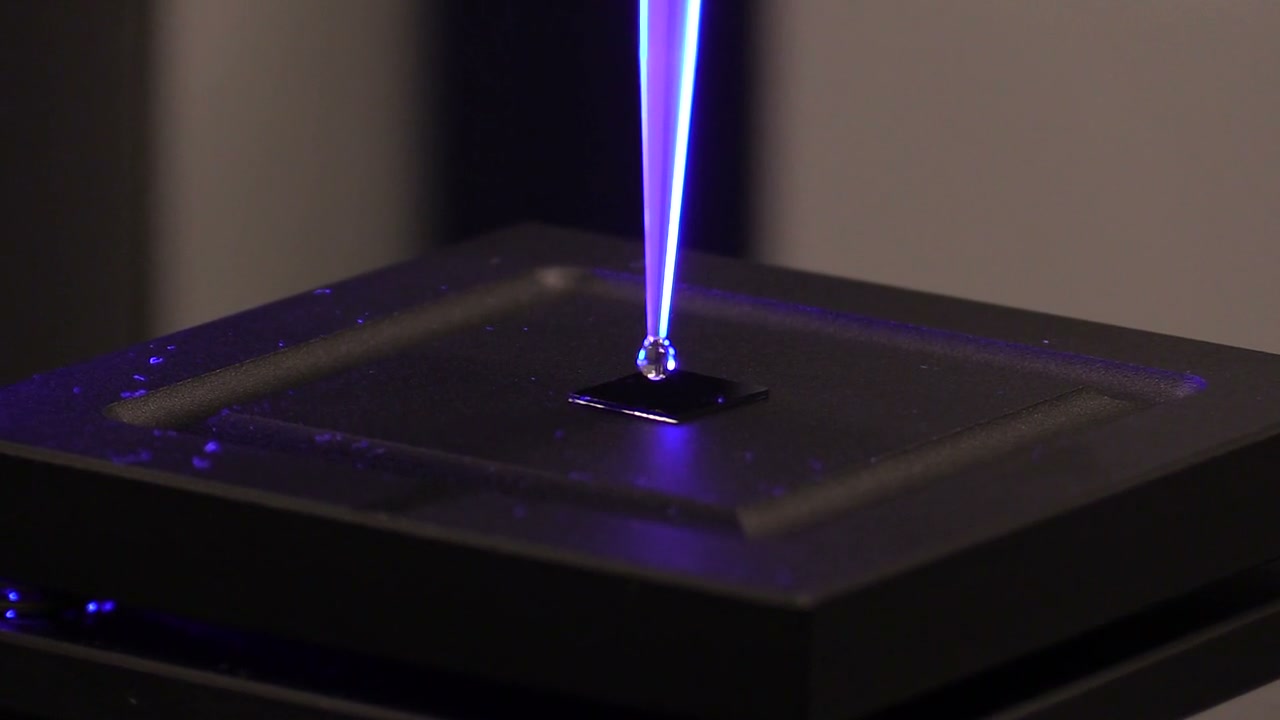
 Film credits
A process window worth carrying forward.
Investigate how energy history, composition and thermal exposure affect the preparation before attempting a larger batch.
Proposed programme | Application, materials, capacity and rights to be qualified.
An equipment setting is not a transferable recipe.
A mixing speed or pressure can describe one machine while leaving the actual preparation history incomplete.
A mixing speed or pressure can describe one machine while leaving the actual preparation history incomplete. Batch mass, geometry, residence time and temperature can change when the process moves elsewhere. A buyer scaling a carrier needs to identify which physical conditions produced the useful function, rather than copy one headline setting.
The proposed investigation connects process history with a measured preparation endpoint. It might ask whether a lower-energy route meets the same distribution and active-retention brief, or whether a transfer introduces a thermal or handling problem. The incumbent process remains part of the comparison so that the new route must earn its complexity.
Examine the development decision
A process window worth carrying forward.
Open the sequence to examine what a development decision needs.
Identify the exact preparation, its source, and the properties a second laboratory must be able to reproduce.
Explanatory geometry · no simulated or measured performance
Different formulations can need different routes.
Algahtani, Ahmad and Ahmad (2020) investigated preparation variables in a particular retinyl-palmitate nanoemulsion.
Algahtani, Ahmad and Ahmad (2020) investigated preparation variables in a particular retinyl-palmitate nanoemulsion. Zhao et al. (2023) studied emulsifier-specific essential-oil systems, while Sakellari et al. (2021) examined structured lipid preparations. These sources demonstrate that composition and process need to be read together.
They do not supply a universal energy target or an authorised cosmetic recipe. A proposed process brief would recover the actual input materials, batch scale and thermal record, then identify which comparisons are relevant to the buyer. The measured function could concern active retention, distribution, incorporation or a matrix state; it should be selected before an energy-saving story is written.
(Algahtani, Ahmad and Ahmad, 2020) | (Zhao et al, 2023) | (Sakellari et al, 2021)
Record energy on a stated basis.
Specific input energy can be defined as measured process power integrated over time and divided by batch mass.
Specific input energy can be defined as measured process power integrated over time and divided by batch mass. The displayed relation is an engineering accounting definition, not a claim that all electrical energy becomes useful droplet-breakup work. Idle loads, heat losses and equipment efficiency can complicate interpretation.
A reader could compare their own process histories using clearly labelled measurements and units. The result should remain separate from a predicted particle size. A transferable description may also need local shear, residence-time distribution and temperature. The equation makes the bulk basis visible while leaving the detailed fluid mechanics and efficacy of the process unresolved.
(Algahtani, Ahmad and Ahmad, 2020) | (Sakellari et al, 2021)
Bulk energy accounting, not useful breakup energy or a size prediction.
- specific measured input energyJ kg⁻¹
- measured process power at time tW
- processing durations
- batch masskg
- elapsed process times
Model conditions. Positive batch mass; power basis and baseline subtraction stated. Heat loss and local flow dissipation not inferred from bulk input.

The carrier and its contribution.
Compare a structured carrier with a simpler vehicle around loading, availability, handling and the intended formulation.
Treat heating as a process outcome.
More input can change temperature as well as structure.
More input can change temperature as well as structure. A temperature rise may alter viscosity, lipid phase state or active survival, making an apparent energy effect chemically confounded. The proposed comparison would record temperature history and use suitable controls when the mechanism matters.
Cooling capacity and hold time can become practical constraints during transfer. A preparation that meets the distribution target immediately after processing may change before incorporation. The scope should include the relevant delay and downstream condition, so the sponsor can distinguish a useful process window from a short-lived laboratory result that cannot be carried into the intended production route.
(Algahtani, Ahmad and Ahmad, 2020) | (Sakellari et al, 2021)
Compare the usable output.
The relevant output is the fraction of preparation that meets the agreed quality and application requirements, not simply the total material produced.
The relevant output is the fraction of preparation that meets the agreed quality and application requirements, not simply the total material produced. Active recovery, size distribution and incorporation behaviour may all constrain usable yield. A faster process can still be commercially unattractive if it creates variable or difficult-to-handle material.
A proposed transfer record would retain independent batch identity and the actual sampling points. Physical measurement should use suitable medium and analysis settings (Hackley and Clogston, 2015). An attractive mean can conceal a large-particle tail or an analytical preparation effect, so raw observations and uncertainty should remain available to the qualified reviewer.
Link process science with the buyer’s commitment.
A development sponsor may be choosing whether to repeat a laboratory route, transfer it to a partner or reject it in favour of a simpler formulation.
A development sponsor may be choosing whether to repeat a laboratory route, transfer it to a partner or reject it in favour of a simpler formulation. The proposed paid output would map process variables to the measured function and identify the smallest transfer study capable of changing that decision.
Execution requires qualified processing and analytical capacity, equipment access and appropriate material rights. No available Bio manufacturing line or guaranteed scale-up is implied. A later original process study could support collaboration or evaluation if it yields a reproducible contribution. The scientific and commercial value would come from a window another team can investigate, not from a dramatic machine film.
The preparation history that can be reconstructed.
The useful starting record includes equipment, batch mass, input grades, order of addition, processing duration and temperature history.
The useful starting record includes equipment, batch mass, input grades, order of addition, processing duration and temperature history. Existing distribution and active-assay data should be tied to sample timing. Missing records may determine that a controlled reconstruction is necessary before any scale comparison can be meaningful.
A first milestone could identify which process change genuinely alters the preparation under matched conditions. The next would test whether that relationship survives a limited transfer. If it does not, the report should identify the new constraint and revise the route. The buyer discussion is about an interpretable process decision and the evidence required to justify the next commitment.

The next proposed comparison.
An energy-history and transfer comparison record.
Colloidal delivery · Proposed development discussion
A development path
for this research.
Which process history produces the required preparation without unacceptable heating, variability or downstream burden?
The people this could serve.Formulation, ingredient and application development teams.
The decision behind the project.
Your intended application, present alternative and the constraint behind “Manufacturing energy and transfer”. A useful starting point is the change that would justify another development step.
A proposed scope centred on an energy-history and transfer comparison record.
Agree the comparison, acceptance basis and responsible expertise before discussing a paid package.
Specialist methods and a defined contribution.
Bring relevant analytical or experimental expertise, a comparator suggestion, and the conditions under which your method could resolve this question.
A jointly scoped proposal could connect your contribution with an energy-history and transfer comparison record.
Define contributions, required access, independent preparations and permitted outputs before work or protected information is shared.
The commercial purpose of the next milestone.
Bring the application or asset thesis, the buyer you expect to value it, and the scientific or commercial uncertainty that must be resolved before another commitment.
The proposed decision record would connect the buyer question with an energy-history and transfer comparison record. It would identify what a subsequent comparison needs to demonstrate.
Demand, development cost, resources, rights and a decision-changing milestone would need examination. No financing terms or investment outcome are represented here.
What a useful comparison
would record.
- Record specific measured input energy (J kg⁻¹) with the preparation, method and conditions needed to interpret it.
- Record measured process power at time t (W) with the preparation, method and conditions needed to interpret it.
- Record processing duration (s) with the preparation, method and conditions needed to interpret it.
What the proposed
brief could leave behind.
- An energy-history and transfer comparison record
- A preparation, comparator and endpoint record tied to this question.
- A source-linked account of the evidence gaps, study assumptions and next review point.
The proposed discussion brief
A brief you
can take away.
Use non-confidential notes to connect this topic with your own decision. Entries stay in this browser tab; saving creates a text file on your device. Nothing is submitted.
Scoped paid evidence brief, then separately qualified comparison; evaluation or licensing only after reproducibility, capacity and rights review.
Notes are optional. The brief includes this page’s proposed question and public source links.
Proposed scope; resources, methods, rights and delivery terms would be agreed before work. Begin with non-confidential information.
Sources and reading notes.
External work is identified below. Access notes describe the material inspected for this page; company research questions and proposed work are not presented as findings from these sources.
Algahtani, Ahmad and Ahmad, 2020Algahtani, Ahmad and Ahmad (2020) Nanoemulgel for Improved Topical Delivery of Retinyl Palmitate: Formulation Design and Stability Evaluation
Specific nanoemulsion preparation, retinyl palmitate assay, formulation stress and release/permeation comparison. Retinol/retinyl palmitate labels within article require care.
Scope and limitations: CC BY 4.0 full XML retrieved via Europe PMC. External pharmaceutical preparation and experimental endpoints; no Bio result, cosmetic efficacy, tolerability or recipe adoption implied.
Open original sourceZhao et al, 2023Zhao et al. (2023) Characterization of Nanoemulsions Stabilized with Different Emulsifiers and Their Encapsulation Efficiency for Oregano Essential Oil
Emulsifier-specific physical and oxidative stress responses in oregano-essential-oil emulsions.
Scope and limitations: CC BY 4.0 full XML inspected. Food-related systems and unequal optimised emulsifier concentrations; no transfer to cosmetic preservation, safety or efficacy.
Open original sourceSakellari et al, 2021Sakellari et al. (2021) Formulation design, production and characterisation of solid lipid nanoparticles and nanostructured lipid carriers for the encapsulation of a model hydrophobic active
Lipid screening, DSC thermal histories and mass-normalised recrystallisation accounting.
Scope and limitations: CC BY-NC-ND 4.0. Scientific citation and independently written discussion only; no adaptation or commercial redistribution of text, figures or datasets. Permission required for reused assets. Curcumin formulation is external, not Bio proof.
Open original sourceHackley and Clogston, 2015Hackley and Clogston (2015) Measuring the Size of Nanoparticles in Aqueous Media Using Batch-Mode Dynamic Light Scattering
Stokes–Einstein relation, measurement medium, intensity weighting and reporting.
Scope and limitations: Physical measurement guidance. No qualification of Bio equipment; no universal particle-size threshold or stability conclusion.
Open original source