
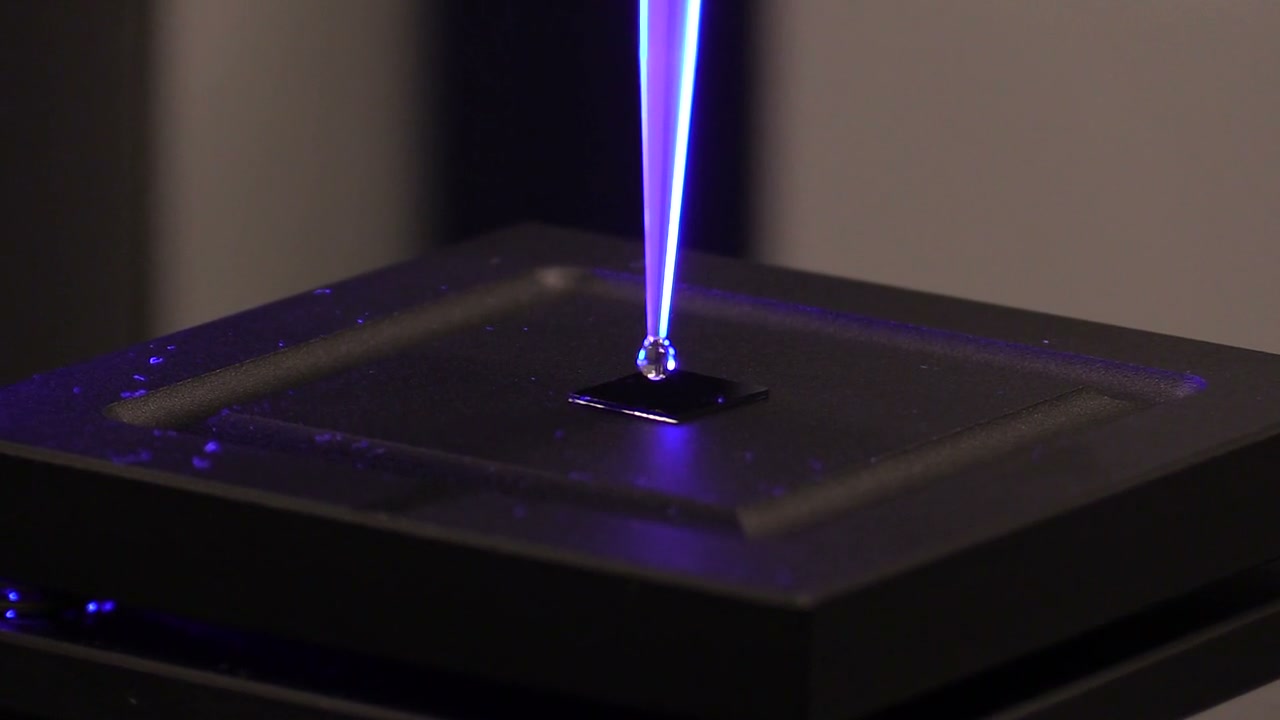
 Film credits
The carrier changes the neighbourhood.
Investigate whether a polymer changes the active’s surroundings, and whether that mechanism helps or compromises the application.
Proposed programme | Application, materials, capacity and rights to be qualified.
A polymer is more than a container.
A degradable particle can alter the chemical environment as well as hold an ingredient.
A degradable particle can alter the chemical environment as well as hold an ingredient. Local pH, water access and polymer breakdown may influence what is released and how it behaves. A formulation team needs to distinguish these effects before describing a measured difference as targeted or enhanced delivery.
The proposed opportunity is a mechanism-led investigation of a polymeric carrier in one non-clinical formulation application. The question might concern active retention, controlled availability or compatibility with a base. A supplier or development sponsor would receive an explanation of the plausible contribution and the controls required to test it, rather than a generic promise attached to nanoparticles.
Examine the development decision
The carrier changes the neighbourhood.
Open the sequence to examine what a development decision needs.
Identify the exact preparation, its source, and the properties a second laboratory must be able to reproduce.
Explanatory geometry · no simulated or measured performance
Using a counterexample to sharpen the mechanism.
Luengo et al.
Luengo et al. (2021) investigated flufenamic acid with PLGA particles under buffered and non-buffered conditions. Their data supported a local-pH explanation for enhanced permeation in that system, rather than establishing that intact particles universally cross skin. The authors also examined caffeine, whose behaviour did not support the same effect.
This is valuable precisely because the mechanism is conditional. For a new active, ionisation, solubility and the polymer’s degradation products need to be considered together. The proposed Bio programme would use that external study to develop controls, while leaving the outcome for the buyer’s compound and formulation unresolved.
Making ionisation an explicit hypothesis.
For a simple monoprotic weak acid, the neutral fraction can be estimated from pH and pKa under a defined equilibrium approximation.
For a simple monoprotic weak acid, the neutral fraction can be estimated from pH and pKa under a defined equilibrium approximation. Lower pH increases that fraction in the model, but does not by itself establish permeation, safety or a useful carrier. A microenvironment may differ from the measured bulk liquid, and activity coefficients can become important.
A reader could explore how changing the stated pH affects neutral fraction while the page keeps solubility and the carrier mechanism separate. The output would be a labelled chemical hypothesis. Real preparations need actual speciation and method review, especially when several ionisable groups, binding or non-aqueous regions make the simple model inappropriate.
Equilibrium speciation estimate, not a skin-delivery prediction.
- neutral weak-acid fraction1
- negative logarithm of hydrogen-ion activity1
- acid dissociation constant expressed on pH scale1
Model conditions. Single monoprotic acid; equilibrium; appropriate activity approximation. Bulk pH does not necessarily represent a particle microenvironment.

The carrier and its contribution.
Compare a structured carrier with a simpler vehicle around loading, availability, handling and the intended formulation.
Design controls that separate contributions.
A proposed experiment could compare dissolved active, dissolved active with empty particles and loaded particles.
A proposed experiment could compare dissolved active, dissolved active with empty particles and loaded particles. Buffered and non-buffered conditions may help distinguish a pH-mediated effect when justified by the chemistry. Matching recoverable active and recording polymer concentration prevents a loading difference from obscuring the question.
The separation method must also be qualified before calling material encapsulated. Wallace et al. (2012) describe how incomplete separation can distort such estimates. For a polymer system, adsorption to surfaces or active exchange during separation can add further uncertainty. The study should report what the analytical operation establishes and what remains a mechanistic inference.
Watch the polymer after incorporation.
The surrounding formulation can change hydration, aggregation and degradation.
The surrounding formulation can change hydration, aggregation and degradation. A particle preparation characterised in water may not represent the same entities after addition to a serum, gel or solvent-rich base. The proposal would compare relevant incorporation and ageing conditions rather than treating the fresh concentrate as the finished product.
The NIST light-scattering protocol helps frame the measurement inputs and reporting needed for size estimates (Hackley and Clogston, 2015). Physical size alone would remain insufficient: polymer molecular characteristics, active recovery and local chemistry may need complementary methods. The buyer’s acceptable application window would determine which observations deserve priority and which changes require a new interpretation.
Creating value without claiming a delivery platform.
An ingredient business could use a scoped mechanism brief to decide whether its polymer contribution warrants a larger formulation study.
An ingredient business could use a scoped mechanism brief to decide whether its polymer contribution warrants a larger formulation study. A beauty-development team could use it to choose between a carrier and a simpler pH or solvent adjustment. The comparison should allow the simpler option to win if it solves the same problem more directly.
The proposed paid output is a source-linked mechanism map, control rationale and quotation-ready study scope. A novel carrier claim would come later, if reproducible evidence and rights justify it. This protects the company’s collaboration ambitions while directing resources towards a defined question with a realistic evaluator and commercial consequence.
The first discriminating observation.
The cheapest useful check may be a validated active assay and pH record across preparations, rather than an elaborate uptake image.
The cheapest useful check may be a validated active assay and pH record across preparations, rather than an elaborate uptake image. If those measurements show that a bulk chemical change explains the difference, the programme can be reframed before a costly study is commissioned. Fluorescent labels would need their own retention and specificity controls.
A useful opening discussion includes active chemistry, polymer grade, preparation method, intended base and the endpoint that matters. The first milestone should identify a test capable of separating competing mechanisms. New laboratory work, human tissue use and any downstream product claims need separately qualified delivery and review; the proposed page invites that specific development discussion.

The next proposed comparison.
Mechanism-discriminating polymer-carrier comparison brief.
Colloidal delivery · Proposed development discussion
A development path
for this research.
Is an observed delivery difference caused by encapsulation, polymer degradation or a changed local chemical environment?
The people this could serve.Formulation, ingredient and application development teams.
The decision behind the project.
Your intended application, present alternative and the constraint behind “Polymeric carriers and local chemistry”. A useful starting point is the change that would justify another development step.
A proposed scope centred on mechanism-discriminating polymer-carrier comparison brief.
Agree the comparison, acceptance basis and responsible expertise before discussing a paid package.
Specialist methods and a defined contribution.
Bring relevant analytical or experimental expertise, a comparator suggestion, and the conditions under which your method could resolve this question.
A jointly scoped proposal could connect your contribution with mechanism-discriminating polymer-carrier comparison brief.
Define contributions, required access, independent preparations and permitted outputs before work or protected information is shared.
The commercial purpose of the next milestone.
Bring the application or asset thesis, the buyer you expect to value it, and the scientific or commercial uncertainty that must be resolved before another commitment.
The proposed decision record would connect the buyer question with mechanism-discriminating polymer-carrier comparison brief. It would identify what a subsequent comparison needs to demonstrate.
Demand, development cost, resources, rights and a decision-changing milestone would need examination. No financing terms or investment outcome are represented here.
What a useful comparison
would record.
- Record neutral weak-acid fraction (1) with the preparation, method and conditions needed to interpret it.
- Record negative logarithm of hydrogen-ion activity (1) with the preparation, method and conditions needed to interpret it.
- Define the active, carrier composition and recoverable loading on a common mass basis.
What the proposed
brief could leave behind.
- Mechanism-discriminating polymer-carrier comparison brief
- A preparation, comparator and endpoint record tied to this question.
- A source-linked account of the evidence gaps, study assumptions and next review point.
The proposed discussion brief
A brief you
can take away.
Use non-confidential notes to connect this topic with your own decision. Entries stay in this browser tab; saving creates a text file on your device. Nothing is submitted.
Scoped paid evidence brief, then separately qualified comparison; evaluation or licensing only after reproducibility, capacity and rights review.
Notes are optional. The brief includes this page’s proposed question and public source links.
Proposed scope; resources, methods, rights and delivery terms would be agreed before work. Begin with non-confidential information.
Sources and reading notes.
External work is identified below. Access notes describe the material inspected for this page; company research questions and proposed work are not presented as findings from these sources.
Luengo et al, 2021Luengo et al. (2021) Human Skin Permeation Enhancement Using PLGA Nanoparticles Is Mediated by Local pH Changes
Carrier degradation, local pH, ionisation and controls in flufenamic-acid/caffeine skin experiments.
Scope and limitations: CC BY 4.0 full XML inspected. Specific acidic-drug study; no general particle passage, product efficacy or permission for Bio human-use work.
Open original sourceWallace et al, 2012Wallace et al. (2012) Drug release from nanomedicines: Selection of appropriate encapsulation and release methodology
Separation efficiency and scattering checks before release/encapsulation interpretation.
Scope and limitations: Abstract-level scope only. No quantitative result or figure reused; full methods review needed before any study design is commissioned.
Open original sourceHackley and Clogston, 2015Hackley and Clogston (2015) Measuring the Size of Nanoparticles in Aqueous Media Using Batch-Mode Dynamic Light Scattering
Stokes–Einstein relation, measurement medium, intensity weighting and reporting.
Scope and limitations: Physical measurement guidance. No qualification of Bio equipment; no universal particle-size threshold or stability conclusion.
Open original source