
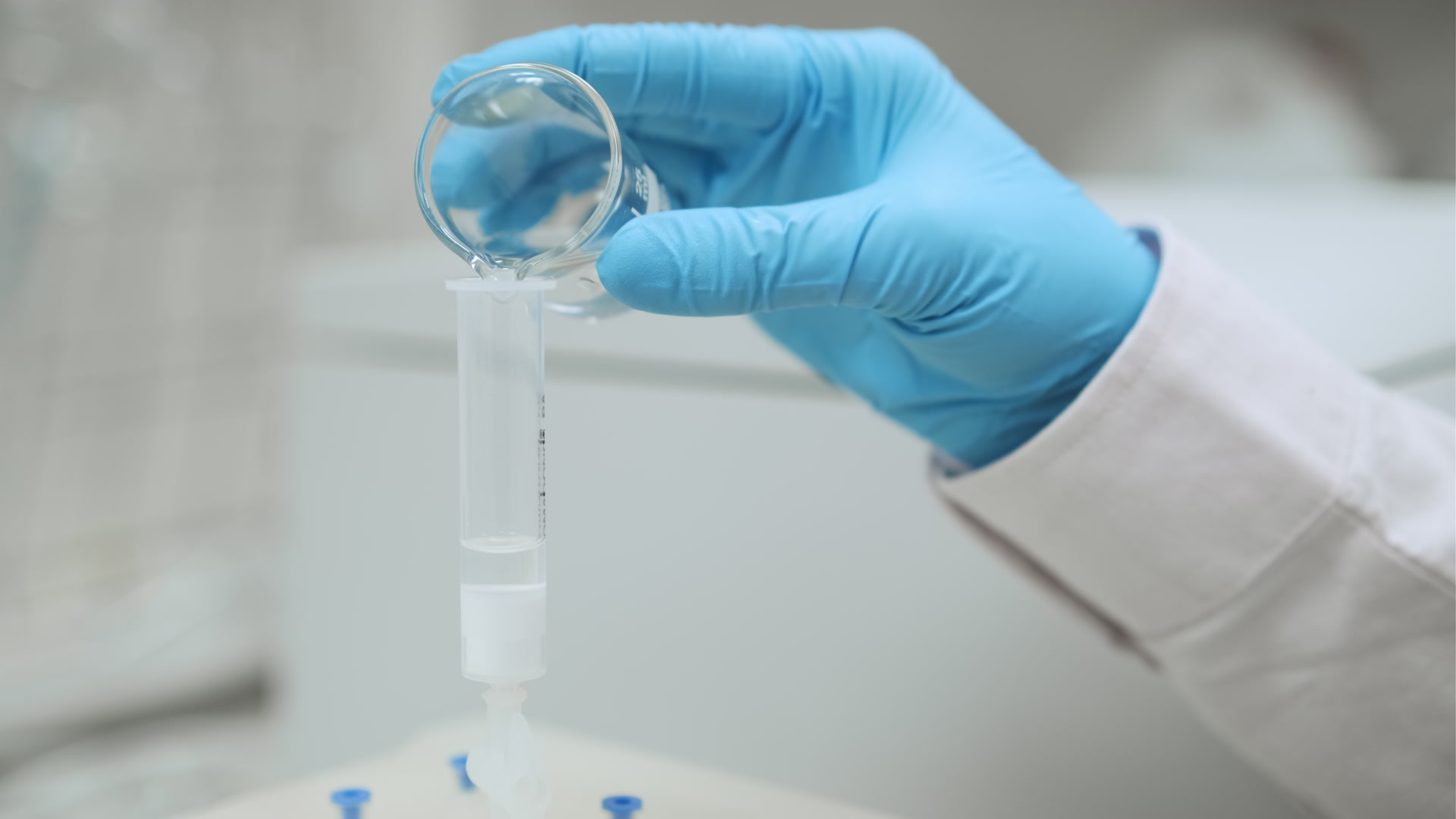
 Film credits
Identifying the polymer inside the recovery cost.
A candidate PHA recovery appraisal separating biomass content, recovered polymer, preparation quality and the process burden required to deliver it.
Candidate programme | Proposed scope, expertise and material access to be established.
The product location changes the route.
Intracellular material begins with a different boundary.
A target stored within biomass creates a recovery question distinct from a polymer released into the liquid. The proposed programme asks how much target is present, how much can be recovered and what properties remain useful after the selected sequence. A high biomass concentration alone does not establish a large or usable polymer output.
A materials sponsor should identify the intended polymer composition and application requirements before choosing a recovery study. The relevant asset may depend on molecular integrity, residual components and process feasibility. The first brief connects those requirements with the actual feed, rather than using a generic bioplastic market story to justify an extraction campaign.
Examine the development decision
Identifying the polymer inside the recovery cost.
Open the sequence to examine what a development decision needs.
Identify the exact preparation, its source, and the properties a second laboratory must be able to reproduce.
Explanatory geometry · no simulated or measured performance
The detail of the recovery evidence on its own conditions.
A solvent name is not an extraction result.
Montiel-Jarillo et al. (2022) compared pretreatment and extraction conditions for PHA-containing mixed-culture biomass. The study supports retaining feed composition and treatment sequence when assessing recovery. Its observations are external and are not inserted as expected Bio yields or transferred into a commercial operating method.
The candidate appraisal would identify whether the starting material is wet, dried or otherwise conditioned and how target content was measured. A route applied to one biomass composition may answer a different question from another. Those distinctions should be resolved before a sponsor compares reported recovery fractions or makes a plant assumption.
Separate content, recovery and accepted mass.
Each denominator answers a different question.
Target content is a share of biomass on a specified basis. Recovery is the share of that target retained through the defined process. Accepted output additionally requires the resulting material to meet a stated requirement. The model can connect those quantities without implying that retained mass has the necessary purity or performance.
A process team should retain dry-biomass basis and the analytical method used for target content. If crude solids are counted as polymer, the calculation can overstate both feed value and output. The proposed model is an inventory structure and contains no invented PHA concentration, recovery fraction or commercial acceptance rate.
Connect biomass, measured target content and recovery on one basis.
- Dry biomass entering the defined processkg
- Target-polymer dry mass fractionkg kg⁻¹
- Analytically matched recovery fraction1
- Recovered target masskg
Model conditions. Defined biomass and target assay, consistent moisture basis. Accepted quality and residuals require separate assessment. Descriptive identity or proposed planning relation; cited sources provide the relevant method/process context, not empirical Bio validation.

Count the output you can actually use.
Connect biological production, recovery and analytical qualification before committing to the next process step.
The detail of the material after recovery.
Mass retention does not guarantee unchanged properties.
The recovery sequence may involve treatments that affect the polymer or leave additional components. The proposed comparison should therefore pair mass accounting with the property relevant to the buyer’s application. A route that recovers more material but makes it unsuitable for processing may not improve the ingredient or material proposition.
Taylor and Kuyatt (1994) provide measurement-uncertainty guidance relevant to interpreting such records. Their framework does not validate a Bio assay. The scope should identify uncertainty in target content, recovered mass and property measurements before displaying a precise-looking economic result.
Change the conditions · examine the reference
Which kilogram are we discussing?
Follow target material from feed to accepted output. Change two retentions and see why recovered mass alone does not settle the proposition.
The data, equations and controls remain available below if 3D cannot load.
Defined model · illustrative conditions
Initial target 3 kg in 20 kg dry matter. Extraction, purification and qualification use different retained-mass boundaries.
Identify the recovery or qualification uncertainty that could change usable output before discussing process economics.
The defined comparison
Illustrative accounting: 100 kg wet feed, dry fraction 20%, target fraction in dry feed 15%, purification retention 80%; extraction and qualification retentions are selected. Qualification retention means the fraction of target mass meeting a stated criterion, not a probability of regulatory approval. Bar lengths use one common target-mass scale; losses are the differences between stages. Wet feed, dry feed and target mass are distinct denominators. No Bio yield, process price, environmental benefit or scale-up result is implied.
Inspect the calculated values
Calculation grid, not measured observations. Inputs and assumptions are stated above.
| Extraction retention / % | Extracted target | Accepted target |
|---|
Compare complete process burdens.
An extraction advantage can require expensive finishing.
The proposed route record would include feed conditioning, recovery agents, separation, residual removal, drying and waste handling. A comparison that counts only the central extraction step can omit the resources needed to deliver the material. The sponsor should define the boundary that corresponds to the intended commercial preparation.
CPI publishes downstream-processing capabilities that provide an external access model for such development work (CPI, n.d.). This is not a Bio partnership, available booking or price quote. An appropriate provider would need to review the actual target, biomass and output requirements before an experiment or transfer study is commissioned.
Identify the application-facing specification.
The buyer determines which quality differences matter.
A development sponsor could be assessing a polymer for a particular material function or processing route. It would need to specify the incumbent, required preparation and unacceptable residual or structural changes. Those criteria turn a generic recovery assay into a meaningful comparison. A lower gross recovery might be acceptable if it yields the usable material.
The programme would not infer biodegradability under all conditions, environmental superiority or application approval from the PHA label. Those are separate claims with separate evidence. The proposed first output is an accountable recovery and property question, capable of identifying the next laboratory or analytical decision.
Making the study quotation-ready.
The proposed package identifies inputs and responsibilities.
The scope would retain biomass identity, target-content method, candidate route boundaries and required output analyses. A qualified team could then propose a comparison that separates recovery from unwanted changes in the material. It should show which experiments are necessary and which assumptions can be resolved from existing records.
Material permissions, appropriate handling and competent execution are opening requirements. The commercial model begins with a bounded appraisal and an agreed experimental package where feasible. It does not describe Bio as a PHA manufacturer, owner of an extraction platform or supplier of qualified polymer.
The next proposed comparison.
A target-mass recovery and property-preservation decision brief.
The smallest go or stop check.
A recovery programme should serve the material decision.
A go decision would require a plausible route to sufficient accepted output and an application-relevant property record. A redesign could change the feed state or recovery boundary. A no-go could arise when the preparation cannot meet requirements or the full process burden removes the commercial reason to continue.
The cheapest useful test is often a paired target-content and recovered-product analysis on a defined feed. It can reveal whether the main uncertainty lies in biology, extraction or measurement. That insight should precede a larger process campaign, so capital follows the bottleneck rather than the attraction of a biopolymer headline.
Bioprocess development · Proposed development discussion
A development path
for this research.
Choose whether an intracellular-polymer recovery route deserves a qualified comparison before scale investment.
The people this could serve.Biopolymer process developers and material sponsors.
The decision behind the project.
Your intended application, present alternative and the constraint behind “Identifying the polymer inside the recovery cost.”. A useful starting point is the change that would justify another development step.
A proposed scope centred on a target-mass recovery and property-preservation decision brief.
Agree the comparison, acceptance basis and responsible expertise before discussing a paid package.
Specialist methods and a defined contribution.
Bring relevant analytical or experimental expertise, a comparator suggestion, and the conditions under which your method could resolve this question.
A jointly scoped proposal could connect your contribution with a target-mass recovery and property-preservation decision brief.
Define contributions, required access, independent preparations and permitted outputs before work or protected information is shared.
The commercial purpose of the next milestone.
Bring the application or asset thesis, the buyer you expect to value it, and the scientific or commercial uncertainty that must be resolved before another commitment.
The proposed decision record would connect the buyer question with a target-mass recovery and property-preservation decision brief. It would identify what a subsequent comparison needs to demonstrate.
Demand, development cost, resources, rights and a decision-changing milestone would need examination. No financing terms or investment outcome are represented here.
What a useful comparison
would record.
- Record dry biomass entering the defined process (kg) with the preparation, method and conditions needed to interpret it.
- Record target-polymer dry mass fraction (kg kg⁻¹) with the preparation, method and conditions needed to interpret it.
- Record analytically matched recovery fraction (1) with the preparation, method and conditions needed to interpret it.
What the proposed
brief could leave behind.
- A target-mass recovery and property-preservation decision brief
- A preparation, comparator and endpoint record tied to this question.
- A source-linked account of the evidence gaps, study assumptions and next review point.
The proposed discussion brief
A brief you
can take away.
Use non-confidential notes to connect this topic with your own decision. Entries stay in this browser tab; saving creates a text file on your device. Nothing is submitted.
Proposed recovery economics appraisal and qualified extraction comparison.
Notes are optional. The brief includes this page’s proposed question and public source links.
Proposed scope; resources, methods, rights and delivery terms would be agreed before work. Begin with non-confidential information.
Sources and reading notes.
External work is identified below. Access notes describe the material inspected for this page; company research questions and proposed work are not presented as findings from these sources.
Montiel-Jarillo et al, 2022Montiel-Jarillo et al. (2022) Improvement of the Polyhydroxyalkanoates Recovery from Mixed Microbial Cultures Using Sodium Hypochlorite Pre-Treatment Coupled with Solvent Extraction
Topic-specific external research context and measurement definitions; proposed Bio comparisons remain independent plans.
Scope and limitations: No Bio reproduction, access to strains, commercial rights or validation follows. Raw data and supplements not independently analysed. Citation only; no source images or passages reproduced. Individual licence retained in private retrieval receipt.
Open original sourceNIST/SEMATECH, n.d.Taylor and Kuyatt (1994) NIST Technical Note 1297
Narrow topic-specific context cited in the associated section.
Scope and limitations: Measurement uncertainty framework; no Bio method validation or accreditation.
Open original sourceCPI, n.d.CPI (n.d.) Downstream processing
Narrow topic-specific context cited in the associated section.
Scope and limitations: Official process capabilities; no Bio access or performance assumption.
Open original source