
 Film credits
The product changes the process around it.
Read shear-dependent broth behaviour alongside mixing, recovery and the function an ingredient buyer needs to preserve.
Candidate programme | Proposed scope, expertise and material access to be established.
Viscosity needs a condition.
One number can conceal the operating problem.
A broth described as viscous may behave differently during circulation, in a low-motion region or through a membrane module. The proposed comparison begins by specifying material state, temperature, shear range and process question. A single viscosity value without those conditions may not help a team decide whether a batch can be mixed or recovered.
For a polymer-producing process, the material can also change over time. The sponsor should identify the production phase in which the constraint appears and the operation it affects. A practical answer might concern a pumpable concentrate or a harvest window, rather than the largest viscosity value an analytical instrument can display.
Examine the development decision
The product changes the process around it.
Open the sequence to examine what a development decision needs.
Identify the exact preparation, its source, and the properties a second laboratory must be able to reproduce.
Explanatory geometry · no simulated or measured performance
Using a limited constitutive model.
A fitted relation has a range of validity.
Mohd Sauid et al. (2013) used a power-law description in a xanthan-solution oxygen-transfer study. That gives a relevant model form for discussing shear-dependent apparent viscosity. It is not a universal constitutive law for every broth, and their simulated liquid should not be presented as an actual Bio fermentation.
A proposed rheology record would retain the measured range and the fitting procedure. If yield behaviour, time dependence or structural recovery matters, the simple relation may be insufficient. The decision should therefore identify whether a model is being used to interpolate a defined measurement or to extrapolate beyond evidence.
Translate the fit into the question.
Apparent viscosity is not a material constant.
In the power-law model, apparent viscosity depends on shear rate when the flow index differs from one. The consistency coefficient has units that depend on that exponent. Comparing numerical coefficients across differently fitted ranges or units can be misleading. The proposed model view would therefore retain the dimensions and measurement window.
The buyer may care about the viscosity encountered in a particular operation, not the fitted coefficient itself. A process engineer would need to relate the measured material behaviour to the relevant device, geometry and operating context. No pump rating, mixing guarantee or safe operating point follows from this introductory relation.
A limited empirical fit over the stated measurement range.
- Shear stressPa
- Consistency coefficientPa sⁿ
- Shear rates⁻¹
- Flow index1
- Apparent viscosityPa s
Model conditions. No yield stress or time-dependent structure represented. Fit range, temperature and preparation must be retained; no Bio curve is supplied.
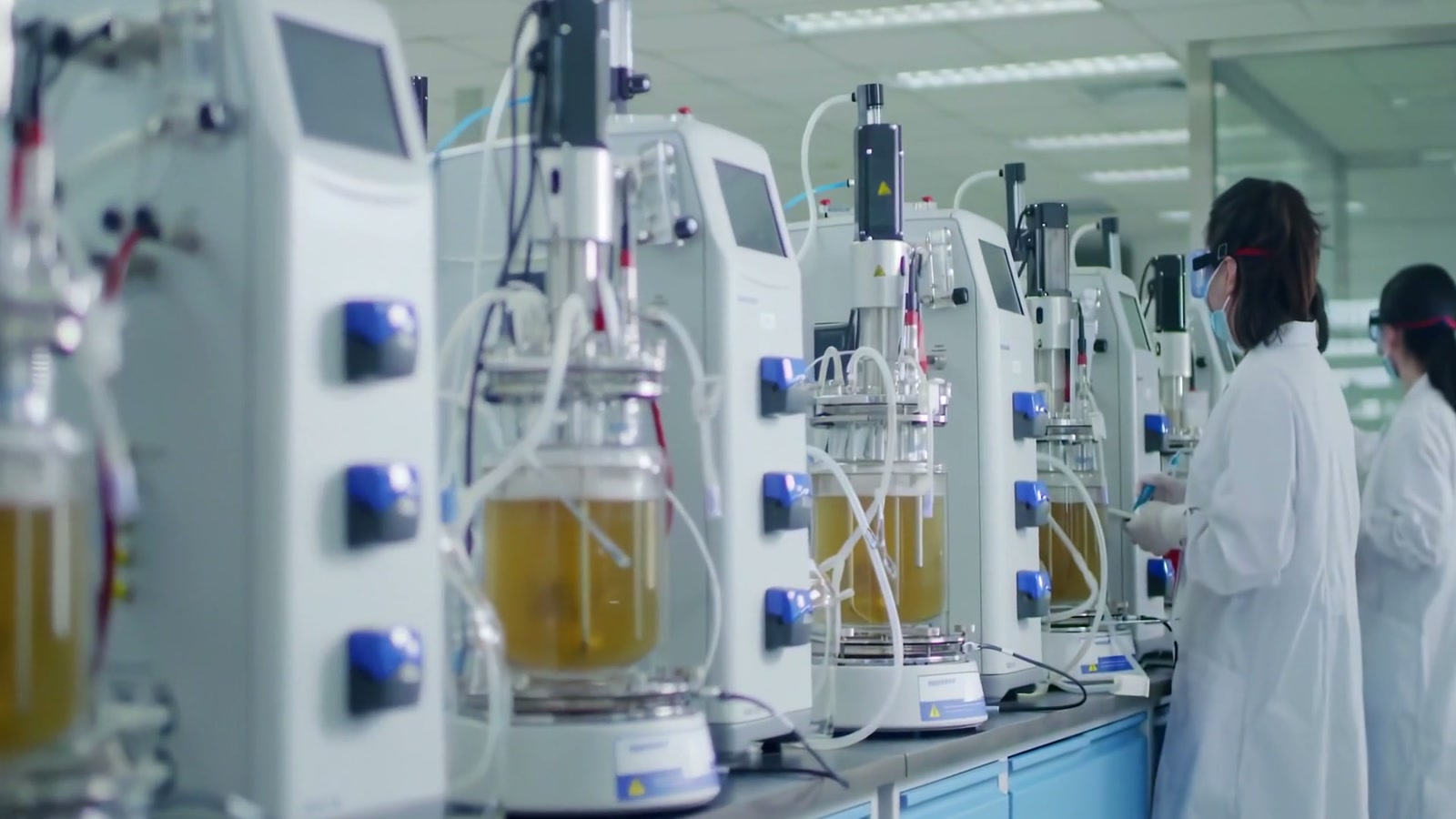
Count the output you can actually use.
Connect biological production, recovery and analytical qualification before committing to the next process step.
Keeping sample preparation visible.
The measured material must match the interpretation.
Schulze et al. (2023) included rheological measurements in a fermentation study involving extracellular polymer formation. The relevant methodological distinction is that a prepared analytical sample has its own state and history. Its behaviour should not be silently assigned to every stream in the production process.
The proposed scope would compare whole broth, clarified liquid or concentrate only where those are genuinely required. Centrifugation, storage and dilution can change the material being tested. An evaluator should be able to follow each rheogram to the actual preparation and sampling time before using it to support an equipment or recovery decision.
Consider the price of dilution.
Easier handling can create more downstream work.
A dilution step may make a material easier to circulate while increasing the liquid volume that must later be processed. A proposed comparison would examine the operation it enables, the target product retained and the additional water and concentration burden. The useful question is whether the complete sequence improves the delivered-material proposition.
Baptista et al. (2022) examined membrane recovery of FucoPol and product properties. That is a relevant external example of connecting downstream choices with the polymer received. It does not establish a dilution strategy, membrane or recovery performance that can be transferred unchanged to the candidate material.
Preserve the useful material.
A process-friendly change can alter the application.
An ingredient sponsor may need a molecular-size range or functional response that makes the polymer worth considering. A treatment that reduces broth resistance can also change the product. The proposed comparison should pair process measurements with the analytical or application endpoint that the buyer wants preserved.
The output should distinguish a handling improvement from an ingredient improvement. A lower viscosity might be helpful in one unit operation and undesirable in the formulation. The review would identify that trade-off explicitly, enabling the sponsor to choose the next test without assuming that every reduction in processing difficulty creates a better material.
Agree a characterisation package.
Measure only what the decision requires.
The proposed package would include sampling states, relevant shear and time conditions, temperature, fitting choices and a process interpretation. It could identify whether a more detailed model, different sample or additional device characterisation is necessary. A qualified rheologist and process engineer would need to review the scope before experimental work is offered.
Customer inputs should include the problematic operation, material history, acceptable handling constraints and the application endpoint. An initially small comparison of the correct samples may clarify the bottleneck more effectively than a large suite of unrelated measurements. Fees and execution would follow actual capacity and an agreed method.
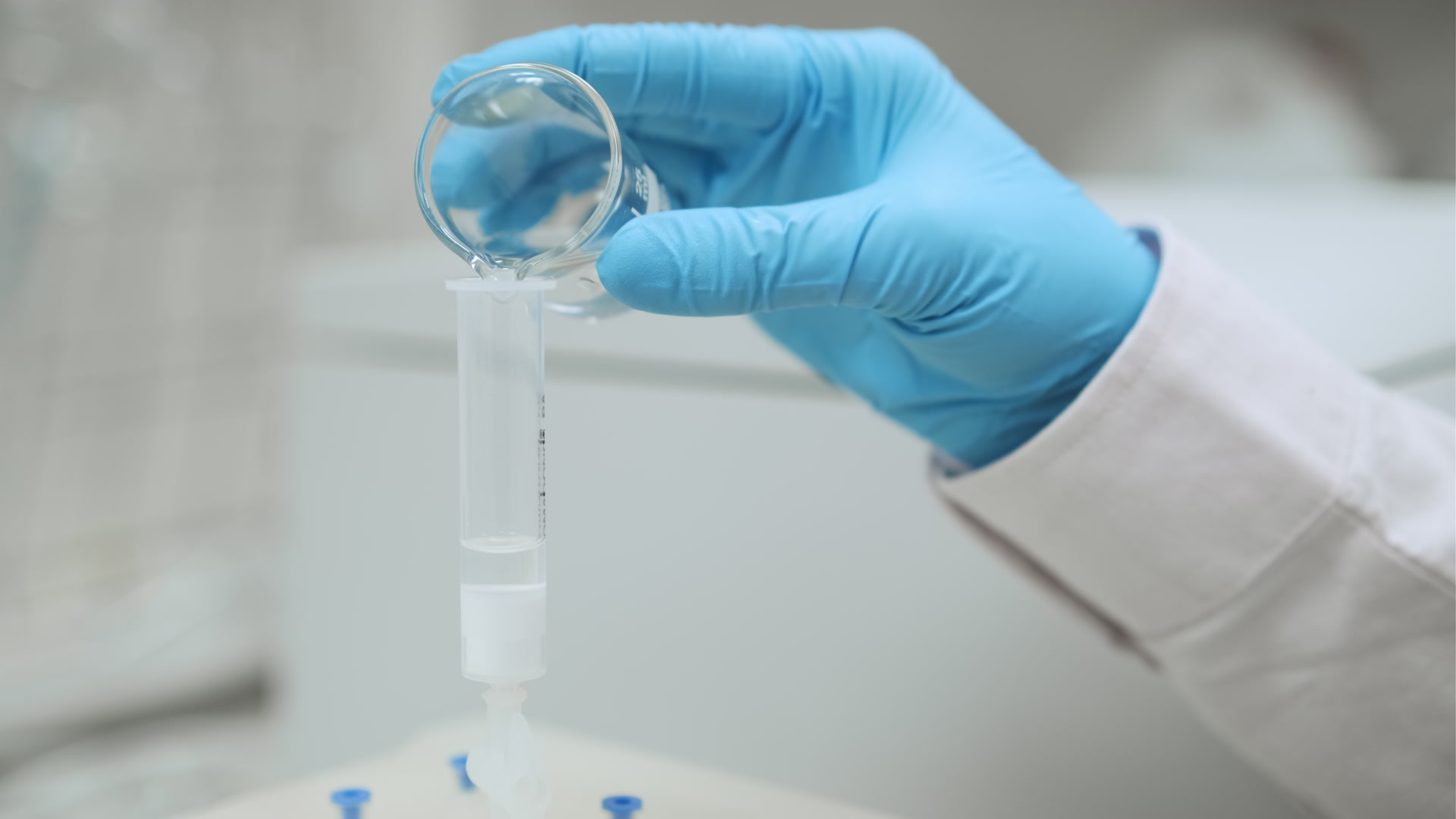
The next proposed comparison.
A condition-specific rheology and process-impact comparison brief.
An intervention worth testing.
The next step should resolve a specific constraint.
A go decision might support a narrow dilution or harvest comparison while retaining the useful function. A redesign might follow evidence that the selected model does not represent the relevant material. A no-go could arise if the recovery route requires a transformation that removes the buyer’s reason to use the product.
The cheapest useful check is often a matched rheology record at the process-relevant states, alongside a basic material identity assay. The proposed programme invites a sponsor to bring the operation and product requirement together. That is how a viscosity problem can become an actionable development decision rather than an isolated graph.
Bioprocess development · Proposed development discussion
A development path
for this research.
Choose whether a viscous-broth constraint needs dilution, process redesign or a different harvest condition.
The people this could serve.Polymer fermentation and downstream teams.
The decision behind the project.
Your intended application, present alternative and the constraint behind “The product changes the process around it.”. A useful starting point is the change that would justify another development step.
A proposed scope centred on a condition-specific rheology and process-impact comparison brief.
Agree the comparison, acceptance basis and responsible expertise before discussing a paid package.
Specialist methods and a defined contribution.
Bring relevant analytical or experimental expertise, a comparator suggestion, and the conditions under which your method could resolve this question.
A jointly scoped proposal could connect your contribution with a condition-specific rheology and process-impact comparison brief.
Define contributions, required access, independent preparations and permitted outputs before work or protected information is shared.
The commercial purpose of the next milestone.
Bring the application or asset thesis, the buyer you expect to value it, and the scientific or commercial uncertainty that must be resolved before another commitment.
The proposed decision record would connect the buyer question with a condition-specific rheology and process-impact comparison brief. It would identify what a subsequent comparison needs to demonstrate.
Demand, development cost, resources, rights and a decision-changing milestone would need examination. No financing terms or investment outcome are represented here.
What a useful comparison
would record.
- Record stress or shear rate, temperature, geometry and the complete conditioning sequence.
- Retain flow or oscillatory observations over the application-relevant operating window.
- Compare the response after the defined deformation and recovery interval against a matched preparation.
What the proposed
brief could leave behind.
- A condition-specific rheology and process-impact comparison brief
- A preparation, comparator and endpoint record tied to this question.
- A source-linked account of the evidence gaps, study assumptions and next review point.
The proposed discussion brief
A brief you
can take away.
Use non-confidential notes to connect this topic with your own decision. Entries stay in this browser tab; saving creates a text file on your device. Nothing is submitted.
Proposed broth characterisation and recovery-feasibility appraisal.
Notes are optional. The brief includes this page’s proposed question and public source links.
Proposed scope; resources, methods, rights and delivery terms would be agreed before work. Begin with non-confidential information.
Sources and reading notes.
External work is identified below. Access notes describe the material inspected for this page; company research questions and proposed work are not presented as findings from these sources.
Mohd Sauid et al, 2013Mohd Sauid et al. (2013) Enhancement of Oxygen Mass Transfer and Gas Holdup Using Palm Oil in Stirred Tank Bioreactors with Xanthan Solutions as Simulated Viscous Fermentation Broths
Topic-specific external research context and measurement definitions; proposed Bio comparisons remain independent plans.
Scope and limitations: No Bio reproduction, access to strains, commercial rights or validation follows. Raw data and supplements not independently analysed. Citation only; no source images or passages reproduced. Individual licence retained in private retrieval receipt.
Open original sourceSchulze et al, 2023Schulze et al. (2023) Investigation of exopolysaccharide formation and its impact on anaerobic succinate production with Vibrio natriegens
Topic-specific external research context and measurement definitions; proposed Bio comparisons remain independent plans.
Scope and limitations: No Bio reproduction, access to strains, commercial rights or validation follows. Raw data and supplements not independently analysed. Citation only; no source images or passages reproduced. CC BY-NC-ND: no adapted source content or reproduced data is included.
Open original sourceBaptista et al, 2022Baptista et al. (2022) Extraction of the Bacterial Extracellular Polysaccharide FucoPol by Membrane-Based Methods: Efficiency and Impact on Biopolymer Properties
Topic-specific external research context and measurement definitions; proposed Bio comparisons remain independent plans.
Scope and limitations: No Bio reproduction, access to strains, commercial rights or validation follows. Raw data and supplements not independently analysed. Citation only; no source images or passages reproduced. Individual licence retained in private retrieval receipt.
Open original source