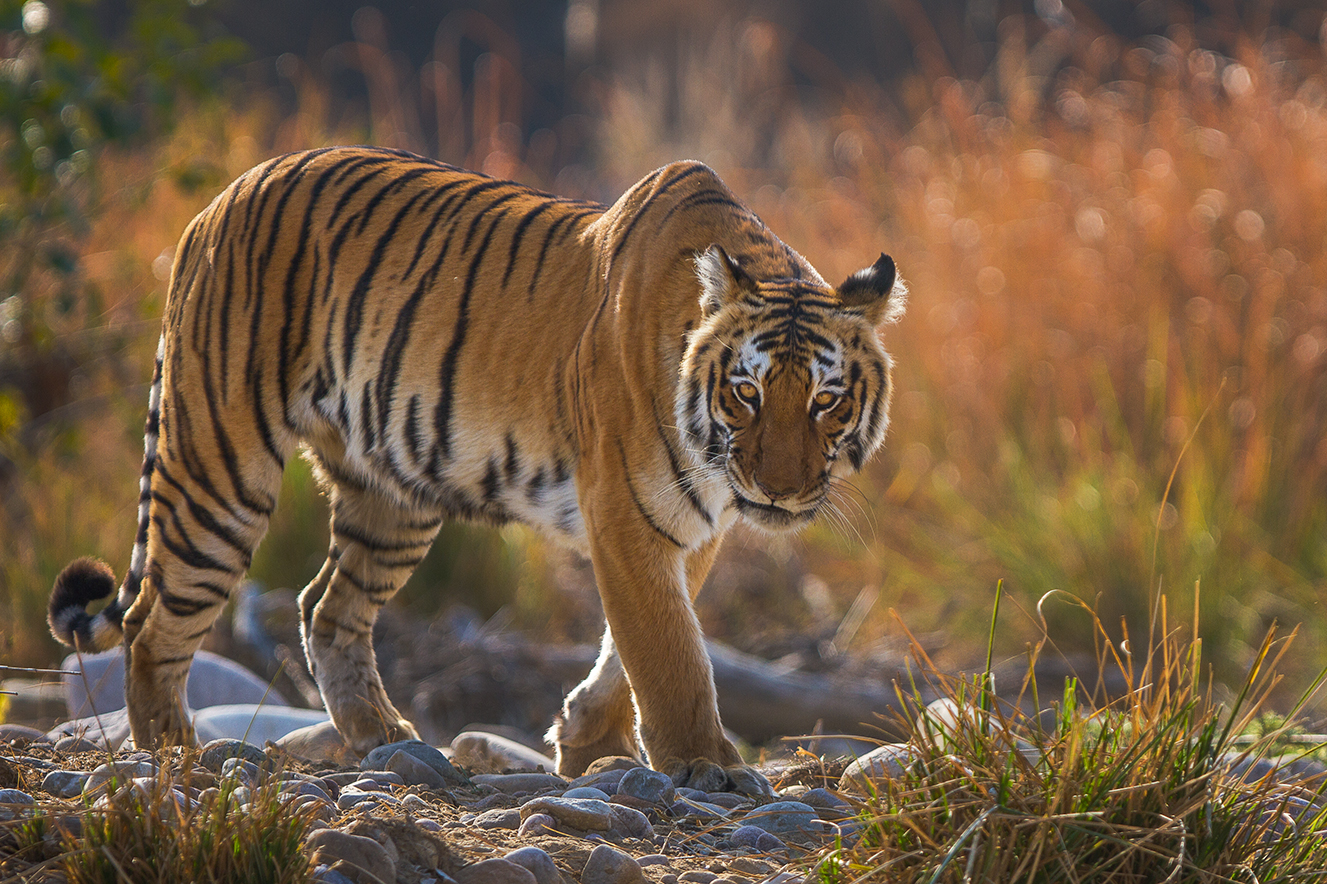
A pattern with an identity.
Individual stripes help researchers distinguish tigers in camera-trap records.

Himalayan foothills | Forests and grasslands of the Terai
Below the Himalayan peaks, a tiger’s future depends on prey, connected habitat and safer coexistence with people. A reserve is a beginning. A living landscape needs connections.
Global species assessment published in 2022. National population changes do not describe every local population.
A life worth understanding
The Shivalik foothills and Terai bring together forests, grasslands, rivers and farms. Tigers move through this mosaic to find prey and mates. Their wider range also includes other parts of Asia; this story focuses on one important landscape.
Tigers usually live and hunt alone. Each animal’s stripe pattern is distinctive, helping researchers recognise individuals in camera-trap images. A life that can be difficult to observe becomes more understandable through careful monitoring.
Individual stripes help researchers distinguish tigers in camera-trap records.
Large prey and sufficient territory are part of the foundation for this carnivore’s survival.
Habitat beyond a reserve boundary can matter for access to food, mates and space.
The facts | Their context
Conservation figures and assessments describe particular places, dates and methods. Their meaning matters as much as their size.
The All India Tiger Estimation gave a range of 3,167–3,925. Reaffirmed in an official 2024 response, this is a national estimate with uncertainty, not a 2026 or global headcount.
Read the evidenceThe IUCN assessment was completed in December 2021 and published in 2022. Recovery in some places does not mean every tiger population is secure.
Read the evidenceHabitat | Pressure | Possibility
Explore the relationships that shape this animal’s future. Each pathway shows where protection can make a difference.
Forests and grasslands
Connected movement routes
Access to prey and mates
Landscape planning and habitat connections help address needs that cross reserve boundaries. Roads, settlement and other land uses can interrupt those routes.
Changing water and vegetation
Habitat and fire pressures
Additional demands on wildlife and people
Climate can change habitat suitability and interactions with people. In the Terai, this must be considered alongside poaching, prey loss and fragmentation. Coastal sea-level projections cannot simply be transferred to the foothills.
Trained local response
Coordinated professional support
Safer shared landscapes
The Wildlife Trust of India’s Terai Tiger Project describes community response teams working with professional support in the Pilibhit–Dudhwa–Katerniaghat landscape. Local people and forest staff are central to the work.
Illustrative relationships, not a geographic map or a prediction of conservation outcomes.
Why protection matters
The tiger’s need for prey and territory gives conservation a wider horizon. Protecting suitable, connected habitat can benefit other species living within it. Those benefits are not automatic: the work must also account for the safety and livelihoods of people sharing the landscape.
The longer story
Recognising individuals helps connect a glimpse in a camera trap with a larger picture of where animals live and move.
Living Species: Tiger ↗India’s tiger assessment provides a dated monitoring baseline. Its range belongs beside its headline number.
PARLIAMENT QUESTION: Increase in Tiger Population ↗Terai conservation includes habitat connectivity, coexistence and infrastructure planning, alongside protection inside reserves.
Terai Arc ↗The VARUNÉ Bio contribution
The Himalayan exploratory world extends from high mountains to their foothills. Our conservation story follows that geography, while keeping tiger habitat distinct from alpine snowfields.
Publish an illustrated account of connected forests, tiger biology and the people working on coexistence. Direct readers to the organisations responsible for that work.
Assess one organisation-defined education or coexistence priority in the Terai, with an owner, realistic budget and proportionate reporting before deciding on a contribution.
Set a budget, purpose, reporting basis and permissions with the organisation. A financial contribution and a formal partnership are separate decisions.
Report confirmed support against its agreed purpose. A story about conservation is not evidence that VARUNÉ has protected a corridor, funded a field team or saved a specific animal.
The research connection. VARUNÉ Bio’s commercial work is ingredient research and cosmetic formulation science. Explore connects that work to biological questions and their environmental context. Wildlife conservation does not provide materials, permissions or evidence of cosmetic performance.
Explore the research questionsAction starts with understanding
Use the organisation’s own information to choose how to help. These links go directly to independent organisations.
Read how trained community teams and professionals respond to human–tiger encounters in the Terai.
Explore the Terai Tiger ProjectUse the official route and read how funds are allocated. A general donation may support the organisation’s wider priorities.
WWF-India givingKeep your distance, never feed wildlife and follow current park rules and authorised guides.
Read responsible visiting guidanceOrganisations are included as independent resources. Inclusion does not indicate a partnership, endorsement or financial contribution by VARUNÉ Bio.
The source trail | Checked 20 October 2026
AITE 2022: 3,682 estimated tigers; range 3,167–3,925. This is an India estimate, not a global count or a 2026 census.
Global Endangered, A2abcd. Date the assessment; national recovery does not change the global category.
Solitary, territorial carnivore; individual stripe patterns; prey-dependent spatial requirements. Taxonomy is under review, so use Panthera tigris at species level rather than debating subspecies.
Indian Terai in Uttarakhand, Uttar Pradesh and Bihar; corridor fragmentation, coexistence, monitoring, Chilla–Motichur crossing work. Programme self-report, not independent impact evaluation. Do not mix approximate landscape counts with the national census.
Climate can change habitat suitability, fire and water conditions and interactions with people. Use qualitatively; do not transplant Sundarbans sea-level findings into the Himalayan foothills.
Pilibhit–Dudhwa–Katerniaghat; trained local Primary Response Teams and professional response support. Public current project lead: Abhishek Ghoshal, head.conflictmitigation@wti.org.in. Describe activities without adopting unverified impact claims.
Keep distance, no wildlife feeding, avoid flash, use local guides and leave no litter. Apply general wildlife-viewing principles alongside current park rules, not as encounter-management instructions.
Route readers directly to the organisation. It states donation options are indicative and funds used where most required; do not imply a gift is restricted to one species or that VARUNÉ receives it.
Apex-predator role and broad benefits of habitat protection. No quantified carbon claim for VARUNÉ and no simplistic guarantee that tiger presence restores every forest.