Ice is a hunting platform.
The animal’s connection to sea ice is about access to prey, not simply a preference for cold weather.

Arctic | Sea ice and coastal habitats
For a polar bear, sea ice is a place to hunt, travel and find a mate. When the season of ice changes, the challenge is not simply staying cool. It is finding enough food to live.
US legal protection status. Regional populations and trends differ.
A life worth understanding
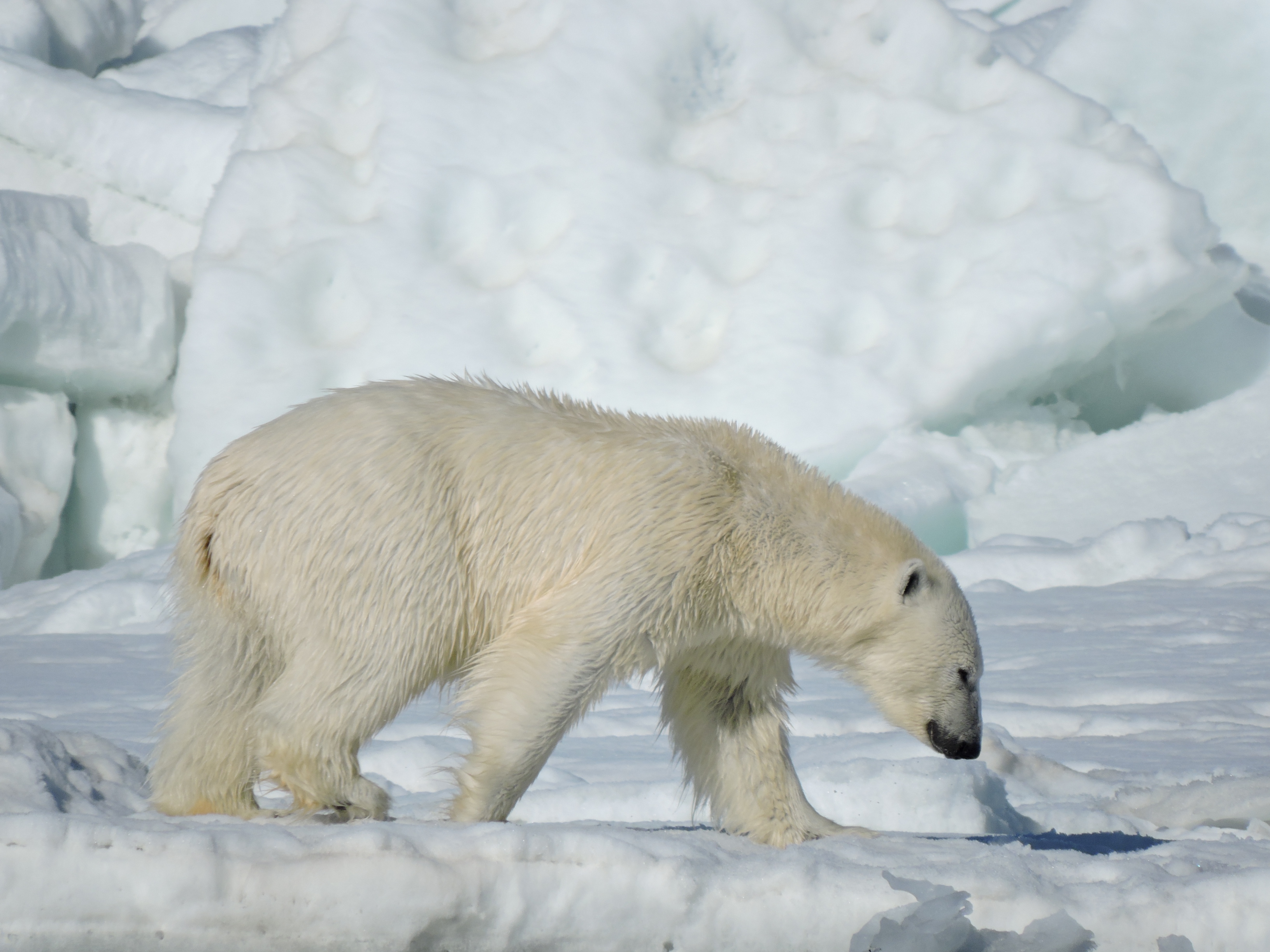
A polar bear is a marine mammal with a highly specialised way of life. Seals provide the energy-rich food it needs; sea ice provides access to that food. This is an animal adapted to a moving, seasonal landscape.
Its story is also a family story. A mother gives birth in a snow den and nurses her cubs using stored reserves. The young remain with her for just over two years, learning the skills of life on the ice.
The animal’s connection to sea ice is about access to prey, not simply a preference for cold weather.
Energy stored when hunting is successful matters during periods when food is harder to reach.
Cubs depend on maternal care and time together while developing the skills to survive.
The facts | Their context
Conservation figures and assessments describe particular places, dates and methods. Their meaning matters as much as their size.
NSIDC’s September 2026 release places all 20 in the last 20 years of its nearly 48-year satellite record. The 2026 minimum remains preliminary in that release. Extent is not ice thickness or volume.
Read the evidenceThe Western Hudson Bay aerial-survey estimate changed from 842 to 618 bears. The 2021 confidence interval was 385–852. This is not a count of deaths or a global trend.
Read the evidenceA 2024 paper followed bears near Churchill for 19–23 days in late-summer field seasons in 2019, 2021 and 2022. This small observational cohort cannot describe all polar bears.
Read the evidenceHabitat | Pressure | Possibility
Explore the relationships that shape this animal’s future. Each pathway shows where protection can make a difference.
Seasonal sea ice
Access to seals
Energy for survival and reproduction
The timing, location and duration of ice influence hunting opportunity. Different Arctic regions have different ice conditions, so an accurate account keeps regional evidence visible.
Less access to sea ice
Longer periods ashore
Greater demands on stored reserves
In the 2024 Churchill study, varied feeding and activity strategies on land generally did not prevent mass loss. The study explains an energy challenge; it does not measure global mortality.
Reduce warming pressures
Support research and coexistence
Protect people and bears
Climate action addresses the long-term habitat pressure. Established conservation work also studies bears, shares evidence and helps communities live safely alongside them. These are complementary tasks.
Illustrative relationships, not a geographic map or a prediction of conservation outcomes.
Why protection matters
Polar bears belong to an Arctic food web that connects ice, seals and the sea beneath them. They also have deep meaning for people who live in the North. A future for the bear requires a future for its habitat, with local communities involved in the decisions that affect both.
The longer story
A mother relies on stored energy while denning and nursing. In seasonal-ice regions, fasting may last around eight months; the duration varies by place and individual.
Top Mom and Cub Facts ↗Cubs stay with their mother for just over two years. Protecting the conditions for successful reproduction means thinking beyond a single season.
Top Mom and Cub Facts ↗Modern tracking and physiological measurements help explain how bears use energy during the ice-free season. That evidence supports decisions; it is not a substitute for habitat protection.
Polar bear energetic and behavioral strategies on land with implications for surviving the ice-free period ↗The VARUNÉ Bio contribution
Polar biology informs our scientific curiosity. This conservation strand asks what the surrounding habitat needs, alongside what materials research might learn.
Maintain this illustrated account of sea ice, feeding and family life, with dated evidence and direct links to established polar-bear organisations.
Discuss one education or research-communication priority with an established organisation, then assess an appropriate giving route and its actual requirements.
Set a budget, purpose, reporting basis and permissions with the organisation. A financial contribution and a formal partnership are separate decisions.
Report any confirmed contribution and its purpose, using the recipient’s description. We will not translate a donation into an invented number of bears saved.
The research connection. VARUNÉ Bio’s commercial work is ingredient research and cosmetic formulation science. Explore connects that work to biological questions and their environmental context. Wildlife conservation does not provide materials, permissions or evidence of cosmetic performance.
Explore the research questionsAction starts with understanding
Use the organisation’s own information to choose how to help. These links go directly to independent organisations.
Use the organisation’s own giving information to decide whether and how to contribute. Donations through this link go directly to Polar Bears International.
Polar Bears International givingSpecies protection and reducing the pressures on sea ice belong together. Explore practical civic, community and personal actions.
Explore climate actionsShare an accurate account of why ice matters, and keep dates and regional context with the numbers.
Explore polar educationOrganisations are included as independent resources. Inclusion does not indicate a partnership, endorsement or financial contribution by VARUNÉ Bio.
The source trail | Checked 20 October 2026
Biology and feeding ecology only; do not reuse older population-count labels as current
Conservation specialist natural-history explanation
2026 minimum explicitly preliminary in this release
Regional estimate; uncertainty and inter-population movement; do not repeat the separate 40%/2011 comparison without resolving its arithmetic
20 bears, short observation windows in Manitoba; not a global mortality estimate
Official public giving routes and terms