Balance on difficult terrain.
The long tail helps with balance and can wrap around the animal’s body.

Himalaya and the high mountains of Asia
A snow leopard can disappear against a mountainside while still needing an enormous landscape to survive. Its future depends on connected terrain, wild prey and coexistence with the people who live there.
The 2017 assessment estimated 2,710–3,386 mature individuals. This is not a 2026 census; reliable global estimates remain difficult.
A life worth understanding
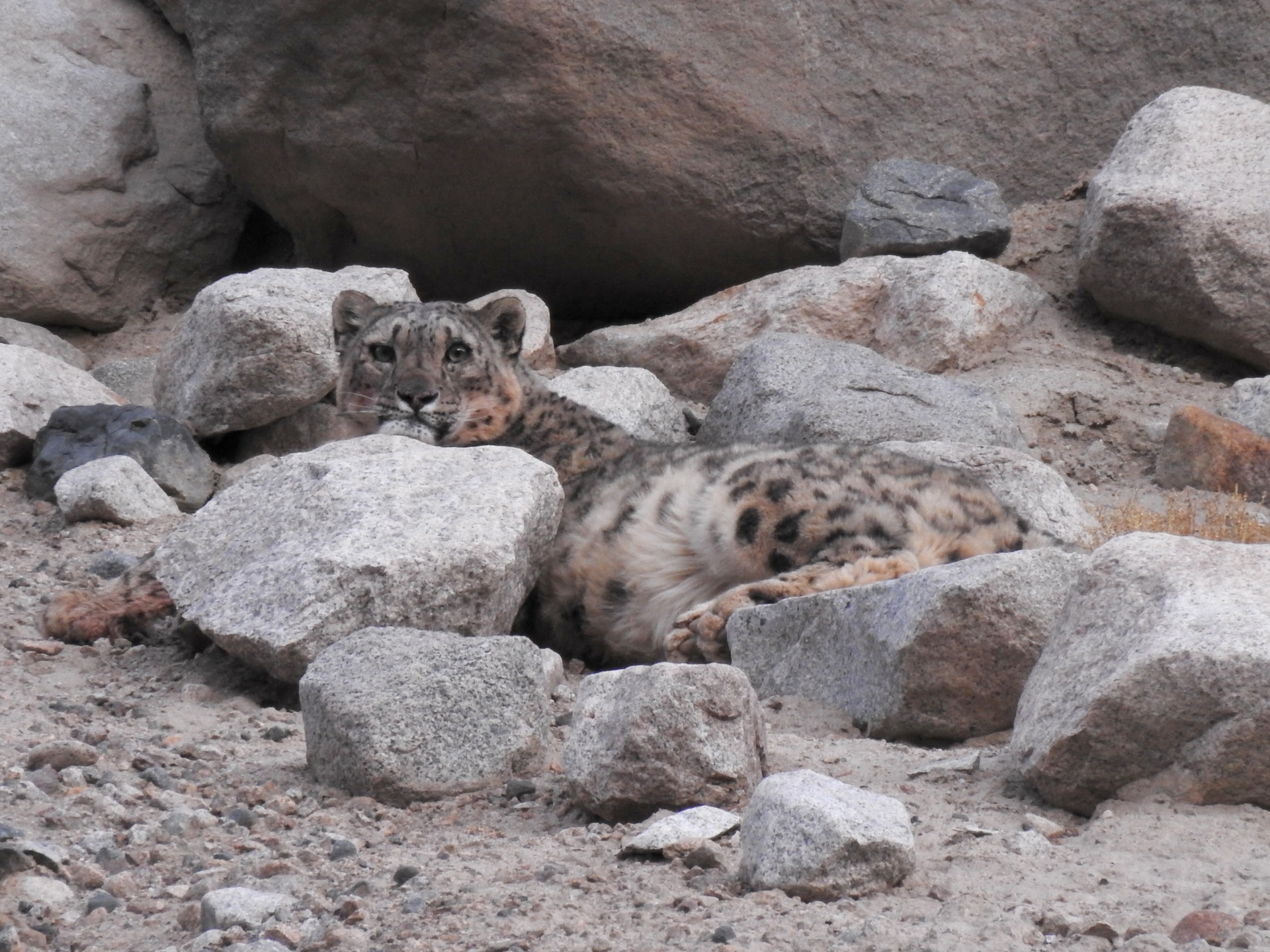
A long balancing tail, broad paws and patterned fur make the snow leopard a remarkable mountain specialist. Usually solitary, it often becomes active around dawn and dusk. Wild sheep and goats are important prey, with differences between regions.
Its range extends across 12 countries in Central and South Asia. “High mountain” does not mean the same elevation everywhere: northern populations can occur much lower than those in the Himalaya.
The long tail helps with balance and can wrap around the animal’s body.
Patterned fur blends with rocky terrain; the habitat is more than an expanse of snow.
The cat needs access to prey across terrain that can extend beyond the boundaries of one protected area.
The facts | Their context
Conservation figures and assessments describe particular places, dates and methods. Their meaning matters as much as their size.
Snow leopard conservation crosses borders and landscapes. This is a geographic range count, not a population trend.
Read the evidenceA 2016 study combined tracking of 16 cats in Mongolia with protected-area comparisons. This dated study is not a census of every reserve today.
Read the evidenceA 2024 study interviewed 139 households in 22 communities in India, Mongolia and Pakistan. The result is self-reported and context-specific, not a promise of zero conflict everywhere.
Read the evidenceHabitat | Pressure | Possibility
Explore the relationships that shape this animal’s future. Each pathway shows where protection can make a difference.
Healthy wild prey
Connected mountain habitat
Space for snow leopards
Effective protection needs enough suitable habitat and connections between it. A boundary on a map does not necessarily contain the full landscape an individual uses.
Changing climate
Shifting vegetation and water
Changing habitat continuity
Climate models suggest that treeline shifts can alter Himalayan habitat. These projections depend on scenarios and geography. Retaliation, prey loss, illegal trade and infrastructure create additional pressures.
Community-designed protection
Fewer livestock losses in protected corrals
A stronger basis for coexistence
A secure corral can protect a household’s livelihood and reduce one source of conflict. The 2024 evaluation supports targeted action; it does not establish a universal effect or a measured increase in snow leopard populations.
Illustrative relationships, not a geographic map or a prediction of conservation outcomes.
Why protection matters
Snow leopards are predators within mountain food webs. Protecting their terrain also concerns the wild prey and other biodiversity that share it. For herding communities, a livestock loss can be a serious livelihood shock. Lasting protection needs local agency, workable livelihoods and room for wildlife together.
The longer story
The 12 range states established the GSLEP cooperation framework for snow leopards and their ecosystems.
Global Snow Leopard and Ecosystem Protection Programme ↗The UN General Assembly designated 23 October as International Day of the Snow Leopard.
United Nations | International Day of the Snow Leopard ↗A fossil and anatomical study proposed repeated dispersal beyond Tibet and gradual adaptations for steep terrain, as well as cold and altitude.
Snow leopard evolution and mountain adaptations | 2025 ↗The VARUNÉ Bio contribution
The Himalaya is a distinct exploratory world within VARUNÉ Bio. Its material-research questions sit alongside an interest in the living landscape, including snow leopards.
Publish a clear account of mountain biology and coexistence, with a practical explanation of why secure livestock protection and community livelihoods matter.
Assess a defined education or coexistence priority with an established snow leopard organisation, then consider an appropriate financial contribution.
Set a budget, purpose, reporting basis and permissions with the organisation. A financial contribution and a formal partnership are separate decisions.
Report the organisation, agreed purpose and delivered contribution. Snow leopards are not sources of ingredients or subjects of a VARUNÉ cosmetic research programme.
The research connection. VARUNÉ Bio’s commercial work is ingredient research and cosmetic formulation science. Explore connects that work to biological questions and their environmental context. Wildlife conservation does not provide materials, permissions or evidence of cosmetic performance.
Explore the research questionsAction starts with understanding
Use the organisation’s own information to choose how to help. These links go directly to independent organisations.
Consider a direct contribution to the Snow Leopard Trust through its own giving route.
Explore the Trust’s work and givingLearn how local handicraft production and income connect with community conservation agreements.
Explore Snow Leopard EnterprisesKeep the date and meaning of population figures intact. The specialist species account is a useful place to start.
Read the species evidenceOrganisations are included as independent resources. Inclusion does not indicate a partnership, endorsement or financial contribution by VARUNÉ Bio.
The source trail | Checked 20 October 2026
Species biology, threats, range and the 2017 assessment estimate. The estimate is not a 2026 census.
Study using GPS data from 16 cats in Mongolia’s Tost Mountains and comparisons with 170 protected areas.
Evaluation of coexistence interventions, including self-reported livestock losses. Context-specific outcomes, not a universal guarantee.
Modelled habitat changes under treeline-shift assumptions. Projections are not observed global habitat losses.
Fossil and anatomical reconstruction of dispersal and adaptations. The authors’ interpretation remains part of an evolving scientific picture.
Cooperation framework established by the 12 range states in 2013.
23 October designated by the UN General Assembly in 2024.
Conservation agreements linked to local handicraft production and income.