Seeds travel with the animal.
Feeding and movement can carry seeds beyond the parent plant, connecting animal behaviour with forest regeneration.

Asian forests and foothills | The Terai and beyond
An elephant’s journey can carry seeds and shape a forest. Keeping those journeys possible means making room for wildlife and for the people who share the same land.
Asian elephant assessment completed in 2019 and published in 2020. This is a distinct species from African forest and savanna elephants.
A life worth understanding
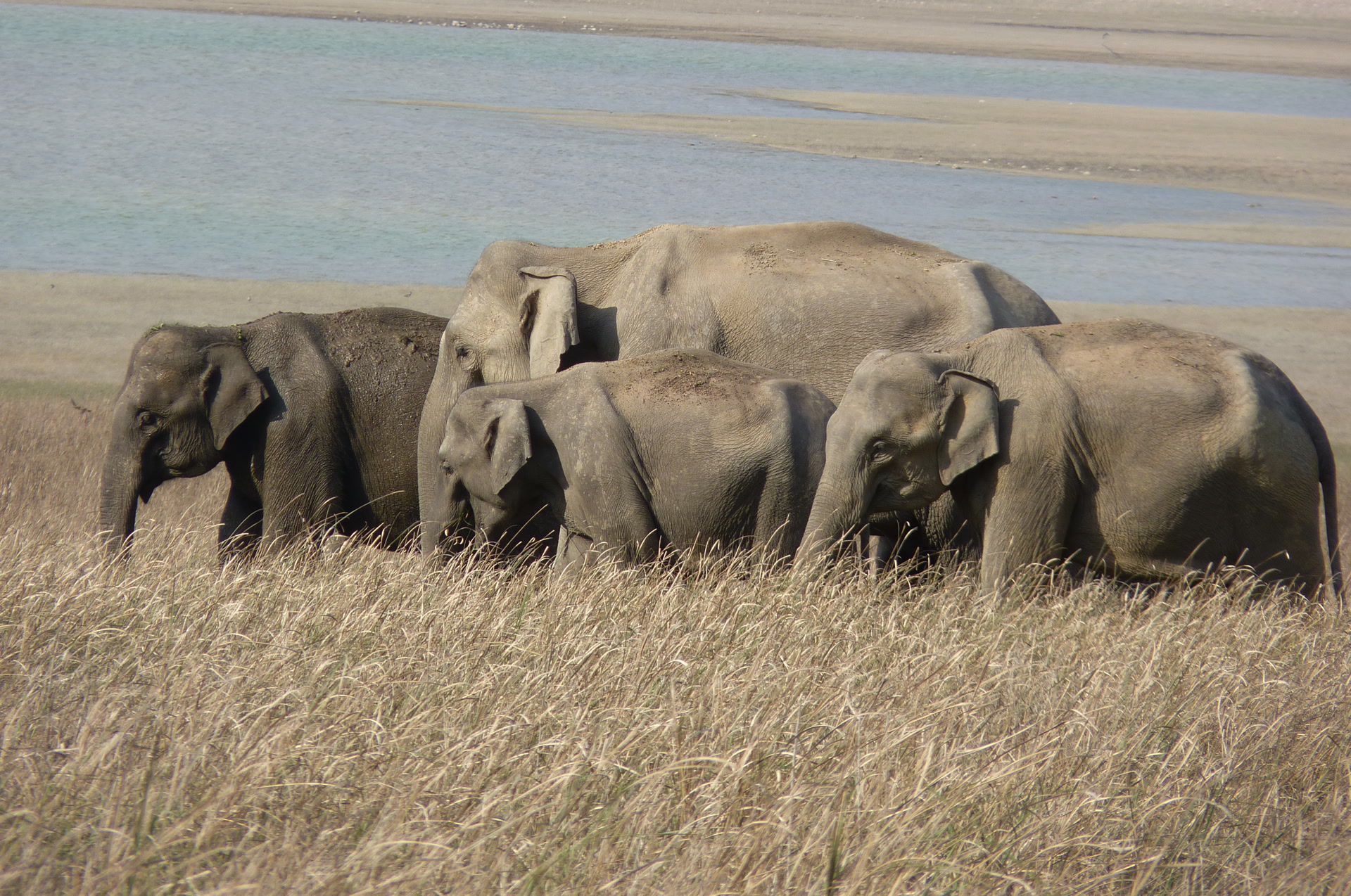
Female Asian elephants and their young live in social groups. Their feeding and movement connect places with vegetation and water, including the forests and lowlands beneath the Himalaya and other parts of South and Southeast Asia.
They also carry seeds. Research in Buxa Tiger Reserve studied three large-fruited plants and found that other animals may not fully replace the elephant’s dispersal role, particularly over distance. Each journey is part of a larger ecological story.
Feeding and movement can carry seeds beyond the parent plant, connecting animal behaviour with forest regeneration.
Access to freshwater and food matters in a landscape where heat and rainfall patterns can change.
Females and young live in groups. Protection concerns connected lives as well as individual animals.
The facts | Their context
Conservation figures and assessments describe particular places, dates and methods. Their meaning matters as much as their size.
The DNA-based estimate has a range of 18,255–26,645. Official 2025 proceedings say the changed method makes it non-comparable with earlier estimates. It is not a global total or evidence of a calculated decline.
Read the evidenceThe assessment was completed in 2019 and published in 2020. A country-level estimate and a global conservation category answer different questions.
Read the evidenceA 2017 Buxa Tiger Reserve study examined three large-fruited plant species. Its finding that other animals may not fully replace elephant dispersal is specific to the study and its assumptions.
Read the evidenceHabitat | Pressure | Possibility
Explore the relationships that shape this animal’s future. Each pathway shows where protection can make a difference.
Feed on fruit
Carry seeds across the landscape
Create opportunities for dispersal
Seed dispersal connects elephants with plant communities. Not every seed becomes a tree, and results vary by plant and place; the Buxa study shows why the elephant’s role deserves attention.
Fragmented habitat
Unsafe crossings and restricted access
Pressure on elephants and communities
Roads, railways, electrical hazards and land-use changes can make movement dangerous. Crop losses, injuries and deaths impose real burdens on residents. Protection must take those burdens seriously.
Understand movement and local needs
Protect links and improve infrastructure
Support specialist-led coexistence
Locally appropriate warning, response and livelihood measures belong alongside habitat protection. Models suggest possible shifts along lower Himalayan valleys under climate and land-use change; these are scenarios, not a move to high snowfields.
Illustrative relationships, not a geographic map or a prediction of conservation outcomes.
Why protection matters
An elephant carries more than its own future through a landscape. Its feeding and movement can contribute to seed dispersal, while its need for space draws attention to the connections between habitats. Protecting that role means working with the communities who also need safe homes, farms and livelihoods.
The longer story
Research in Buxa examined the ecological consequences of losing elephant seed dispersal for three large-fruited plants.
Functional nonredundancy of elephants in a disturbed tropical forest ↗A modelling study combined climate and land-use scenarios for India and Nepal to examine possible future changes in suitable habitat.
Predicting range shifts of Asian elephants under global change ↗India’s DNA-based assessment changed the approach to estimating elephant numbers. Its results cannot be used as a simple percentage comparison with older methods.
Proceedings of the 22nd Steering Committee Meeting of Project Elephant ↗The VARUNÉ Bio contribution
The Asian elephant belongs in our Himalayan foothill story and the wider discussion of biological systems. This conservation interest is separate from our ingredient-development questions.
Explain seed dispersal, habitat connections and coexistence with clear evidence, real locations and properly credited photography. Link readers directly to established conservation work.
Assess an organisation’s own priority for education, connected habitat or coexistence, and agree scope and reporting before any funding or public partnership claim.
Set a budget, purpose, reporting basis and permissions with the organisation. A financial contribution and a formal partnership are separate decisions.
Publish what was agreed and delivered. We will not use conservation content to imply product sustainability, wildlife access or an offset for environmental impacts.
The research connection. VARUNÉ Bio’s commercial work is ingredient research and cosmetic formulation science. Explore connects that work to biological questions and their environmental context. Wildlife conservation does not provide materials, permissions or evidence of cosmetic performance.
Explore the research questionsAction starts with understanding
Use the organisation’s own information to choose how to help. These links go directly to independent organisations.
Learn about Asian elephant habitats and the pressures that differ across their range.
Read the Asian elephant accountExplore Elephant Family’s own information on Asian wildlife conservation and ways to take action.
Explore Elephant FamilyObserve from a distance, avoid feeding wildlife and follow authorised guides and current local rules.
Read responsible visiting guidanceOrganisations are included as independent resources. Inclusion does not indicate a partnership, endorsement or financial contribution by VARUNÉ Bio.
The source trail | Checked 20 October 2026
Indian Terai in Uttarakhand, Uttar Pradesh and Bihar; corridor fragmentation, coexistence, monitoring, Chilla–Motichur crossing work. Programme self-report, not independent impact evaluation. Do not mix approximate landscape counts with the national census.
PDF page 5 reports SAIEE 2021–25 estimate 22,446 (18,255–26,645), DNA mark–recapture and explicitly non-comparable with earlier figures. Also identifies electrocution, train collisions, poisoning and poaching concerns; regional variation matters.
Global Endangered, A2c; evaluated 2019 and published 2020. This is the Asian elephant, not the African forest or savanna elephant.
Data and model from Buxa Tiger Reserve, India, on three large-fruited plant species show other dispersers may not fully replace elephant function. Specific plants/site and model assumptions limit generalisation; no claim every seed becomes a tree.
India/Nepal ensemble scenarios combine climate and land use. Water balance and connected lower Himalayan valleys matter. These are scenario-dependent habitat-suitability projections, not measured future losses or proof elephants will occupy high snowfields.
Heat sensitivity, freshwater needs, habitat fragmentation and slow reproduction; climate-informed protection should retain connected habitat and water while addressing conflict. This is vulnerability synthesis, not a local attribution study.
Habitat loss/fragmentation and human–elephant conflict are principal threats. Seed dispersal and female/young social groups. Avoid transferring African ivory statistics to Asian elephants.
Current partnership enquiry form; named beauty, fragrance and design collaborations are the charity’s own existing relationships, not VARUNÉ’s. Footer says part of British Asian Trust, charity 1127366. No verified corporate email on page.
Keep distance, no wildlife feeding, avoid flash, use local guides and leave no litter. Apply general wildlife-viewing principles alongside current park rules, not as encounter-management instructions.