
 Film credits
The pairing. Earn the application.
A proposed selection study connecting catalytic behaviour, substrate availability, measurement and the practical operating window of a research tool or inert surface.
Proposed research project | Scientific question, methods and next comparisons. Published study results are attributed to their original sources.
The task before choosing the luciferase.
A useful pairing begins with a user and a measurable operating window.
An assay developer may need a reproducible signal after a handling delay; an inert-surface developer may need a spatially confined emission that lasts through a defined observation period. Those briefs select different experiments. We would first state the sample or surface, temperature range, activation procedure, instrument or viewing condition, usable duration and the established alternative. The customer's decision is which pairing deserves a controlled feasibility comparison, rather than which enzyme wins a context-free brightness ranking.
This proposed project would make the operating window an explicit selection constraint. A system that produces a sharp peak immediately after mixing may fail a workflow requiring sequential plate reading. A system that persists might be unsuitable where rapid response is essential. The brief would also state whether the candidate needs repeated activation or a single use, how much substrate can be supplied, and which processing or storage step the components must tolerate. No candidate would inherit those attributes from a photograph of natural bioluminescence.
Examine the development decision
The pairing. Earn the application.
Open the sequence to examine what a development decision needs.
Identify the exact preparation, its source, and the properties a second laboratory must be able to reproduce.
Explanatory geometry · no simulated or measured performance
Making enzyme and substrate one selection.
The reaction partners and the surrounding solution jointly determine the useful comparison.
Hall et al. (2012) developed an engineered luciferase together with a substrate, showing why an enzyme-only identity is an incomplete description of a reference system. NanoLuc and firefly luciferase also have different reaction-component requirements; an ATP-dependent firefly assay cannot be substituted into a NanoLuc materials brief without redefining the chemistry. Hall et al. (2012) Our first comparison would therefore name both partners, their source and preparation, and the cofactors or reactants required by the selected system.
The selection record would separate concentration added from concentration actually available in the reacting phase. A substrate can precipitate, partition into another phase, adsorb to a vessel or produce background under the chosen conditions. A favourable nominal concentration does not resolve any of those possibilities. We would compare a concentration series within a verified solubility and handling window, with substrate-only controls and solvent-matched references. This helps a buyer distinguish an attractive molecular pair from a practical reagent or material function.
What the kinetic parameter actually measures?
A transparent model is useful only while its assumptions survive the data.
The Michaelis-Menten relation provides a useful starting model for a suitably controlled initial-rate experiment. Its normalised form asks how far the system is from the modelled rate ceiling at a particular available substrate concentration. The original kinetic framework remains instructive precisely because the observation, model and parameter interpretation need to be kept together. Johnson and Goody (2011) The equation below is an explanatory model, not a fit to VARUNÉ Bio data or a guarantee that NanoLuc follows this law in every setting.
We would estimate parameters by fitting the declared response model to rates measured across the concentration series, retaining uncertainty and inspecting residual structure. A reciprocal plot is not a substitute for that analysis because transforming noisy data changes the weighting of errors. If high substrate changes the shape, or rates depend on pre-incubation time, an allosteric, inhibitory or time-dependent description may be required. Km should not casually become a binding dissociation constant, and published kcat should not become the rate coefficient of an enzyme-loaded film.
Under the stated model, the available active-enzyme concentration sets the rate ceiling and substrate concentration sets the fraction of that ceiling. At S=Km the rate is half Vmax. The expression describes substrate conversion in declared rate units; it does not determine photon escape, detector counts or perceived brightness.
- Initial volumetric substrate-conversion ratemol m^-3 s^-1
- Model maximum volumetric rate at fixed active-enzyme amountmol m^-3 s^-1
- Available substrate concentration in the same reacting phasemol m^-3
- Michaelis constant of the justified fitted modelmol m^-3
- Turnover coefficient for a specified active enzyme and conditionss^-1
- Concentration of catalytically available enzymemol m^-3
Model conditions. A well-mixed initial-rate experiment; negligible substrate depletion during the fitted interval. An appropriate single-substrate Michaelis-Menten description; the other required reactants and conditions are controlled and not limiting. Fixed active-enzyme concentration; no relevant transport limitation, inhibition, time-dependent activation or inactivation. NanoLuc allostery can violate this simplified description. Parameters must not be fitted or transferred without checking residuals and competing models.
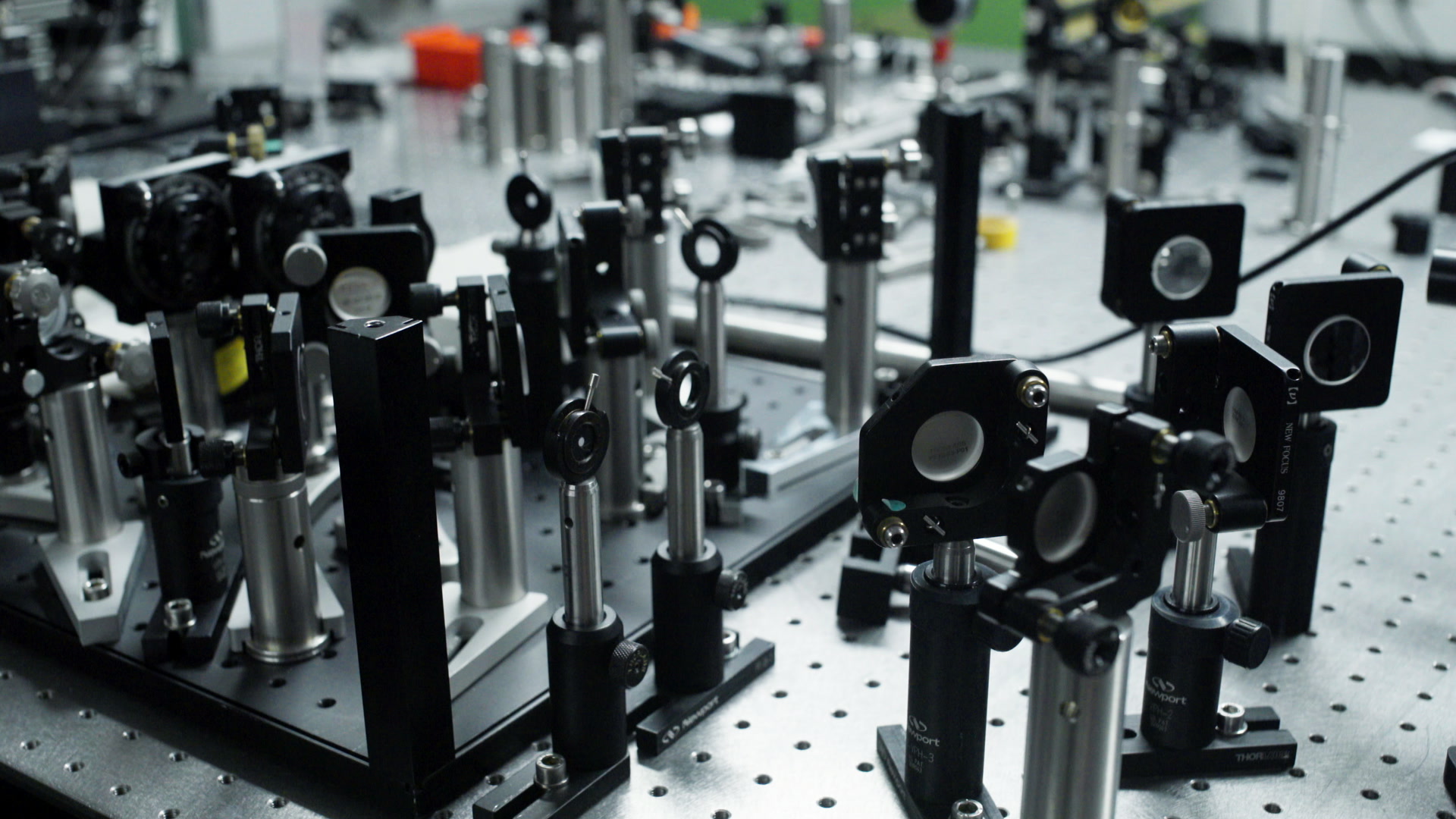
Give the light a reason to exist.
Explore retained biochemical reactions for a defined inert-material or research-tool setting, with output and access measured together.
Read the published ranking with its conditions attached.
The reference evidence supplies a question, not a Bio performance specification.
Nemergut et al. (2023), Table 1, reports catalytic efficiencies of 37 ± 1 for the NanoLuc D9R/K89R variant and 4.4 ± 0.2 for the reference with coelenterazine. With furimazine, the corresponding reported values are 33 ± 2 and 64 ± 2, in s^-1 µM^-1, means ± SD with n=3. These are purified-enzyme observations at 37 °C in potassium phosphate, pH 7.50. They show why substrate choice can change a ranking; they do not measure the visual brightness or durability of a finished material. Nemergut et al. (2023)
The CTZ triple-mutant row also requires an explicit source-quality note. Its reported efficiency is 70 ± 7, whereas dividing the reported turnover mean, 40 s^-1, by the reported Km mean, 0.77 µM, gives approximately 51.95 s^-1 µM^-1. We retain the published columns without silently repairing them, and would seek clarification before treating the exact magnitude as resolved. Ratios of published means are descriptive arithmetic; they do not supply replicate-level uncertainty or establish what happens after immobilisation.
Change the conditions · examine the reference
Temperature changes more than one process.
Compare two assumed temperature dependencies. Ask which experiments would distinguish useful reaction from loss.
The data, equations and controls remain available below if 3D cannot load.
Defined model · illustrative conditions
Move a control to compare the selected condition with the defined reference curve.
Design a temperature comparison that measures both useful output and the process that limits it.
The defined comparison
Relative Arrhenius sensitivities referenced to 25 °C. The productive process has assumed apparent activation energy 40 kJ mol⁻¹; the loss process is selected. R = 8.31446261815324 J mol⁻¹ K⁻¹; temperatures are converted to kelvin. Constant mechanisms and parameters are assumed over 5–45 °C. No freezing, phase transition, denaturation, viscosity, oxygen solubility or transport model. Relative rate selectivity is a ratio, not a measured yield, lifetime, cold suitability or optimum. Geometry represents relative rate magnitudes only.
Inspect the calculated values
Calculation grid, not measured observations. Inputs and assumptions are stated above.
| Temperature / °C | Productive-process reference | Loss-process reference |
|---|
Keeping background and detection inside the selection.
A useful chemical signal has to survive the measurement chain.
A pairing would be compared against substrate-only, enzyme-only, buffer and material-background observations using the same timing and optical arrangement. The purpose is to identify spontaneous substrate emission, instrument dark response and a matrix contribution before assigning the net signal to the intended reaction. A plate-reader result in relative light units is an instrument-dependent observation, not an absolute photon count. Changing a filter, gain setting or collection geometry can change the apparent ranking without changing the molecular reaction.
We would therefore preserve the raw response alongside any background-corrected result and specify whether selection concerns peak response, integrated output or time above a useful threshold. Spectral response matters if the variants or conditions emit differently. A detector calibrated at one wavelength cannot automatically support comparison across another spectral band. An assay customer gains a selection rationale that can be reconstructed on the intended instrument, rather than a favourable number produced by a different measurement window.
Design a comparison that can reject a favourite.
The experiment needs competing explanations and a decision rule.
A proposed first stage would compare a small, justified set of permissioned reference pairings in solution before adding a matrix. The design would vary substrate within its relevant operating window, keep active-enzyme amount comparable, and include independent reagent preparations. The same pairings would then face the intended formulation background. A decline could reflect enzyme inactivation, substrate sequestration or altered detection; measuring only the final light trace would leave those explanations entangled.
The acceptance criteria would be agreed with the customer before inspecting outcomes. They could concern repeatable detection after the permitted handling delay, a usable concentration range and acceptable background under the intended conditions. Technical repeat readings would be distinguished from independent preparation and lot variation. A candidate that produces more output but requires unacceptable handling or correction could be rejected. The aim is an inspectable comparison that narrows the next experiment, including a negative result, rather than a competition designed to confirm a preferred enzyme.
Placing supply and permissions beside the chemistry.
A useful reference system is not automatically an asset Bio can exploit.
The proposed scientific brief would include reagent provenance, storage conditions, activation consumables, preparation burden and the permissions needed for the intended work. Publication of an enzyme sequence or a high-performance reporter result does not establish commercial rights, freedom to operate or a supplier agreement. Those questions would be assessed separately for any selected construct, substrate or application. This page does not identify a Bio-owned enzyme or an available licensed product.
For an assay developer, the practical question might be whether a pairing reduces the burden of timing and checking in an established workflow. For a materials customer, it may be whether substrate supply and replacement are realistic for the intended surface. We would describe total use conditions before attaching an economic interpretation. A technically interesting pairing can remain unsuitable if its supply, processing or activation requirement defeats the application. That is a useful development finding, not a failure to tell a persuasive story.

The next proposed comparison.
A retained-reaction operating-window brief and an application-specific optical comparison.
Advance the pairing that earns the next experiment.
The result would be a conditional selection, not a universal best-enzyme claim.
The proposed output is a pairing-selection brief: a declared task, traceable reference evidence, solution and matrix comparisons, uncertainty, unresolved source issues and a justified next study. It would name the conditions under which the selection might change. The brief should also identify what has not been measured, such as substrate transport within a film, processing survival or repeated activation. Those become explicit dependencies for the immobilisation and reaction-transport workstreams.
A prospective partner can bring an assay or inert-surface use case, an existing comparison and the handling constraint that cannot be ignored. We would agree an investigation scope before committing to experiments or claiming delivery. The project would advance only if the candidate's comparative behaviour and practical burden justify further development. Otherwise it could select a different pairing, narrow the application or stop. That is the customer value of a scientifically accountable selection: the next expenditure has a reason, and a weak assumption can be challenged early.
Biochemical light · Proposed development discussion
A development path
for this research.
Could a defined biochemical-light system provide useful output under the intended handling conditions?
The people this could serve.Research-tool, biochemical-material and optical-measurement developers.
The decision behind the project.
Your intended application, present alternative and the constraint behind “Enzyme-substrate selection”. A useful starting point is the change that would justify another development step.
A proposed scope centred on a biochemical-light operating brief connecting active retention, access and measured output.
Agree the comparison, acceptance basis and responsible expertise before discussing a paid package.
Specialist methods and a defined contribution.
Bring relevant analytical or experimental expertise, a comparator suggestion, and the conditions under which your method could resolve this question.
A jointly scoped proposal could connect your contribution with a biochemical-light operating brief connecting active retention, access and measured output.
Define contributions, required access, independent preparations and permitted outputs before work or protected information is shared.
The commercial purpose of the next milestone.
Bring the application or asset thesis, the buyer you expect to value it, and the scientific or commercial uncertainty that must be resolved before another commitment.
The proposed decision record would connect the buyer question with a biochemical-light operating brief connecting active retention, access and measured output. It would identify what a subsequent comparison needs to demonstrate.
Demand, development cost, resources, rights and a decision-changing milestone would need examination. No financing terms or investment outcome are represented here.
What a useful comparison
would record.
- Record the enzyme–substrate pairing, concentration, buffer and observation time.
- Separate instrument counts, calibrated optical output and any normalisation used.
- Retain background, collection conditions and the time-resolved response for the comparator.
What the proposed
brief could leave behind.
- A biochemical-light operating brief connecting active retention, access and measured output
- A preparation, comparator and endpoint record tied to this question.
- A source-linked account of the evidence gaps, study assumptions and next review point.
The proposed discussion brief
A brief you
can take away.
Use non-confidential notes to connect this topic with your own decision. Entries stay in this browser tab; saving creates a text file on your device. Nothing is submitted.
Begin with a scoped evidence or study-design discussion; experimental delivery would need separately agreed expertise, access and resources.
Notes are optional. The brief includes this page’s proposed question and public source links.
Proposed scope; resources, methods, rights and delivery terms would be agreed before work. Begin with non-confidential information.
Sources and reading notes.
External work is identified below. Access notes describe the material inspected for this page; company research questions and proposed work are not presented as findings from these sources.
Johnson and Goody, 2011Johnson and Goody (2011). The Original Michaelis Constant: Translation of the 1913 Michaelis-Menten Paper. Biochemistry 50, 8264-8269.
Original kinetic framework and the need to distinguish a model parameter from an unrestricted binding or performance claim.
Scope and limitations: Historical kinetic framework; not a fitted NanoLuc matrix model or Bio experiment.
Open original sourceNemergut et al., 2023Nemergut et al. (2023). Illuminating the mechanism and allosteric behavior of NanoLuc luciferase. Nature Communications 14, 7864.
Defined enzyme-substrate kinetic comparisons, allosteric behaviour and Table 1 values under specified solution conditions.
Scope and limitations: External purified-enzyme observations. CTZ triple-mutant reported efficiency 70 differs from 40/0.77 of reported turnover and Km means; retain the discrepancy. No matrix or Bio performance follows.
Open original sourceHall et al., 2012Hall et al. (2012). Engineered Luciferase Reporter from a Deep Sea Shrimp Utilizing a Novel Imidazopyrazinone Substrate. ACS Chemical Biology 7, 1848-1857.
Joint development of an engineered luciferase and substrate; distinct signal, duration and biochemical attributes.
Scope and limitations: Published reporter-system conditions cannot become specifications of a future material or Bio product.
Open original source