
 Film credits
Retain the catalyst. Keep the function available.
A proposed materials project separating enzyme association, usable catalytic activity, reactant access and release before choosing an immobilisation route.
Proposed research project | Scientific question, methods and next comparisons. Published study results are attributed to their original sources.
Keeping the catalyst where the application needs it.
Retention is useful only when activity remains available.
A biochemical-light material has a placement question before it has a brightness question. Does the intended inert surface need the enzyme to remain attached, to be entrapped while reactants enter, or to be released when activated? Each architecture creates a different product and experiment. A reusable research tool may value retained activity and reproducible washing; a single-use format may prefer reliable reconstitution. We would define that intended function before treating every form of retention as an improvement.
The proposed project examines the relationship between association with a material, catalytic competence and practical handling. High protein loading can coexist with poor activity, restricted access or rapid release. Conversely, a modest retained fraction could be useful if it remains active and accessible through the customer's operating window. The development decision would therefore compare the complete material-associated system with an appropriate free-system reference, including the handling steps that create the supposed advantage. No Bio immobilised reagent or surface performance has yet been established by this page.
(Guan et al, 2021) | (Esimbekova, Kirillova and Kratasyuk, 2023)
Examine the development decision
Retain the catalyst. Keep the function available.
Open the sequence to examine what a development decision needs.
Identify the exact preparation, its source, and the properties a second laboratory must be able to reproduce.
Explanatory geometry · no simulated or measured performance
The attachment mechanism, not just the carrier name.
Adsorption, covalent attachment and entrapment create different hypotheses.
Adsorption can preserve a gentle preparation process while allowing desorption when the environment changes. Covalent attachment can reduce release while changing orientation, accessible sites or protein conformation. Entrapment retains a macromolecule through the surrounding network but may impose a transport barrier on smaller reactants. These are proposed design alternatives, not claims that Bio has manufactured any of them. A fair route comparison would record the chemical mechanism, support geometry and accessible surface or pore environment rather than grouping everything under the word immobilised.
Guo et al. (2022) examined surface-associated activity of an engineered circularly permuted NanoLuc biosensor in a defined plate method. That is a relevant example of asking whether a protein function survives its new context, rather than proof of a generic coating technology. Guo et al. (2022) For our intended materials brief, a coupling route would need an appropriate free-enzyme control exposed to the same preparation reagents, so chemical damage is not mistaken for a transport or attachment effect.
Separate protein recovery from active recovery.
A missing protein signal and a retained catalytic signal answer different questions.
We would account for applied protein, material-associated protein, supernatant, wash fractions and unresolved recovery. A decrease in liquid-phase protein concentration can reflect attachment, precipitation, adsorption elsewhere or a changed assay response. It is not enough to infer efficient active immobilisation. Material-only blanks and matrix-matched analytical recovery checks would be needed before interpreting the balance. Where the identity of an insoluble fraction is uncertain, that uncertainty would remain in the record rather than become a loading percentage.
Activity would be examined separately under a specified common assay, with carrier and liquid fractions tested independently. The activity-recovery ratio below is useful only when its measurement basis is explicit. Comparing a light-emitting carrier with a free solution can introduce different photon collection, attenuation and transport. Without the necessary controls, the comparison remains an apparent recovery. A customer needs to know whether the preparation retains usable catalytic work, not merely whether a protein assay reports that something has left the starting solution. Where feasible, substrate conversion or product formation would be measured by an orthogonal analytical method; light-response calibration alone does not establish molar catalytic activity.
(Guan et al, 2021) | (Esimbekova, Kirillova and Kratasyuk, 2023)
A closed recovery record separates material-associated protein from recovered liquid fractions and unresolved losses. An unmeasured disappearance from solution is not evidence that active enzyme attached to the intended carrier.
- Protein mass applied to the preparationkg
- Protein mass independently assigned to the carrierkg
- Protein mass recovered in the remaining preparation liquidkg
- Sum of protein mass in declared wash fractionskg
- Residual recovery difference, including measurement uncertainty and unresolved losseskg
Model conditions. A defined preparation and recovery boundary; consistent protein-assay response and background corrections. Fractions are not counted twice; insoluble or vessel-associated losses remain explicit. Protein identity and active fraction need separate evidence. Uncertainty can produce a signed residual; it is not automatically a physical positive loss.
(Guan et al, 2021)(Esimbekova, Kirillova and Kratasyuk, 2023)
This ratio compares catalytic activity associated with the carrier against the applied input under a declared common assay. It is not a protein immobilisation yield. Unless transport, released enzyme and optical effects are controlled, it is an apparent activity recovery rather than intrinsic catalytic retention.
- Activity-recovery ratio under the specified assaydimensionless
- Measured catalytic activity associated with the carriermol s^-1 in the declared conversion assay
- Catalytic activity of the applied input under matched reference conditionsmol s^-1 in the same assay
Model conditions. Input catalytic activity must be positive and distinguishable from assay background; otherwise recovery remains unresolved rather than becoming a numeric ratio. Comparable substrate, temperature, pH, timing and active input; appropriately calibrated conversion readout. Carrier-associated and released activity are measured separately; no unrecognised leaching contribution. Transport and detection differences must be assessed. Relative detector counts alone cannot be relabelled as catalytic activity.
(Guan et al, 2021)(Esimbekova, Kirillova and Kratasyuk, 2023)
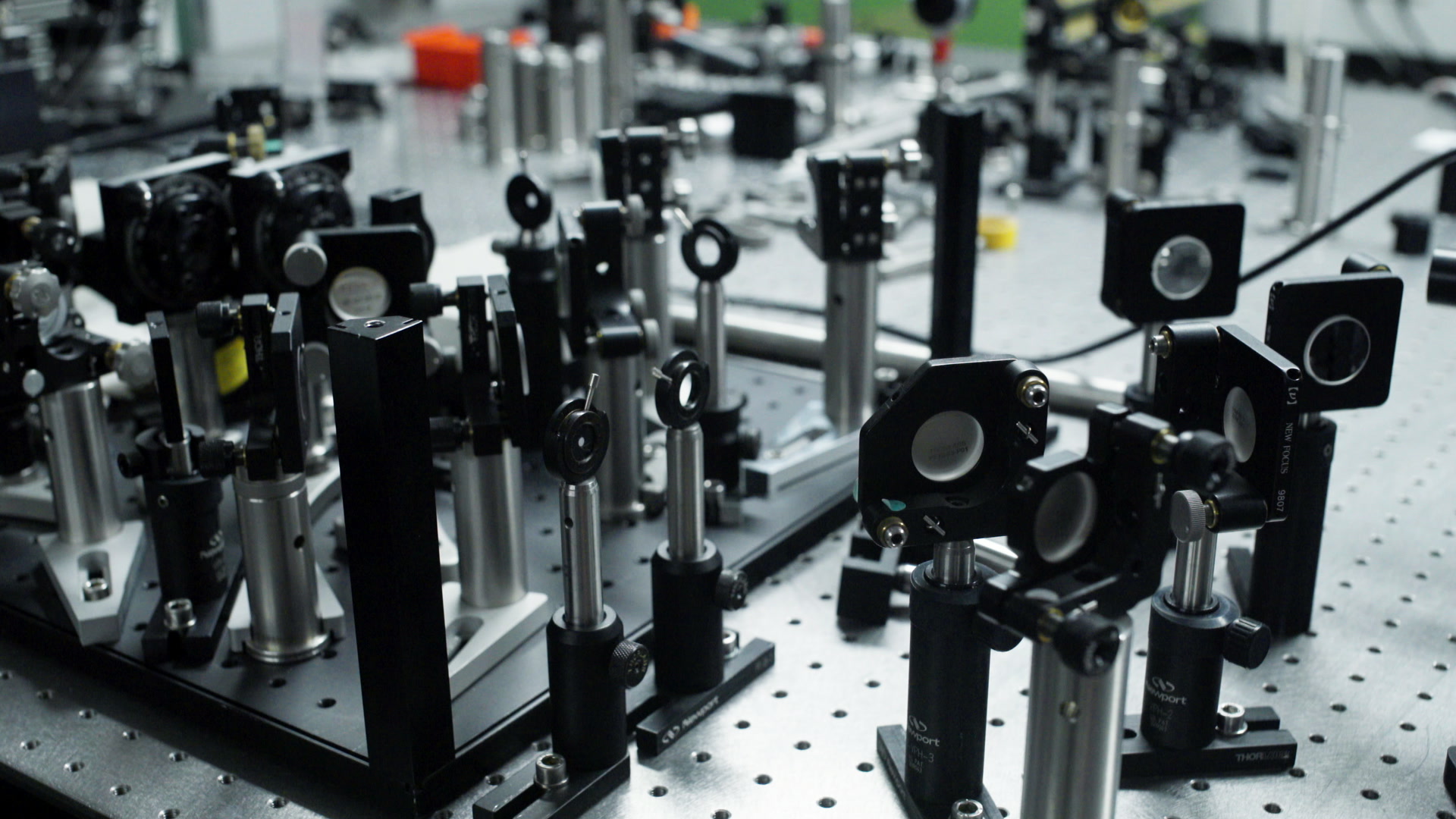
Give the light a reason to exist.
Explore retained biochemical reactions for a defined inert-material or research-tool setting, with output and access measured together.
Treat the microenvironment as part of the reaction.
The enzyme experiences the matrix, not the nominal bulk recipe.
A material can change local ionic conditions, hydration, reactant partitioning and the accessibility of the catalyst. An apparent Km measured for an immobilised preparation can incorporate transport and partitioning effects; it should not automatically be interpreted as an altered molecular binding affinity. We would ask whether a substrate-series result changes with film thickness, mixing or equilibration time before assigning a mechanistic explanation. The same underlying enzyme can be observed through different physical constraints.
Guan et al. (2021) incorporated NanoLuc into engineered protein condensates and found that the material environment and transport affected the emitted signal. Their in-vitro coacervate system is not a finished surface or a transferable Bio formulation. Guan et al. (2021) It motivates measuring association, reactant access and optical effects together. A fluorescent tracer's mobility can help examine a matrix, but a different tracer cannot supply the luciferin diffusion coefficient without evidence that the relevant size, interactions and partitioning are comparable.
Change the conditions · examine the reference
The reaction needs a way in.
Change layer depth and consumption rate. Follow the competition between access and reaction inside a retained-material reference.
The data, equations and controls remain available below if 3D cannot load.
Defined model · illustrative conditions
The guide marks the sealed backing. Internal effectiveness is the depth-averaged concentration for this first-order reference.
Define thickness, diffusivity, substrate access and a measurable optical output before selecting a retained-reaction architecture.
The defined comparison
Maintained surface concentration, sealed planar backing, constant D = 10⁻¹⁰ m² s⁻¹ and first-order consumption. Rate input is a logarithmic exponent: k = 10ᵃ s⁻¹. The 3D slices show the calculated normalised concentration across depth. No swelling, binding, geometry change, enzyme saturation or predicted luminosity. L²/D is a characteristic diffusion timescale, not measured duration.
Inspect the calculated values
Calculation grid, not measured observations. Inputs and assumptions are stated above.
| Normalised depth / fraction | Steady concentration profile |
|---|
What processing does to the active preparation?
Hydrated reaction performance is only one stage of a material's life.
The proposed evaluation would separate preparation, storage, activation and observation. A polymerisation step, drying interval, rehydration procedure or wash can change the accessible active population. We would record the state and history of each test sample and compare activity before and after the relevant operation. A result obtained immediately after entrapment would not be presented as storage stability, and a material that survives storage mechanically may still have lost the function the customer needs.
Esimbekova, Kirillova and Kratasyuk (2023) experimentally compared firefly-system preparations and found carrier and component-handling choices mattered; their gelatin and starch findings did not generalise interchangeably. Esimbekova et al. (2023) This is a firefly reference, with different chemistry from NanoLuc. It supports testing a carrier-specific process rather than assuming an enzyme-compatible polymer label guarantees success. Bio would need its own justified comparative study before adopting a process, including a free reference exposed to the corresponding environmental history.
Making release a measured part of the architecture.
A bright wash fraction can expose a retention problem.
For a retained-catalyst application, we would measure activity in the carrier and each collected liquid fraction across the defined wash or activation sequence. A system can appear reusable because residual liquid contains active enzyme; a falling carrier signal can reflect release rather than irreversible inactivation. Both explanations matter commercially because they change replacement, contamination control and consistency. The recovery boundary would include liquid carried between cycles, rather than treating every cycle as a fresh independent test.
A release-oriented format would require a different interpretation. Controlled release may be its intended function, so low retained activity alone would not be a failure. The study would instead ask whether activation produces the expected accessible components within a useful interval, and whether the residual carrier behaves acceptably. Recovery methods must not themselves destroy the activity being investigated. The important distinction is whether retention, release and reconstitution are deliberate design choices with measurable consequences, not whether one headline persistence number can be made large.
(Esimbekova, Kirillova and Kratasyuk, 2023) | (Guo et al, 2022)
Compare routes with a study that isolates the trade-off.
Change a controllable factor and preserve the competing explanations.
A proposed first comparison would use a narrow set of support chemistries or matrix formulations, with defined enzyme input and a fixed substrate challenge. The design could examine loading and network density as separate factors, then test whether thickness or mixing changes the observed rate. Increasing enzyme input and polymer content together would obscure the cause of a signal change. Independently prepared materials, rather than repeated readings from one preparation, would be the basis for assessing preparation repeatability.
Controls would include the free active system, the same preparation without enzyme, an appropriately inactivated reference where justified, and an enzyme control exposed to the preparation conditions without the final carrier. Protein recovery, liquid-phase activity and spectral or geometrical effects would be examined alongside emission. The decision criteria would reflect the intended use: usable output after a handling step, acceptable release, repeatable activation or another pre-agreed endpoint. A carrier that requires extra correction and processing could lose despite a favourable initial response.
(Guan et al, 2021) | (Esimbekova, Kirillova and Kratasyuk, 2023)

The next proposed comparison.
A retained-reaction operating-window brief and an application-specific optical comparison.
Advance an architecture with a reason to be used.
The proposed output is a route decision and the next experiment it earns.
The proposed partner-facing record would identify the material preparation, attachment hypothesis, recovered protein and activity, transport limitations, release behaviour and the uncertainties that remain. It would compare the candidate with a credible established reagent or surface approach under the intended workflow. The purpose is an accountable immobilisation-route decision, including why another route might be preferable. It is not a claim of a manufactured kit, established supply chain or performance guarantee.
An assay developer could contribute its activation sequence and relevant reference system. A materials customer could contribute the surface, handling and replacement constraints that determine whether an architecture is useful. A subsequent study would be agreed only after the first comparison shows a reproducible function worth testing further. Access to constructs, substrates, support chemistry and application permissions would remain separate requirements. A negative retention or processing result can prevent a larger investment in the wrong matrix, while a promising result identifies the specific property the next experiment must challenge.
Biochemical light · Proposed development discussion
A development path
for this research.
Could a defined biochemical-light system provide useful output under the intended handling conditions?
The people this could serve.Research-tool, biochemical-material and optical-measurement developers.
The decision behind the project.
Your intended application, present alternative and the constraint behind “Enzyme immobilisation in materials”. A useful starting point is the change that would justify another development step.
A proposed scope centred on a biochemical-light operating brief connecting active retention, access and measured output.
Agree the comparison, acceptance basis and responsible expertise before discussing a paid package.
Specialist methods and a defined contribution.
Bring relevant analytical or experimental expertise, a comparator suggestion, and the conditions under which your method could resolve this question.
A jointly scoped proposal could connect your contribution with a biochemical-light operating brief connecting active retention, access and measured output.
Define contributions, required access, independent preparations and permitted outputs before work or protected information is shared.
The commercial purpose of the next milestone.
Bring the application or asset thesis, the buyer you expect to value it, and the scientific or commercial uncertainty that must be resolved before another commitment.
The proposed decision record would connect the buyer question with a biochemical-light operating brief connecting active retention, access and measured output. It would identify what a subsequent comparison needs to demonstrate.
Demand, development cost, resources, rights and a decision-changing milestone would need examination. No financing terms or investment outcome are represented here.
What a useful comparison
would record.
- Account separately for protein mass retained and activity recovered after preparation.
- Measure activity with matched assay background, substrate access and observation time.
- Record support chemistry, washing and handling alongside the unbound reference.
What the proposed
brief could leave behind.
- A biochemical-light operating brief connecting active retention, access and measured output
- A preparation, comparator and endpoint record tied to this question.
- A source-linked account of the evidence gaps, study assumptions and next review point.
The proposed discussion brief
A brief you
can take away.
Use non-confidential notes to connect this topic with your own decision. Entries stay in this browser tab; saving creates a text file on your device. Nothing is submitted.
Begin with a scoped evidence or study-design discussion; experimental delivery would need separately agreed expertise, access and resources.
Notes are optional. The brief includes this page’s proposed question and public source links.
Proposed scope; resources, methods, rights and delivery terms would be agreed before work. Begin with non-confidential information.
Sources and reading notes.
External work is identified below. Access notes describe the material inspected for this page; company research questions and proposed work are not presented as findings from these sources.
Guan et al, 2021Guan et al. (2021). Incorporation and Assembly of a Light-Emitting Enzymatic Reaction into Model Protein Condensates. Biochemistry 60, 3137-3151.
NanoLuc localisation and reaction in engineered RGG coacervates; material dynamics and transport affect observed emission.
Scope and limitations: Specific in-vitro protein condensates, not a transferable Bio film. Tracer FRAP is not direct luciferin diffusivity.
Open original sourceEsimbekova, Kirillova and Kratasyuk, 2023Esimbekova, Kirillova and Kratasyuk (2023). Immobilization of Firefly Bioluminescent System: Development and Application of Reagents. Biosensors 13, 47.
Carrier-specific enzyme entrapment, component separation and storage/handling trade-offs in a firefly system.
Scope and limitations: Firefly luciferase, ATP and D-luciferin chemistry differs from NanoLuc. No reported activity, detection limit or storage duration is transferred to Bio.
Open original sourceGuo et al, 2022Guo et al. (2022). Engineering and exploiting synthetic allostery of NanoLuc luciferase. Nature Communications 13, 789.
A primary example of circular permutation, biochemical switching and surface-associated biosensor testing.
Scope and limitations: External biosensor architecture and plate conditions. Does not establish rights, assay access, Bio immobilisation or human-use readiness.
Open original sourceNemergut et al., 2023Nemergut et al. (2023). Illuminating the mechanism and allosteric behavior of NanoLuc luciferase. Nature Communications 14, 7864.
Defined enzyme-substrate kinetic comparisons, allosteric behaviour and Table 1 values under specified solution conditions.
Scope and limitations: External purified-enzyme observations. CTZ triple-mutant reported efficiency 70 differs from 40/0.77 of reported turnover and Km means; retain the discrepancy. No matrix or Bio performance follows.
Open original source