
 Film credits
The ingredient has to earn its place.
Varun Sharma on why an unusual biological origin becomes interesting when it changes a formulation decision.
Founder perspective | External research and proposed company work are distinguished.
What does it help someone do?
An extraordinary organism can begin a story. I want the material to carry the next chapter.
I am interested in biological functions because they can make us reconsider familiar development problems. A formulator, however, has a demanding question: what changes when this ingredient enters my system? That is where I want VARUNÉ Bio to become useful. A source can create curiosity; a defined contribution creates a reason to investigate.
The first brief should name the task, the current alternative and the constraint that makes improvement difficult. Is the developer trying to change a deposited film, simplify a mixture or preserve performance under a relevant condition? Those are different opportunities. Each deserves its own comparison.
I would begin by separating the desired improvement from the acceptable compromises. A hypothetical customer brief might require a different film response while preserving a workable application process. That is more informative than asking which material gives the highest value on one test. It tells us which improvement would matter, which inconvenience would cancel it and what the comparison needs to explain.
Examine the development decision
The ingredient has to earn its place.
Open the sequence to examine what a development decision needs.
Identify the exact preparation, its source, and the properties a second laboratory must be able to reproduce.
Explanatory geometry · no simulated or measured performance
The material in the vial.
A name on the front of a paper is the beginning of identification.
Sun and colleagues’ polar-bacterial EPS study distinguishes a crude preparation used in functional experiments from further purification for structural characterisation. That distinction matters when following a reported observation back to the material actually tested (Sun et al., 2015).
My development question is deliberately practical. Which preparation would enter the next experiment, what accompanies it and which specification would another team need to understand it? If a result depends on a mixture, the mixture deserves investigation. Calling it a single purified ingredient too early makes the next conversation less useful.
The preparation history can become a scientific variable in its own right. I would ask whether an observation survives a documented change in preparation, and whether that change also alters the constituents being evaluated. If it does, the study has identified a relationship worth investigating. The next useful specification would follow that evidence, rather than assume that greater purification automatically creates a better application ingredient.
The surrounding formulation matters.
I want the benchmark to make the candidate work for its place.
Consider a hypothetical film-forming candidate tested beside an established polymer. Equal nominal concentration might be one comparison, but a developer may also need to understand differences in dry loading, handling and the resulting layer. I would want the team to explain why its comparison answers the intended question before choosing a winner.
This is a proposed reasoning approach, not a report of Bio experiments. The design needs appropriate scientific ownership. NIST’s experimental-design guidance begins with objectives and factors because the structure of the comparison shapes what can be learned from it (NIST/SEMATECH, n.d.).
I would also distinguish a comparison intended to explain a contribution from one intended to choose a practical formula. Holding a particular attribute constant may help with the first question; allowing the team to formulate each candidate appropriately may help with the second. The brief should explain which decision it serves. Otherwise an apparently fair comparison can quietly answer a question nobody needed answered.

The application changes the question.
The applied layer, the conditions and the established alternative give the comparison its purpose.
An advantage should have an address.
A useful contribution belongs to a defined application and a person making a decision.
An ingredient business might need a characterisation package that helps an application scientist support customers. A beauty-group formulator might need to know whether the candidate survives an inconvenient combination of processing and performance requirements. A research partner might want to isolate which component explains an observation. I see three different briefs, even when the starting material is shared.
Public language should make that distinction easy to follow. A property observed in an ingredient preparation cannot simply become an asserted finished-product benefit. Great Britain’s cosmetic-claims guidance makes that evidence connection explicit (OPSS, n.d.).
The proposed output should fit the person receiving it. An application scientist might need conditions under which the preparation warrants another test. A technical buyer might need the outstanding specification and supply questions. A research lead might need the alternative explanation that deserves a control. I want the same evidence to remain consistent across those conversations, while its practical relevance becomes clearer for each reader.
A result can earn a narrower opportunity.
The most ambitious answer is sometimes a more precise one.
I want Bio to make room for a candidate that performs usefully in one setting and disappoints in another. The narrower setting could be the one with a credible development path. It needs a customer problem, a repeatable specification and an alternative against which the contribution matters.
An inconclusive result has a different job. It should identify whether the uncertainty sits in sample identity, measurement, the comparison or the candidate itself. Repeating the same unclear test with a larger promotional claim would not move the company forward. A sharper next question could.
A narrower opportunity can also reveal a different route to value. A candidate may deserve investigation as one part of a mixture rather than as a replacement for an established material. That possibility would need its own comparison and an account of the added complexity. I would rather develop a precise contribution that matters than expand a broad promise the evidence cannot distinguish from the existing approach.
Leave something another team can use.
My ambition is for knowledge to travel with the material.
A useful package would connect preparation history, composition, the test conditions, relevant comparisons and the decision supported by the evidence. It would make the limits readable too. That gives a prospective collaborator something concrete to challenge and gives an investor a clearer view of the next uncertainty.
It also changes what a commercial conversation is about. The discussion can examine the value of resolving a formulation problem, the resources required and the rights in permitted outputs. No single business model needs to be assumed before that conversation has substance.
The output also needs an acceptance basis: what the record must contain, what its reviewer should be able to inspect and which conclusion it is intended to support. That gives the package an end point. It helps separate a useful development asset from another round of exploratory work, and it gives a prospective investor a clearer explanation of what the proposed commitment would leave behind.
The difficult part of the brief.
I want to hear where a promising ingredient stops being convenient.
For a formulation team, that could be a performance requirement its current material cannot meet without an unacceptable compromise. For an ingredient developer, it could be a promising observation that needs a better connection to application. For a scientist, it could be an alternative explanation worth testing.
That is an introduction worth making. Tell us what the material must do, how the current approach is judged and what evidence would change the decision. An unusual origin can open the door. The work should give someone a reason to stay.
An initial introduction need not expose the whole formula. A non-confidential account of the application, benchmark and unresolved constraint can establish whether the direction fits. The discussion can then decide what additional information is necessary and how it should be handled. That keeps the commercial conversation purposeful: establish the development question first, then define the evidence and arrangement needed to take it further.
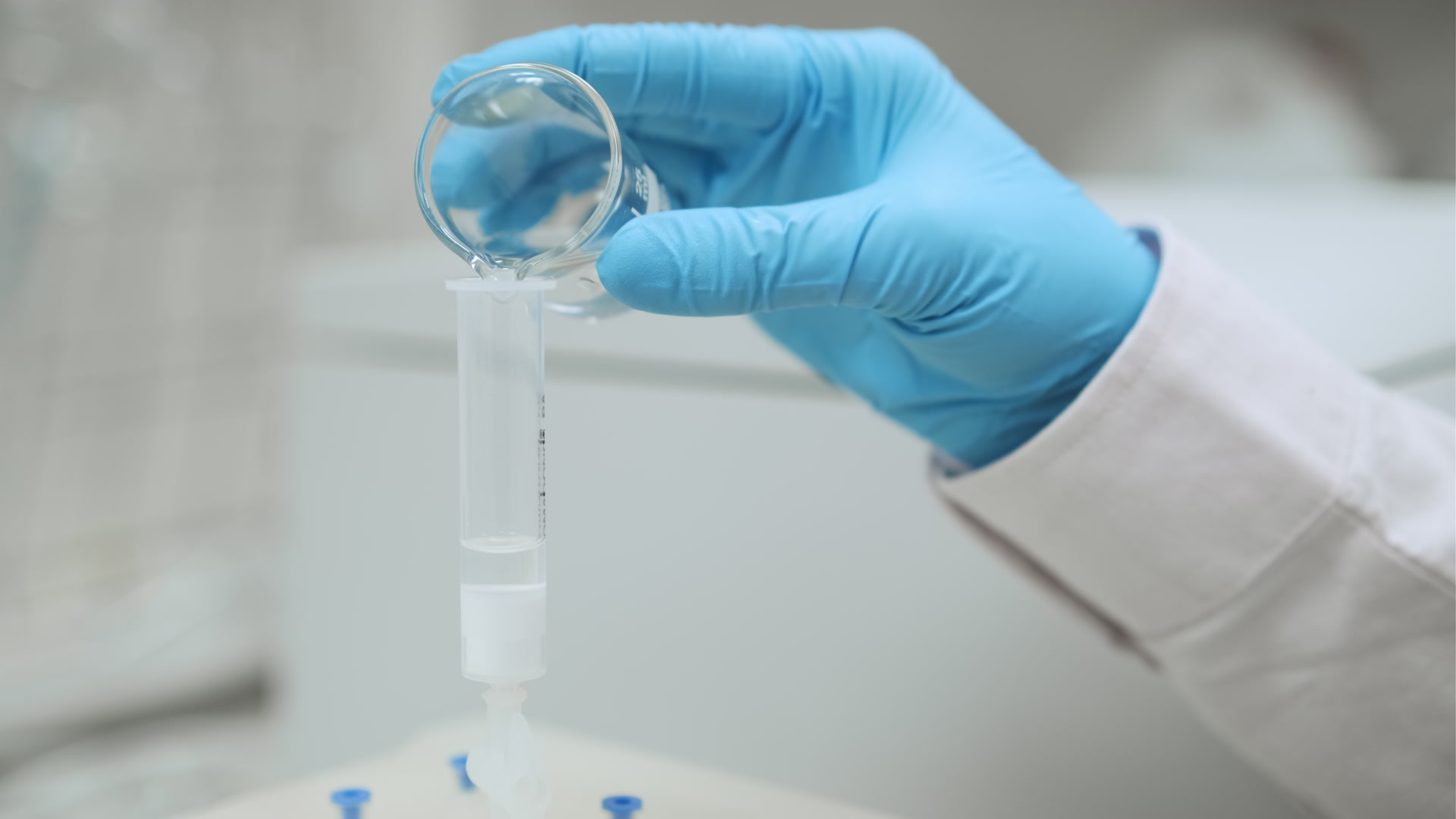
The preparation is part of the performance.
Composition and processing must connect with a specification another team can use.
Bring the formulation question.
A short, non-confidential introduction can outline the application, the current approach, and where scientific input could help. Scope and next steps would be agreed around the actual project.
Discuss the development questionSources and reading notes.
External work is identified below. Access notes describe the material inspected for this page; company research questions and proposed work are not presented as findings from these sources.
Sun et al., 2015Sun, M.-L. et al. (2015) Characterization and Biotechnological Potential Analysis of a New Exopolysaccharide from the Arctic Marine Bacterium Polaribacter sp. SM1127. Scientific Reports, 5, 18435. doi:10.1038/srep18435.
Distinguishes crude EPS functional testing from further purified structural preparation; moisture absorption and retention experiments use specified material conditions.
Scope and limitations: External work on the authors’ preparations. Raw data, supplements and strain access were not reanalysed or secured. No Bio reproduction, skin efficacy, material ownership or commercial permission follows.
Open original sourceNIST/SEMATECH, n.d.NIST/SEMATECH (n.d.) e-Handbook of Statistical Methods: Choosing an experimental design.
Objective setting, factor selection, randomisation, blocking and replication inform interpretable experimental design.
Scope and limitations: General methods guidance. No Bio protocol, sample-size calculation, statistical power assessment or independent experimental validation is asserted.
Open original sourceOPSS, n.d.Office for Product Safety and Standards (n.d.) Regulation 1223/2009 and the Cosmetic Products Enforcement Regulations 2013: Great Britain. Article 20: Product Claims.
Cosmetic claims in Great Britain need an appropriate evidence basis and must not imply functions a finished product does not possess.
Scope and limitations: GB scope. Public research commentary is not legal advice, a finished cosmetic claim dossier, safety approval or evidence of Bio compliance.
Open original source