
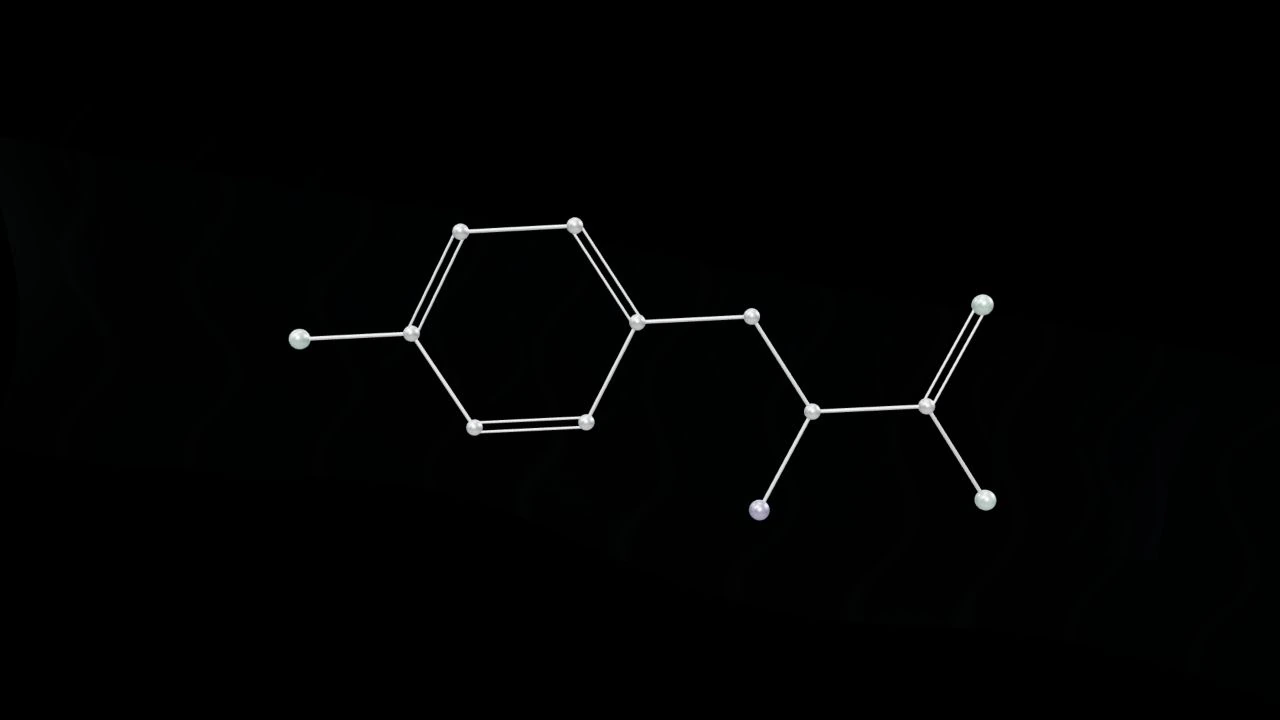
Skin pigmentation.
Pigmentation connects molecular processes inside cells with the way skin absorbs and scatters light. Our research direction brings ingredient discovery and formulation behaviour into the same question, with under-eye appearance as the first proposed application.
Discuss this research programmeCan a candidate produce an interpretable pigmentation-related effect that remains useful and available within a formulation?
Programme definition
A molecule-to-application question
Conceptual programme logic. Each transition requires separate evidence.
- 01
Biological process
Define pigment production or a specific transfer-related event.
- 02
Available ingredient
Establish activity, stability and relevant local exposure.
- 03
Formulated application
Evaluate biological contribution separately from temporary optical correction.
Begin with the biological process.
Melanin production and the transfer of pigment-containing structures from melanocytes to keratinocytes are distinct processes. A reduction in pigment synthesis and a change in pigment transfer therefore require different evidence. Tyrosinase catalyses early oxidation steps that feed melanin synthesis. Enzyme activity is therefore measurable, while cellular access and effects on viable cells remain separate questions.
Human tyrosinase provides one molecular entry point for discovery. Transfer between cells provides another. Published work on keratinocyte PAR-2 shows why the receiving cell can matter; it does not make every transfer-related ingredient a direct PAR-2 inhibitor. The initial discovery branch remains to be selected through scientific review.
Use reference chemistry honestly.
A comparator is a known reference used to interpret a result. It is not automatically a development candidate, and citation does not give a company rights to use it commercially.
Hakozaki and colleagues reported a melanosome-transfer effect for niacinamide in their models, alongside clinical observations. That provides mechanistic context without establishing a universal explanation of under-eye darkness. Human-tyrosinase structure–activity research offers a separate example of how changes to a molecule can alter biochemical and cellular behaviour. Those published compounds are reference chemistry, not VARUNÉ discoveries.
Activity must survive the formulation.
An isolated-enzyme result is only part of a candidate’s story. The molecule must remain identifiable, chemically stable and available in the formulation, then reach the intended local compartment at a relevant exposure.
A compound can show enzyme activity yet fail in a cell system. A formulation can also bind, precipitate or redistribute a molecule during storage or drying. The proposed programme would examine activity alongside these constraints instead of ranking candidates by a single potency value.
Make the signal interpretable.
A lower pigment or transfer-marker signal can have several explanations. Cell loss, altered marker expression, optical interference and a change in the process under investigation must be distinguished.
Published co-culture methods illustrate ways to observe melanosome transfer. Their output is a model measurement; it is not a measurement of finished-product efficacy or eye-area tolerability. The next scientific brief must define which biological event a chosen assay can support.
A parallel question at the skin surface.
Tinted skincare changes appearance through pigment dispersion, absorption, scattering and the deposited film. Immediate correction has its own formulation problem: shade, coverage, finish and persistence must work under relevant lighting and wear conditions.
This surface effect is distinct from a repeated-use biological contribution. A favourable photograph while product is worn cannot establish a persistent skin change. The first proposed application therefore keeps optical development and active discovery separately interpretable.
What the programme would need to establish.
The aim is to connect a defined mechanism with a useful formulation contribution. The present programme does not claim that a candidate already satisfies these requirements.
- A relevant biological effect separated from assay interference and loss of cell viability.
- Chemical identity, stability and local availability consistent with the proposed mechanism.
- A comparison with established reference chemistry and the appropriate formulation base.
- An optical application that can be evaluated independently of the biological workstream.
- A safety and tolerability assessment appropriate to the intended use before human testing.
The application sets the limits.
Under-eye appearance varies with pigmentation, vascular features, tissue structure and shadowing. An ingredient targeting one process is not expected to explain every phenotype.
Study population, measurement conditions and formulation removal matter. Evidence from facial skin or an isolated model cannot simply be relabelled as eye-area efficacy. A candidate or formulation would progress only if the proposed advantage remains useful alongside these constraints.
Current stage and collaboration.
The programme is at definition stage. No lead molecule, finished formula, completed trial or demonstrated efficacy is announced.
We welcome non-confidential discussion with researchers in pigment biology, chemical discovery, skin delivery and formulation science. The next step is a bounded research brief that defines the initial biological branch, the reference comparisons and the intended formulation problem.
Scientific references
Selected independent primary research. The findings belong to the cited authors; they provide context for our proposed work and do not establish VARUNÉ Bio results, ownership or collaborations.
- Original research · 2018
Mann T, Scherner C, Röhm KH, Kolbe L. International Journal of Molecular Sciences, 19, 690. DOI: 10.3390/ijms19030690
Connects chemical structure with enzyme and cellular observations. The proposed binding arrangement is modelled; published compounds and their rights are not VARUNÉ assets.
- Original research · 2002
The effect of niacinamide on reducing cutaneous pigmentation and suppression of melanosome transfer
Hakozaki T, Minwalla L, Zhuang J, et al. British Journal of Dermatology, 147, 20–31. DOI: 10.1046/j.1365-2133.2002.04834.x
Provides a transfer-related mechanistic comparator. It does not establish direct niacinamide binding to PAR-2 or efficacy of a proposed eye-area formulation.
- Original research · 2000
The protease-activated receptor 2 regulates pigmentation via keratinocyte-melanocyte interactions
Seiberg M, Paine C, Sharlow E, et al. Experimental Cell Research, 254, 25–32. DOI: 10.1006/excr.1999.4692
Examines the role of the receiving keratinocyte in pigmentation using cellular and animal models. It does not establish a selected company target or eye-area safety.
- Original research · 2010
Ma HJ, Zhao G, Zi SX, et al. Experimental Dermatology, 19, e282–e285. DOI: 10.1111/j.1600-0625.2009.00956.x
A model for measuring melanosome transfer. A model signal remains separate from clinical efficacy, tissue delivery and tolerability.
- Original research · 2010
Grice JE, Ciotti S, Weiner N, et al. Journal of Pharmaceutical Sciences, 99, 712–718. DOI: 10.1002/jps.21856
Shows why distribution among skin compartments and permeation must be distinguished. Its molecule and vehicles do not establish the delivery of a new pigmentation ingredient.
- Original research · 2019
Mac-Mary S, Zornoza Solinis I, Predine O, et al. Clinical, Cosmetic and Investigational Dermatology, 12, 919–929. DOI: 10.2147/CCID.S217956
Clinical and instrumental observations associated under-eye dark circles with pigmentation, vascular features and skin thickness. The main comparisons were small and population-specific. This informs the measurement question; it does not establish the performance of a VARUNÉ Bio formulation.
- Original research · 2016
Classification by causes of dark circles and appropriate evaluation method of dark circles
Park SR, Kim HJ, Park HK, et al. Skin Research and Technology, 22(3), 276–283. DOI: 10.1111/srt.12258
The study linked the selection of measurements to the type of under-eye dark circles and used a controlled product comparison. It supports a question-led evaluation approach, without predicting which ingredient will work in the proposed programme.
- Original research · 2001
The development of the CIE 2000 colour-difference formula: CIEDE2000
Luo MR, Cui G, Rigg B. Color Research & Application, 26, 340–350. DOI: 10.1002/col.1049
A surface-colour comparison method. Its output is not a validated universal threshold for a meaningful under-eye benefit.
Go further into
the question.
Discuss the evidence, proposed comparisons and formulation questions in the accompanying working paper.
Enquire about the research brief